How an AI Website Chatbot Drives Sales and Business Performance
5 minutes read
Updated on May 04, 2026
In 2026, the debate over AI integration has shifted from "feasibility" to "architectural necessity." According to the latest Generative AI in Chatbots Global Market Analysis Report, the market is projected to grow from about $10.83 billion in 2025 to approximately $35.68 billion by 2029, representing a strong compound annual growth rate (CAGR) of over 34 % during this period. For CTOs and digital strategists, the deployment of an AI-driven chatbot is no longer a customer service gimmick; it is a critical component of a high-performing, data-driven infrastructure.
As we navigate an era defined by Generative AI and Agentic Workflows, here is a technical deep dive into why AI chatbots are indispensable for modern web architectures.
What is an AI chatbot for website?
An AI chatbot is a software application that uses artificial intelligence—such as natural language processing (NLP) and machine learning—to simulate human-like conversations. Unlike rule-based chatbots, AI chatbots learn from past interactions and continuously improve their responses over time.
An AI chatbot for a website is an AI-powered chatbot embedded directly into a website to support business goals. These goals typically include improving user experience, providing instant customer support, reducing operational costs, and increasing conversion rates.
A common example is the chat window that appears while you’re reading an article or browsing products, offering help or answering questions in real time. In 2026, this experience has become standard rather than optional. According to The Business Journals, 62% of businesses plan to integrate AI chatbots into their operations, reflecting how widely adopted this technology has become.
Read more: Benefits companies gain from using Chatbots in Sales
The 2026 Data Paradigm: ROI and Efficiency Metrics
The current market demands quantifiable performance. According to recent benchmarks from Juniper Research and Gartner, the economic impact of AI integration has reached a tipping point:
Global Operational Savings: AI chatbots are projected to drive $11 billion in annual savings for enterprises by streamlining Level 1 support and reducing ticket volume by up to 70%.
The 2.5 Billion Hour Recovery: Automating repetitive query resolution will recover an estimated 2.5 billion labor hours globally in 2026, allowing human capital to focus on high-value DevOps and R&D tasks.
Conversational Commerce Growth: Chatbot-mediated transactions are expected to exceed $142 billion, as users pivot from traditional search-and-click navigation to intent-based conversational interfaces.
From Scripted Logic to Generative Intelligence (RAG Architecture)
The "traditional" chatbot is dead. 2026 belongs to Retrieval-Augmented Generation (RAG) and Large Language Models (LLMs). At Bachasoftware, we emphasize moving beyond static decision trees toward dynamic cognitive agents.
Semantic Understanding: Unlike keyword-matching of the past, 2026 agents utilize Natural Language Understanding (NLU) to comprehend context, nuance, and user intent with near-human accuracy.
Hyper-Personalization via Vector Databases: By integrating with vector databases, chatbots can provide real-time, personalized recommendations based on a user’s unique documentation history and behavioral telemetry.
Multimodal Processing: Modern interfaces now support multimodal inputs—allowing users to upload system logs, screenshots of UI bugs, or voice memos, which the AI processes instantly to provide technical resolutions.
Engineering the Competitive Edge: Strategic Advantages
Zero-Party Data Acquisition
In a post-cookie world, chatbots serve as the primary engine for collecting Zero-Party Data. By engaging in direct dialogue, businesses gain explicit insights into user preferences without infringing on privacy regulations (GDPR/CCPA compliance by design).
Reduced Latency in the User Journey
Modern web users—particularly Gen Z and Alpha—operate on a "zero-latency" expectation. An AI agent integrated via WebAssembly (Wasm) or optimized for Progressive Web Apps (PWA) ensures that support is available instantly, even in low-bandwidth environments, maintaining a seamless Core Web Vital score.
Predictive Analytics & Sentiment Monitoring
Advanced AI agents act as a "smoke detector" for your digital product. By performing real-time Sentiment Analysis, these tools can alert your success teams the moment a cluster of users expresses frustration, allowing for proactive intervention before a churn event occurs.
Read more: AI-Powered Modernization for Legacy Systems: How To Get Started
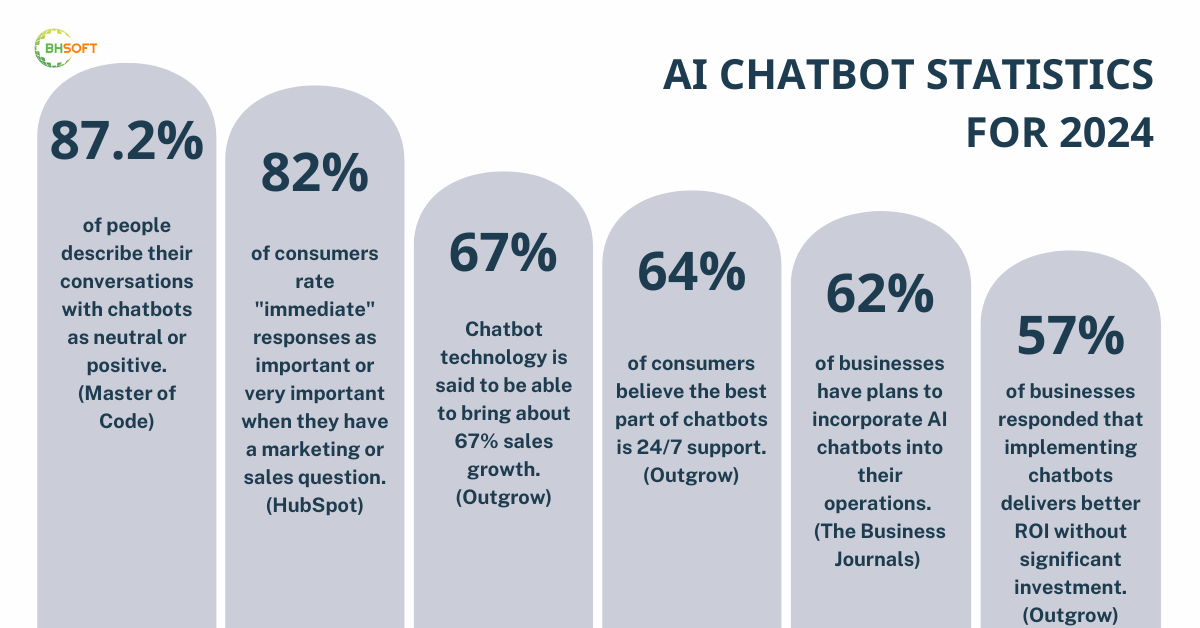
How AI chatbots work on website
Your businesses can lower the frequency of human intervention in customer support by implementing chatbots to increase automation. Now, you have some following virtual assistants:
- Machine learning: Machine learning is important for chatbots to continuously improve their responses and performance. By analyzing large amounts of data from interactions, chatbots can learn user trends and preferences. This iterative process allows the chatbot to adapt and improve over time, providing more accurate and personalized responses to users. By 2024, ML will be one of the top SaaS trends.
- Natural language processing (NLP): Natural language processing (NLP) plays an important role in enhancing user interaction with chatbots. It allows chatbots to understand the nuances of human language, including slang, context, and variations in expression. NLP helps chatbots accurately interpret user queries and provide appropriate responses, leading to more effective communication.
AI-powered chatbots simulate communication by implementing the latest AI technologies. The AI engine will query the company's knowledge base and provide the most accurate answers to questions from chatbot users. By integrating AI chatbots into your website, you can ensure consistent and personalized interactions with customers while also cutting response times.
To gain a better understanding of how AI chatbots work on websites, observe how a typical chatbot interaction flow looks like this:
- Users initiate a conversation by typing a message or talking to the chatbot through the user interface.
- Chatbots use NLP to analyze words and phrases in messages to understand user intent.
- The chatbot will search a database of pre-programmed responses to find the right answer.
- The response is then sent back to the user through the user interface.
- The user can then choose the next response and the process will repeat until the conversation ends.
AI chatbot for website use cases
There are many potential applications of AI-based chatbots. In addition to supporting customer service, these tools are so versatile that they can help teams with tasks across a variety of industries. A typical real-life example is H&M's Kik chatbot.
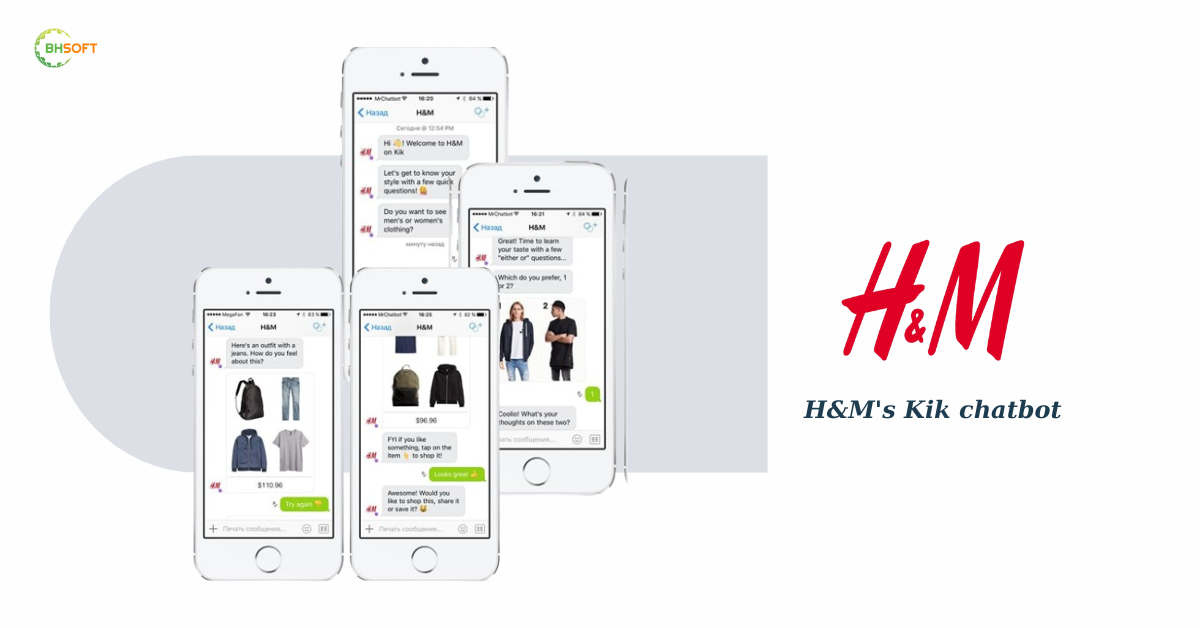
H&M's Kik chatbot provides fashion advice and recommendations to users. Using natural language processing (NLP) technology, this chatbot understands user requests and provides personalized styling tips. The chatbot is built into the Kik Messenger app, which currently has more than 15 million monthly active users.
Feature:
H&M's Kik chatbot is equipped with many superior features to enhance user experience. First, it provides personality tests and style tips, helping users accurately determine their personal style. In addition, chatbots are capable of recommending personalized products, suggesting items that suit each customer's unique preferences and needs. Integrating chatbots into the Kik messaging application makes it easy for users to access and use. At the same time, the easy payment feature supports a seamless shopping process, creating favorable conditions for customers to complete transactions quickly.
Successes achieved:
First, it increases customer engagement through direct interaction and personalization, thereby enhancing the user experience.
Besides, chatbots improve the shopping experience by helping customers easily search and choose suitable products.
This leads to higher conversion rates, with the Kik chatbot achieving an 86% engagement rate, users spending an average of four minutes interacting, and a click-through rate of up to 8%, significantly higher than 2%. of H&M's email marketing campaigns.
This success proves the effectiveness of applying an AI chatbot in improving customer experience and boosting sales.
How to integrate an AI chatbot into your website?
You can integrate an AI chatbot into your website in two ways. The first way is to hire a development company that can create a chatbot with code. An easier alternative is to use a no-code chatbot platform.
1. Custom AI Chatbot Development:
Hiring an AI development company to build a tailored AI chatbot for your website.
When opting for this approach, you will engage a specialized team or agency to handle every aspect of the development process, including:
- Selecting the appropriate AI model and technologies
- Custom development and training
- Integrating the chatbot with your organization's existing technology infrastructure and business applications
- Designing a user-friendly interface (UI/UX)
- Thorough testing and deployment.
Outsourcing chatbot development services is an ideal choice for businesses with specific needs that off-the-shelf solutions cannot meet. Although there may be an upfront investment required to implement a custom AI chatbot, the long-term benefits include a more engaging website, improved customer experience, and higher conversion rates.
2. Ready-made AI Chatbots:
Many AI chatbot vendors offer ready-to-deploy products like Google Dialogflow, IBM Watson Assistant, Zendesk, Drift, Tidio, ect. These platforms often provide code-free options, allowing users to launch a chatbot with just a few clicks.
For training, specialized platforms pre-train their models on domain-specific data, such as conversations and knowledge bases, ensuring the AI chatbot performs as expected. Vendors also provide theme libraries to enhance future interactions between users and AI.
The key advantages of these solutions are their affordability and quick deployment. Being cloud-based SaaS platforms available via subscription, they eliminate the need for managing infrastructure—everything from training to updates, maintenance, and scaling is handled by the vendor.
However, these off-the-shelf solutions come with limitations. They cannot be customized to address specific business processes and tasks as effectively as custom-built chatbots. Additionally, relying on vendor support can sometimes be a drawback. Customers have limited control over the software, and in the event of an issue on the vendor's end, they can only wait for the problem to be resolved.
Conclusion
In today's digital era, integrating AI chatbots into websites is not only a trend but also an essential requirement to enhance the user experience. With the ability to understand and answer complex questions and provide relevant information immediately, AI chatbots have become a powerful tool to help businesses grow their businesses.
As a trusted software development company with over 10 years of experience in web development, BHSoft is proud to be your reliable partner in implementing intelligent AI chatbot solutions. Our dedicated team of skilled developers will help you leverage the full benefits of an AI chatbot for website, from providing a better user experience to enhancing business efficiency.
If you want to enhance user experience and business growth through AI chatbots, contactus us right now. We are ready to accompany you in every process of the project.