
Ngoc Nguyen
Content Marketing
What is Offshore Development? and How to Choose a Partner?
5 minutes read
Audio description available
Updated on Apr 26, 2026
According to research from the U.S. Bureau of Labor Statistics, the tech talent shortage in the U.S. alone is expected to reach 1.2 million by 2026. This issue is not unique to the U.S., many countries are experiencing a similar lack of skilled software developers.
In the current hyper-competitive tech landscape, offshore software development has transitioned from a mere cost-saving maneuver to a critical strategic advantage. For enterprises and high-growth startups alike, the goal is no longer just finding "cheaper labor"—it is about building a scalable, high-velocity engineering engine.
This guide explores the architectural blueprints of a successful offshore partnership and how to navigate the complexities of global distributed teams.
What is Offshore Software Development?
Offshore Software Development refers to the process where an organization hires a dedicated software development team from another country to work on a project. This team handles tasks like software product development, custom software solutions, and more, functioning similarly to an onshore team, but operating from a different location.
Additionally, it's important to understand the concept of an Offshore Development Center when discussing Offshore Software Development . Offshore Development Centers are companies or organizations that provide software development teams to international businesses.
It can be said that Offshore Software Development is gaining increasing attention from CTOs and being widely adopted in their businesses. According to a study by Deloitte, 70% of companies use Offshore Software Development services to cut costs. Beyond reducing operational expenses, CTOs also reap numerous other benefits.
Strategic Advantages: Beyond Cost Arbitrage
While the reduction in OpEx is significant, elite tech leaders leverage offshoring for three primary reasons:
Access to Specialized Tech Stacks: Tapping into global hubs allows you to bypass local talent shortages in niche fields like AI/Machine Learning, Rust, or Cloud-native architecture.
Follow-the-Sun Productivity: By strategically utilizing time zone offsets, your development cycle becomes a 24-hour operation. Code written in the West is tested and refined in the East while the primary team sleeps.
Elasticity and Speed-to-Market: Scaling an internal team takes months of recruiting. An offshore partner provides immediate "bench strength," allowing you to pivot or scale resources within weeks.
Selecting a Partner: The Technical Due Diligence
To ensure your project doesn't become a "legacy debt" nightmare, evaluate potential partners through a technical lens:
A. Engineering Excellence
Don't just look at portfolios. Audit their Technical Debt Management and Code Quality Standards. Do they follow SOLID principles? What is their automated testing coverage?
B. Security & Compliance Architecture
In 2026, data sovereignty is non-negotiable. Ensure your partner adheres to:
- ISO/IEC 27001: For information security management.
- SOC2 Type II: For service organization controls.
- GDPR/HIPAA Compliance: Depending on your industry and geography.
C. The "Product Mindset"
The best offshore teams are not "ticket takers." They are product builders who understand the why behind a feature, offering proactive suggestions to improve User Experience (UX) and system scalability.
Differentiating Between IT Outsourcing Models: Onshore, Nearshore, and Offshore
Offshore Software Development is a popular solution for reducing project costs while quickly accessing software development talent. However, offshore outsourcing is just one of several IT outsourcing models. You may also encounter onshore and nearshore models.
- Onshore means that the company and the outsourced development team are located in the same country (e.g., a US business outsourcing software development within Silicon Valley or to another city like San Francisco).
- Nearshore refers to hiring a development team in a neighboring country or within the same continent. This model provides a balance between the proximity of onshore and the cost savings of offshore.
- Offshore occurs when the company and the development team are located on different continents. And it offers the greatest cost savings but with potential time zone and communication challenges.
With these three models, choosing the right option depends on your project needs, budget, and the level of collaboration required.
Onshore | Nearshore | Offshore | |
Location | In the same country | In a neighboring country or within the same continent | On different countries or continents |
Cost | High | Medium | Low |
Communication | No difference, same time zone, easy to communicate. | Few cultural differences, same time-zone, still easy to communicate. | Many cultural differences, different time zones, can encounter many misunderstandings. |
Talent Pool | Domestic developer resources, less choice. | Larger source of talented developer resources from neighboring countries. | Abundant source of talented developer resources in many different fields. |
Project Management | Easy management, close direct monitoring. | Less easy management, but can still closely monitor the project. | More difficult management due to geographical distance, time, working through online communication tools. |
Security and IP | Ensure security. | Ensure security. | Ensure security, but there will be concerns. |
Offshore Software Development Benefits
In this article, we’ll focus on the offshore software development model. As mentioned earlier, the biggest advantages Offshore Software Development offers are cost optimization and quick access to talented developers. Let’s take a closer look at the specific benefits:
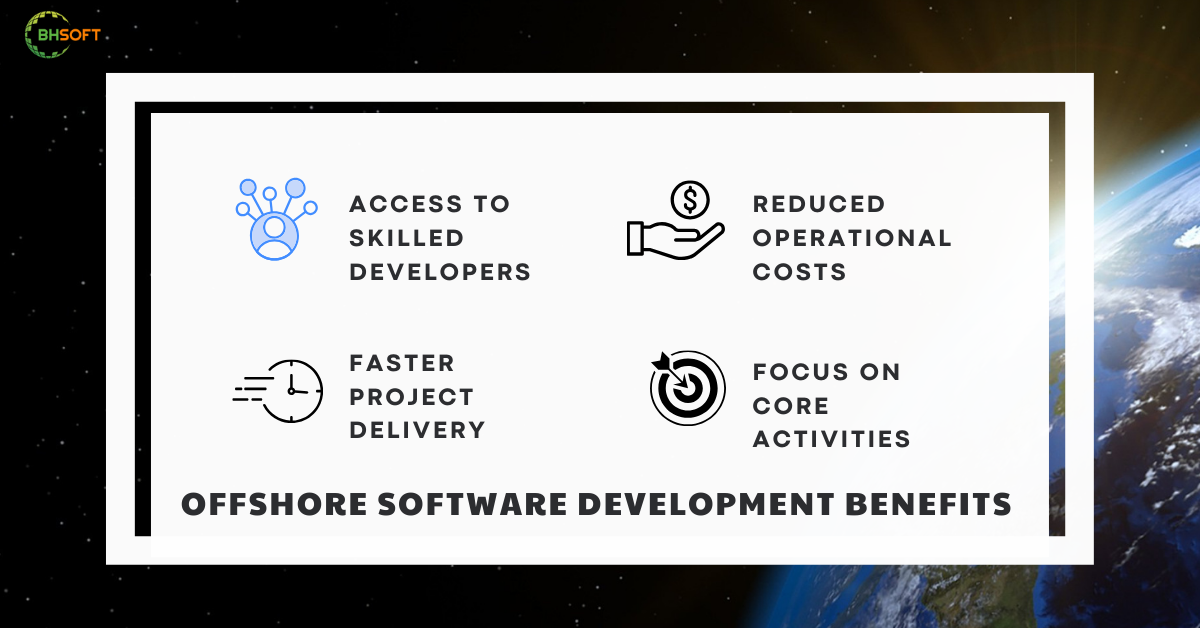
Access to Skilled Developers:
The current shortage of tech talent can be a significant challenge. Offshore software development allows you to tap into talent-rich countries with abundant, well-trained IT professionals who specialize in various technologies. These developers are often adaptable, dynamic, and eager to learn new skills, making them a perfect fit for diverse project needs.
Reduced Operational Costs:
Hiring and training in-house experts requires substantial investment in recruitment, salaries, and infrastructure such as licensed software and hardware. Offshore software development helps cut down on these expenses, saving on office space, infrastructure, and labor costs. In fact, it’s estimated that total project costs can be reduced by up to 30%. Offshore Development Centers typically provide access to affordable labor and already have the necessary resources and infrastructure in place, significantly lowering costs.
Faster Project Delivery:
Developers from Offshore Development Centers are often experienced professionals who can expedite project timelines. They closely monitor the development process and quickly address any issues that arise, ensuring minimal risks during the project build and delivering high-quality products.
Focus on Core Activities:
By outsourcing software development, businesses can focus on their core activities. Instead of managing a large internal development team, Offshore Software Development helps to reduce internal pressures. Additionally, working with an offshore team gives you access to new expertise, as overseas partners bring valuable knowledge and experience that your business may lack.
Read more: How Much Does It Cost to Develop an Application?
Challenges
While Offshore Software Development offers many benefits, it also presents some notable challenges. The distance between your company and the offshore team can introduce issues. Here are some specific challenges to consider:
- Cultural Differences: Language barriers can lead to miscommunication, delays, and unmet expectations. Additionally, differences in work styles and problem-solving approaches across countries may cause conflicts that hinder collaboration.
- Time Zones & Distance: Working across different time zones can complicate scheduling meetings, exchanging information, and addressing issues promptly.
- Team Management: Effectively managing a remote team requires robust project management tools and strategies to ensure smooth collaboration and accountability.
Proper planning and proactive solutions are key to overcoming these challenges.
Factors to consider when choosing an offshore center
Selecting an offshore center is a high-stakes architectural decision. To ensure project velocity and long-term stability, evaluate potential partners against these four critical benchmarks:
1. Technical Talent & Engineering Rigor
The success of your product hinges on the "Seniority" of the assigned engineers.
The Expert Approach: Move beyond general agency profiles. Conduct deep-dive technical interviews and review anonymized CVs to verify expertise in your specific tech stack (e.g., Cloud-native, AI, or specialized DevOps).
2. Infrastructure & Modern Tech Stacks
A partner’s facilities must support a high-availability distributed workflow.
Key Requirements: Ensure the center utilizes modern CI/CD pipelines, secure cloud environments, and robust synchronous communication tools (high-speed dedicated lines and video-conferencing suites). Demand ISO certifications as a baseline for operational quality.
3. Proven Domain Authority
Past performance is the most reliable predictor of future success.
Validation: Audit their portfolio for projects of similar scale and complexity. Look for long-term partnerships—this indicates a "Product Mindset" and a consistent ability to deliver high-quality code under evolving requirements.
4. Advanced Security & Data Sovereignty
In an era of rising cyber threats, security is not a feature—it is a foundation.
Protocol Audit: Your partner must implement rigorous security protocols, including encrypted data transmission, secure code repositories, and compliance with global standards like GDPR, SOC2, or HIPAA to protect your Intellectual Property (IP) at all costs.
Case studies of Offshore Software Development at BHSoft: SNS Data Analysis System
BHSoft, a leading software development company in Vietnam with over 10 years of experience, is a trusted Offshore Development Center for global businesses.
One of our notable projects was a collaboration with a Japanese firm specializing in manufacturing solutions. This client provides advanced CAD-based automated design systems, structural analysis tools for construction and civil engineering, and environmental assessment simulations, among other services.
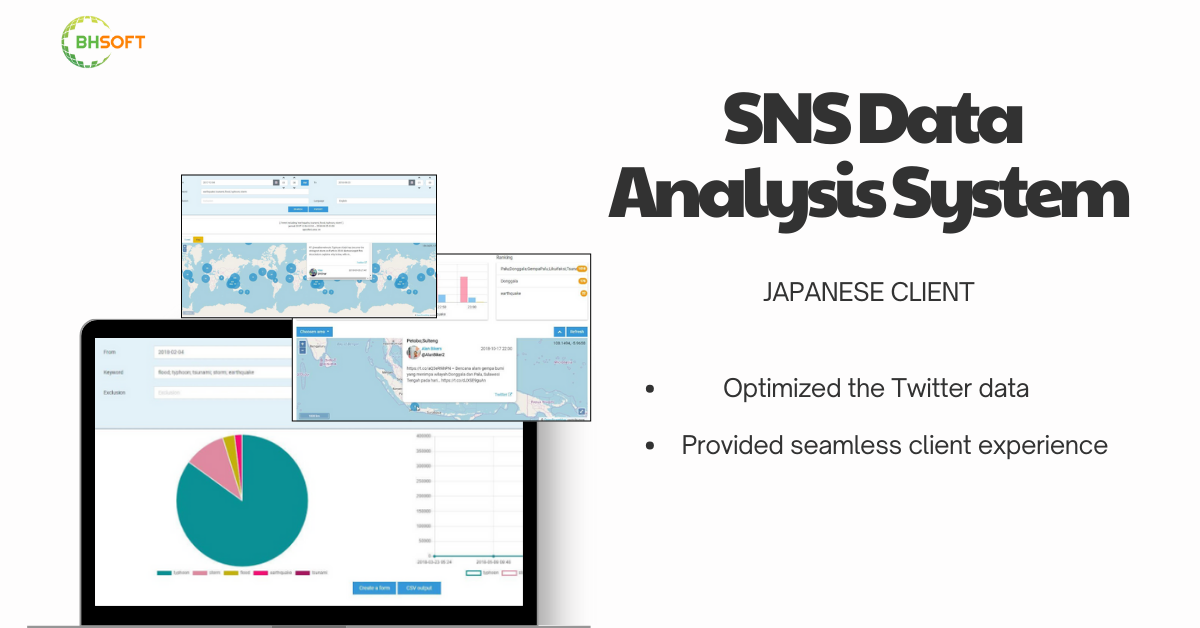
In this project, the Japanese firm needs to develop an SNS (social network service) data analysis system to predict and prepare for natural disasters based on social media data, specifically from Twitter.
As they wanted to focus on their core business, they opted to outsource the web development to an external partner. Among many potential Offshore Development Centers, they chose BHSoft to handle this crucial task.
The main challenge was managing the massive volume of Twitter data, which slowed down the system. However, with our extensive experience in GIS and big data analytics, BHSoft quickly identified a solution. We optimized the Twitter data, ensuring the project ran smoothly, and the system operated efficiently, providing the client with a seamless experience.
.png)
Following the project, this client has remained a loyal partner of BHSoft for an extended period and plans to continue our collaboration. They expressed high satisfaction with BHSoft’s services. They noted that the system runs efficiently, is user-friendly, and that our Offshore Software Development team has displayed great professionalism.
The SNS Data Analysis System handles large volumes of data without overloading, enabling the client to gather critical data for more accurate natural disaster predictions. By working with BHSoft, the client has significantly reduced operational costs and seen a revenue increase of approximately 30% compared to the same period last year.
Why choose the Offshore Development Center at BHSoft?
We hope this article has provided valuable insights into Offshore Software Development. If you have any questions or need further assistance, don't hesitate to contact us.
BHSoft is proud to be one of Vietnam's leading software development companies, committed to helping clients achieve their business goals with top-tier digital products. With a team that is experienced, dedicated, and professional, we have earned the trust of businesses around the world.
Thanks to our extensive experience working with global clients across a wide range of projects, BHSoft is ready to provide the ideal Offshore Software Development team tailored to your needs.