
Ngoc Nguyen
SEO Engineer
Home > Insight > Technology
Waterfall Vs Agile: Which Project Management Methodology Is Right For You?
5 minutes read
Audio description available
June 03, 2026
In the fast-paced era of digital transformation, choosing the right project management methodology plays a crucial role in a software product's success. Especially for businesses seeking outsourced IT services, aligning on how a project will be executed between the client and the technology partner is a critical first step.
The software development world has long been dominated by two giants: Waterfall (Linear/Sequential) and Agile (Iterative/Flexible). But which path is the right fit for your business? This article provides an in-depth analysis, side-by-side comparison, and practical criteria to help you make the best decision.
1. What Is the Waterfall Methodology?
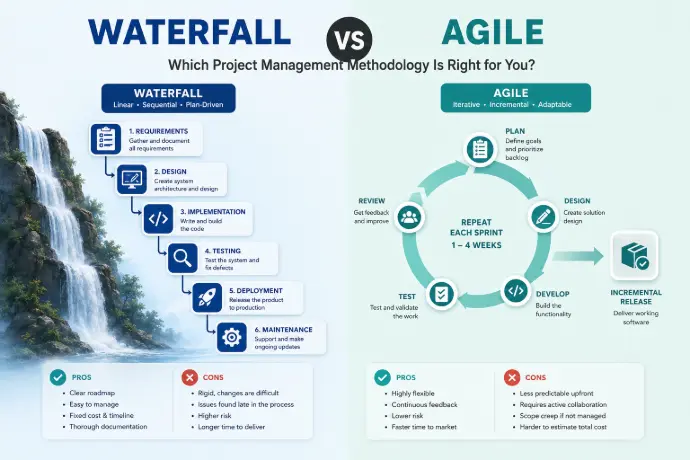
The Waterfall model is a traditional, linear, and sequential approach to project management. As the name suggests, the workflow flows steadily downwards like a waterfall. Each phase must be 100% completed and approved before the next phase can begin. There is no turning back.
A classic Waterfall process strictly follows 6 sequential phases:
- Requirements: Gathering all user expectations and system features into a detailed specification document.
- System Design: Architecting the software, databases, and user interfaces based on the requirement document.
- Implementation: Developers write the actual code.
- Testing: The QA/QC team tests the entire system to find and fix bugs.
- Deployment: Launching the product to the live environment for users.
- Maintenance: Fixing minor post-launch bugs and delivering routine updates.
- Pros: Easy to manage, clear roadmap from day one, predictable fixed costs, and thorough documentation.
- Cons: High rigidity; changing requirements mid-project is incredibly difficult and expensive. Risk is heavily back-loaded (architectural flaws might only be discovered during the final testing phase).
Example of a Waterfall Project
Imagine a company developing an internal payroll management system with well-defined requirements and strict regulatory standards. Since the expected features, workflows, and compliance rules are known in advance, the Waterfall model allows teams to plan, budget, and execute the project with minimal scope changes.
2. What Is the Agile Methodology?
In stark contrast to the rigidity of Waterfall, Agile is an iterative and incremental approach to software development. Grounded in the Agile Manifesto, this methodology prioritizes individuals, interactions, and adaptability over rigid processes and heavy documentation.
Read more: What Is the Agile Methodology?
Instead of tackling the entire project at once, Agile breaks it down into short cycles called Sprints (usually lasting 1 to 4 weeks). Each Sprint acts as a mini-project containing planning, design, coding, and testing phases. At the end of each Sprint, the team delivers a potentially shippable product increment that can be reviewed and tested by stakeholders. (Minimum Viable Product).
- Popular Frameworks: Scrum (the most common, featuring Daily Standups) and Kanban (focusing on visual boards to manage workflow).
- Pros: Highly adaptable to market changes, reduced product risk, continuous feedback from clients, and faster Early ROI (Return on Investment).
- Cons: Difficult to predict 100% of the total budget and timeline upfront; requires high client collaboration; prone to scope creep if not managed tightly.
Example of an Agile Project
A startup building a food delivery application may not know every feature users will need at launch. By using Agile, the team can release core functionality quickly, gather customer feedback, and continuously improve the product based on real-world usage.
3. Side-by-Side Comparison: Waterfall vs Agile
To give you a clear, visual breakdown for quick reference, here is how the two methodologies compare across core criteria:
Những tiêu chí nên bổ sung
|
Comparison Criteria |
Waterfall Model |
Agile Methodology |
|
Core Nature |
Linear and sequential |
Iterative and incremental |
|
Project Planning |
Extensive upfront planning |
Adaptive planning throughout the project |
|
Flexibility |
Low; changes are discouraged after requirements are locked |
High; embraces changing requirements |
|
Client Involvement |
Primarily during requirements and delivery phases |
Continuous throughout development |
|
Testing Frequency |
Conducted after development is completed |
Performed continuously during each Sprint |
|
Documentation |
Extensive and detailed |
Lightweight and focused on essentials |
|
Product Delivery |
One final release |
Frequent incremental releases |
|
Budget Predictability |
Easier to estimate upfront |
More difficult to predict precisely |
|
Timeline Predictability |
Highly predictable |
Flexible but less predictable |
|
Risk Management |
Risks may remain hidden until late stages |
Risks are identified early and addressed continuously |
|
Team Collaboration |
More siloed by phase |
Highly collaborative and cross-functional |
|
Time-to-Market |
Longer |
Faster |
|
Best Suited For |
Fixed-scope, regulated projects |
Dynamic, innovation-driven projects |
4. When to Choose Waterfall vs Agile?
No single methodology is universally superior; the "best" choice depends entirely on the unique nature of your project.
4.1. When to Choose Waterfall
You should opt for the Waterfall model if:
- Your project requirements are clearly defined, stable, and unlikely to change throughout development. (e.g., tax management software, highly regulated systems such as government, healthcare, insurance, or compliance-driven financial platforms, or medical software that must comply with strict legal regulations).
- The client has limited time and cannot participate in weekly progress meetings.
- The technology stack is well-established, leaving little room for experimental risks.
4.2. When to Choose Agile
Agile is often the preferred approach when:
- You are building a new tech product, startup software, or mobile app that needs to pivot features quickly based on user feedback.
- You need to launch to market as quickly as possible (deploying an MVP first to capture market share, then upgrading over time).
- Speed, flexibility, and real-world user experience are valued more than heavy, detailed paperwork.
4.3. The Modern Alternative: The Hybrid Model
In the professional outsourced IT services sector, the Hybrid model has become a dominant trend. Many businesses use Waterfall initially to define the overall system architecture and lock in a macro-budget, but shift to Agile during development and testing to ensure flexible, high-speed execution.
Read more: Software development lifecycle
5. Real-World Delivery Experience at BHSOFT (Bachasoftware)
As a trusted global provider of software development and outsourced IT services, BHSOFT understands that every client brings a unique business challenge. We don't believe in forcing projects into a one-size-fits-all framework.
Instead, our consultants carefully evaluate your project scope, industry compliance, and operational culture to tailor the optimal approach:
- For partners seeking maximum predictability: BHSOFT deploys a well-structured Waterfall process, ensuring strict adherence to timelines and predictable outputs.
- For fast-growing, dynamic projects: We operate under a flexible Scrum/Agile framework, allowing clients to review tangible, working software updates every two weeks.
This adaptive mastery of both tech and management methodologies is exactly why Bachasoftware continues to be a reliable partner for hundreds of enterprises worldwide.
6. Conclusion
Waterfall offers stability and control, while Agile delivers speed and breakthrough flexibility. Your ideal choice depends on your project's scope, your team's capability, and how closely you want to be involved in the day-to-day development.
Which methodology does your business prefer? Leave a comment below, or get in touch with BHSOFT today to get an expert consultation for your upcoming project!