RAG vs. Fine-Tuning: Which Approach Is Right for Enterprise AI?
15 minutes read
Sep 08, 2026
When enterprises start building AI applications, one question appears quickly:
Should we use Retrieval-Augmented Generation (RAG), fine-tune the model, or use both?
The answer depends on what you are trying to change:
- If the goal is to help an AI application answer questions using private, proprietary, or frequently changing information, RAG is often the natural starting point.
- If the goal is to make a model perform a specific task differently, follow a particular output pattern, or consistently behave in a specialized way, fine-tuning may be more appropriate.
And for some enterprise applications, the best architecture combines both.
What Is RAG?
Retrieval-Augmented Generation (RAG) is an architecture that connects an AI model to external sources of information.
Instead of expecting the model to know everything from its original training, the application retrieves relevant information at query time and provides that information to the model as context.
A simplified RAG workflow looks like this: User Question ⟶ Query Processing ⟶ Search / Retrieval ⟶ Relevant Documents or Data ⟶ Context + User Question ⟶ LLM ⟶ Grounded Response
The underlying idea is straightforward: Don't force the model to memorize every piece of enterprise knowledge. Give it access to the knowledge when it needs it.
RAG can use sources such as:
- Internal documents
- Product documentation
- Policies and procedures
- CRM data
- Knowledge bases
- Databases
- Websites
- Technical documentation
- Contracts and reports
- Enterprise applications
Modern RAG systems commonly use semantic search, embeddings, vector databases, keyword search, reranking, metadata filtering, or combinations of these techniques to retrieve relevant context.
Why RAG Is Attractive for Enterprises
Enterprise information changes constantly.
- A company's product catalog may change next week.
- A policy may be updated tomorrow.
- A customer record can change every few minutes.
- A model cannot simply be retrained every time business data changes.
With RAG, the underlying knowledge source can be updated independently of the model. The application retrieves the latest relevant information when a user asks a question.
This makes RAG particularly useful for enterprise knowledge systems and applications that need access to current or proprietary information.
What Is Fine-Tuning?
Fine-tuning takes a different approach.
Instead of retrieving information at runtime, fine-tuning trains an existing foundation model on additional task-specific examples or data so that the model becomes better adapted to a particular objective.
Conceptually: Foundation Model ⟶ Training Dataset ⟶ Fine-Tuning ⟶ Specialized Model ⟶ Application
The objective is not simply to give the model another document to read. The objective is to change how the model responds.
For example, an enterprise might fine-tune a model to:
- Produce outputs in a consistent format
- Follow a particular classification scheme
- Perform a specialized text transformation
- Follow a specific style or tone
- Improve performance on a specialized task
- Better handle domain-specific terminology
- Produce structured outputs for a downstream system
Microsoft describes the distinction similarly: RAG adds relevant information to the model's context, while fine-tuning adapts the model itself to a more specific task or domain.
RAG vs. Fine-Tuning: The Fundamental Difference
The easiest way to understand the difference is:
RAG changes what information the model can access. Fine-tuning changes how the model behaves.
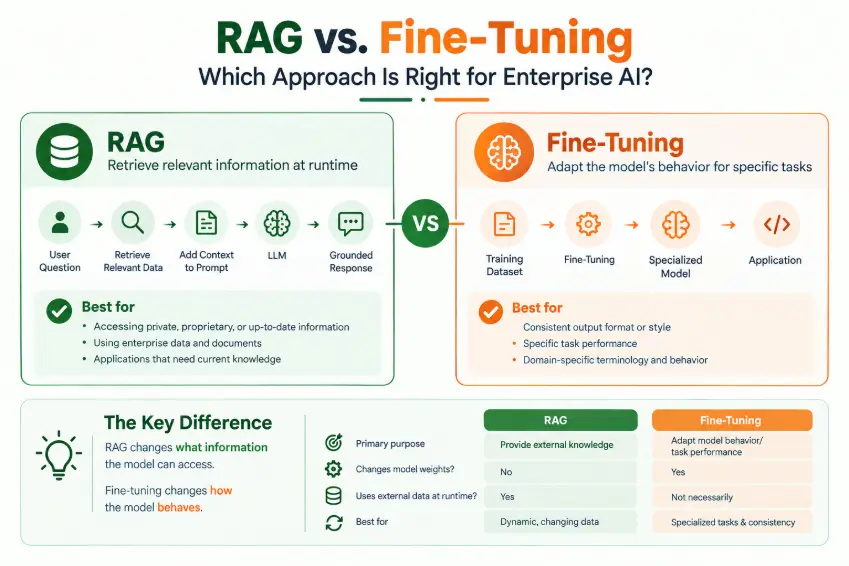
AWS guidance similarly recommends starting with RAG when the primary requirement is answering questions over custom documents, while fine-tuning can be more appropriate when the model needs to perform additional specialized tasks.
RAG Is About Knowledge
Consider an enterprise with thousands of internal documents. Employees want to ask:
"What is our current expense reimbursement policy?". The answer exists in company documentation.
The problem is not that the AI needs a fundamentally different behavior. The problem is that the AI needs access to the right information.
A RAG architecture can retrieve the relevant policy and provide it to the model: Employee Question ⟶ Search Policy Repository ⟶ Retrieve Current Policy ⟶ Provide Policy as Context ⟶ LLM ⟶ Answer + Source
If the policy changes, the enterprise can update the source document and re-index the relevant content. The model itself does not necessarily need to be retrained.
This is one of the strongest reasons RAG has become a practical architecture for enterprise AI.
Fine-Tuning Is About Behavior
Suppose an enterprise receives thousands of customer support messages and wants to classify each message into an internal taxonomy:
- Billing
- Technical Issue
- Account Access
- Feature Request
- Cancellation
- Other
The challenge may not be finding information. The challenge is getting the model to consistently perform a specific classification task according to the company's examples and rules.
This is where fine-tuning can become relevant. The model can be trained using examples such as:
Input | Output |
|---|---|
"I was charged twice this month." | Billing |
"I cannot reset my password." | Account Access |
Over many examples, the model can be adapted to the desired task. The important distinction is that the enterprise is teaching the model how to perform the task, rather than simply giving it access to a document repository.
What About Enterprise Knowledge?
This is where organizations sometimes make the wrong architectural decision.
Imagine a company wants an AI assistant that understands:
- Internal policies
- Customer information
- Product documentation
- Pricing
- Contracts
- Technical manuals
- Project information
A tempting approach is: "Let's fine-tune the model on all our company data."
But this creates an important problem: Enterprise knowledge is not static.
- Documents change.
- Customers change.
- Products change.
- Policies change.
- New information arrives.
Fine-tuning a model every time the underlying business information changes is usually not the most practical way to maintain current knowledge.
RAG is generally better suited to this type of continuously changing information because the knowledge layer can be updated independently from the model.
RAG Does Not Automatically Mean Accurate AI
There is an important misconception: "If we use RAG, hallucinations are solved."
They are not.
RAG improves grounding by giving the model relevant external information, but the quality of the final answer depends heavily on the retrieval system.
Consider this workflow: Question ⟶ Poor Query ⟶ Wrong Documents Retrieved ⟶ LLM ⟶ Confident but Incorrect Answer
A production RAG system therefore needs much more than a vector database. It may require:
- Document preprocessing
- Chunking strategy
- Metadata
- Embeddings
- Hybrid search
- Semantic search
- Keyword search
- Reranking
- Access control
- Query transformation
- Context filtering
- Source attribution
- Evaluation
- Monitoring
Google Cloud specifically highlights retrieval quality as critical to RAG performance: if irrelevant information is retrieved, the model can still generate an incorrect or off-topic answer even though the response is technically "grounded."
This is why RAG is an engineering problem, not simply an LLM integration problem.
Fine-Tuning Does Not Automatically Add Reliable Knowledge
The opposite misconception is: "If we fine-tune the model on our documents, the model will know our company."
Not necessarily.
Fine-tuning is not equivalent to building a searchable enterprise knowledge base. A fine-tuned model learns from training examples, but it does not inherently provide the same source retrieval and provenance mechanism as a RAG system. AWS notes that fine-tuned models do not inherently provide references to source information in their responses. This becomes particularly important for enterprise applications where users need to know:
- Where did this answer come from?
- Which document supports it?
- Which version of the policy was used?
- Can the answer be audited?
- Can the user verify the source?
For these requirements, retrieval and source grounding can be much more appropriate than relying on model parameters alone.
When Should Enterprises Choose RAG?
RAG is usually a strong candidate when the application needs access to external knowledge.
Use RAG when:
1. Your information changes frequently
Examples:
- Product catalogs
- Pricing
- Policies
- Customer information
- Inventory
- Operational data
2. Your data is private
Examples:
- Internal documentation
- Contracts
- HR policies
- Technical documentation
- Customer records
3. Users need source references
RAG architectures can preserve the relationship between generated answers and retrieved sources.
4. You are building enterprise search or knowledge assistants
Examples:
- Internal knowledge assistant
- Customer support assistant
- Technical documentation assistant
- Policy assistant
- Product knowledge assistant
5. You want to update knowledge without retraining the model
This is one of RAG's biggest architectural advantages.
When Should Enterprises Consider Fine-Tuning?
Fine-tuning becomes more interesting when the problem is primarily about model behavior or task performance.
Consider fine-tuning when:
1. You need highly consistent output
For example: Input → Classification → Structured Output
2. The task is specialized
The model needs to perform a narrow task repeatedly and consistently.
3. You have a strong training dataset
Fine-tuning requires meaningful examples that represent the behavior you want the model to learn.
4. Prompting alone is not sufficient
If extensive prompt engineering still does not produce reliable task behavior, fine-tuning may be worth evaluating.
5. You need a particular style or format
For some applications, fine-tuning can help a model consistently follow organizational patterns or output requirements.
RAG and Fine-Tuning Can Work Together
One of the most important points for enterprise architecture is that this is not necessarily an either-or decision. RAG and fine-tuning can be combined.
For example, an enterprise customer-support assistant could use:
| RAG | Fine-tuning |
|---|---|
Current product documentation Current pricing Customer-specific information Support policies | Response classification Specific output structure Consistent response style Specialized task behavior |
AWS explicitly describes combining RAG and fine-tuning as a viable architecture when both external knowledge and specialized model behavior are required.
A Practical Decision Framework
Instead of asking "RAG or fine-tuning?", start with these questions.
Question 1: Does the AI need current or changing information?
Yes → Start by evaluating RAG.
No → Continue evaluating the task itself.
Question 2: Does the AI need to access private enterprise information?
Yes → RAG is often a strong candidate.
Question 3: Is the main problem inconsistent model behavior?
Yes → Evaluate fine-tuning.
Question 4: Do users need citations or source traceability?
Yes → RAG or another grounding architecture should be strongly considered.
Question 5: Does the application require both specialized behavior and enterprise knowledge?
Yes → Consider combining fine-tuning and RAG.
The Enterprise Architecture Matters More Than the Label
Choosing RAG or fine-tuning is only one part of the architecture.
A production AI application still needs:
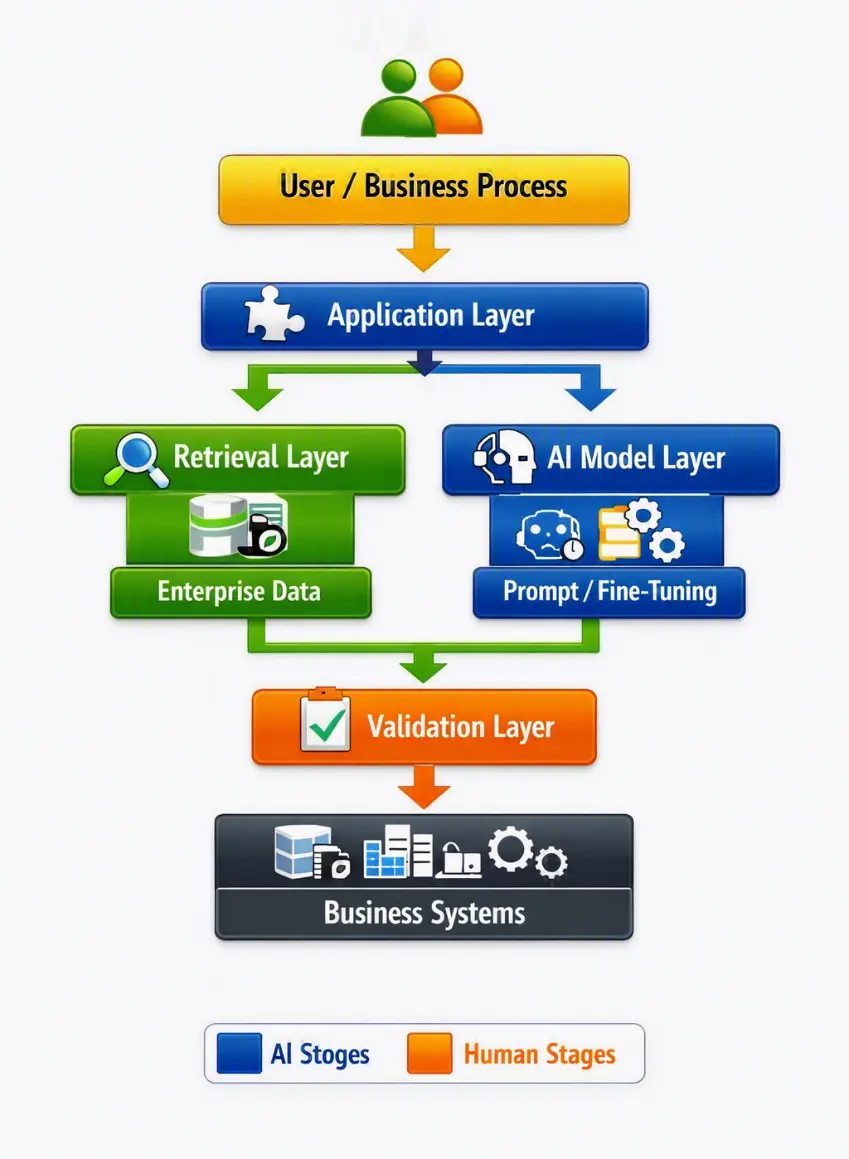
Security and governance must also be considered. For example:
- Who can retrieve which documents?
- Can one customer access another customer's information?
- How are sensitive documents filtered?
- How is access controlled?
- How are prompts and outputs logged?
- How are incorrect answers detected?
- How is model performance evaluated?
- How are knowledge sources updated?
A production RAG architecture therefore involves substantially more than connecting a vector database to an LLM. AWS's current architecture guidance similarly emphasizes components such as orchestration, user identity and access management, retrieval, generation, and operational management.
Common Mistakes We See
1. Fine-Tuning Just Because the Data Is Proprietary
Private data does not automatically mean fine-tuning. If the main requirement is allowing the AI to answer questions using private company information, RAG is often the more direct architecture.
2. Treating RAG as "Just a Vector Database"
A vector database is only one component. Poor document processing or poor retrieval can produce poor AI responses even when the underlying LLM is highly capable.
3. Using Fine-Tuning to Store Frequently Changing Information
If information changes constantly, repeatedly retraining the model can create unnecessary operational complexity. A separate knowledge layer may be more appropriate.
4. Assuming RAG Eliminates Hallucinations
RAG improves grounding, but retrieval quality, context quality, model behavior, and evaluation still matter. A production system needs mechanisms to measure whether the generated answer is actually supported by the retrieved information. Modern RAG platforms increasingly provide evaluation and grounding checks for this reason.
5. Ignoring Data Access Controls
Enterprise RAG introduces an important security question: Should every user be able to retrieve every document?
The answer is usually no. Retrieval must respect the same authorization boundaries as the underlying enterprise systems.
6. Choosing Technology Before Defining the Problem
"Should we use RAG or fine-tuning?" is not the first question.
The first question should be: What does the AI application need to know, and what does it need to do?
Once that is clear, the architecture becomes much easier to define.
From "Using an LLM" to Engineering an AI System
This is where the topic connects directly to AI Engineering.
An enterprise AI application is not simply: Application → LLM
A production architecture may look more like:
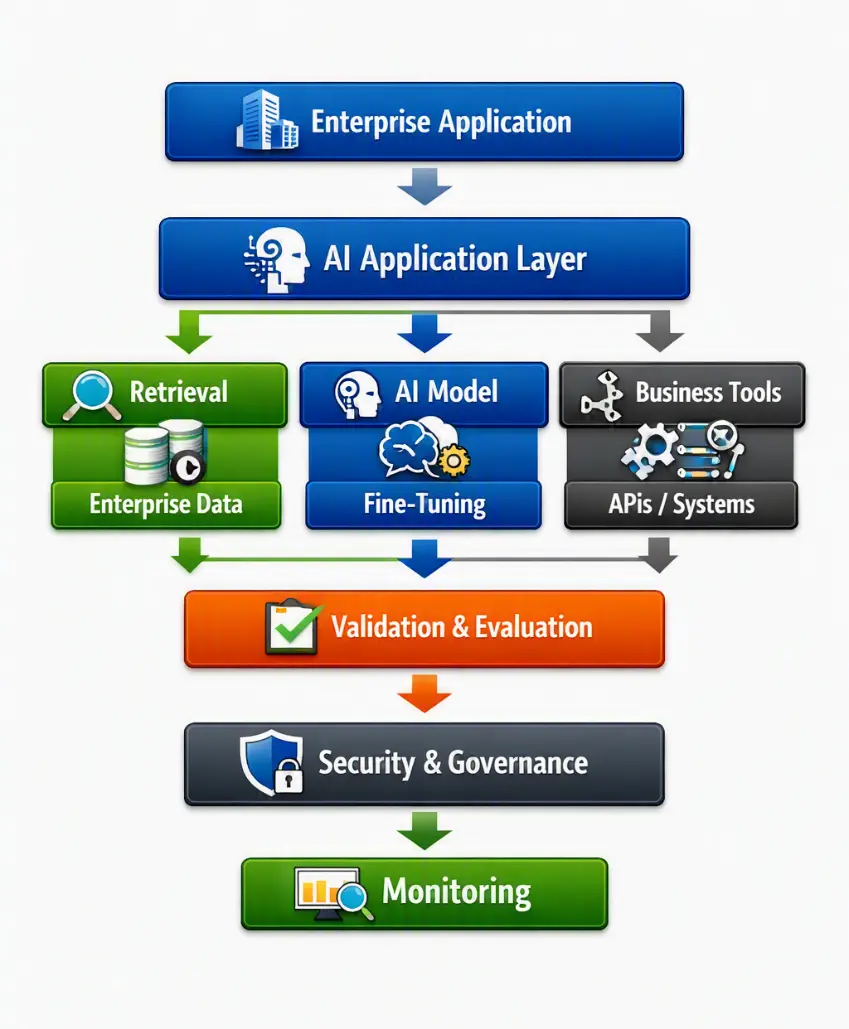
The model is only one component. The real engineering challenge is designing the complete system around it.
This is why AI Engineering goes beyond AI coding or simply connecting an application to an LLM.
It requires combining:
- Software engineering
- AI models
- Data engineering
- Retrieval
- Enterprise integration
- Security
- Evaluation
- Observability
- Workflow design
- Domain expertise
BHSoft's Perspective: Start With the Problem, Not the Model
At BHSoft, we see RAG and fine-tuning as architectural tools rather than products that should be applied to every AI project.
Our approach starts with the business problem. First, we determine whether the application needs:
- Knowledge → RAG
- Behavior → Fine-Tuning
- Knowledge + Behavior → RAG + Fine-Tuning
From there, we design the surrounding software architecture. That can include:
- Enterprise data integration
- Document processing
- Retrieval pipelines
- APIs and business systems
- AI agents
- Access control
- Evaluation frameworks
- Human approval workflows
- Monitoring and observability
The goal is not to use the most advanced AI technique available. The goal is to engineer a system that is reliable, maintainable, secure, and useful in a real enterprise environment.
Conclusion
There is no universal winner. A practical enterprise strategy is:
| Traditional Automation | AI Agents |
|---|---|
| Predefined rules | Goal-oriented instructions |
| Fixed execution paths | Dynamic execution paths |
| Deterministic | Probabilistic |
| Structured inputs | Can handle unstructured inputs |
| Predictable outcomes | Context-dependent outcomes |
| Limited exception handling | Can reason about exceptions |
| Easier to test | Requires AI-specific evaluation |
| Easier to control | Requires stronger guardrails |
| Best for stable processes | Best for variable processes |
The key is to avoid treating RAG and fine-tuning as competing technologies. They operate at different layers of the AI engineering stack.
Looking for an AI Engineering Partner?
BHSoft combines software engineering expertise with AI capabilities to help organizations move from AI experiments and prototypes to practical, production-ready solutions.
Whether you are exploring AI integration, building an AI-powered product, developing intelligent automation, or connecting AI with your existing enterprise systems, our team can help you design and build the right solution.
👉 Build smarter. Engineer AI for real-world impact. Contact BHSOFT today to discuss your project