AI Engineering: A Practical Guide for Enterprises
10 minutes read
Sep 04, 2026
AI is changing how software is built.
Developers can now use AI coding assistants to generate code, write tests, explain unfamiliar systems, and automate repetitive development tasks. But as AI capabilities continue to expand, enterprises are moving beyond the question of how to use AI for coding.
The more important question is: How do we engineer software systems that effectively use AI as part of the development and delivery process?
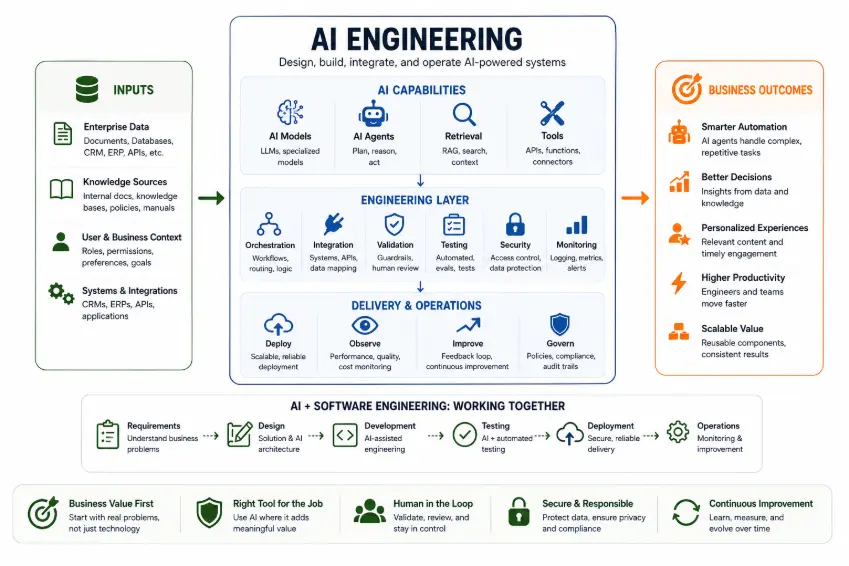
This is where AI Engineering comes in. AI Engineering is an approach to software development that combines traditional software engineering practices with AI models, AI agents, automation, enterprise data, domain knowledge, and systematic validation.
It is not simply about using an AI coding assistant. It is about designing an engineering process and technology architecture where AI can contribute reliably to solving real business and software problems.
For enterprises, this distinction is particularly important. Building a quick AI prototype is relatively easy. Building an AI-powered system that is secure, reliable, maintainable, scalable, and integrated with existing business operations requires a much broader engineering discipline.
AI Engineering in Simple Terms
A simple way to understand AI Engineering is: AI Engineering is the discipline of designing, building, integrating, testing, deploying, and maintaining software systems that use AI as a core part of their capabilities.
Traditional software engineering generally follows a predictable model: Business Requirement ⟶ System Design ⟶ Development ⟶ Testing ⟶ Deployment ⟶ Maintenance
AI Engineering extends this model by introducing AI capabilities throughout the process: Business Requirement ⟶ AI-Assisted Analysis ⟶ Solution & AI Architecture ⟶ AI Models / AI Agents ⟶ Software Development ⟶ AI + Automated Testing ⟶ Human Validation ⟶ Deployment ⟶ Monitoring & Improvement
The important point is that AI does not replace software engineering. AI becomes part of software engineering.
Why AI Engineering Matters to Enterprises
For enterprises, AI cannot simply be treated as another productivity application.
Enterprise software usually exists within a much larger ecosystem. A typical organization may have:
- CRM
- ERP
- HR systems
- Finance systems
- Databases
- Document management systems
- Data warehouses
- Internal applications
- Customer-facing applications
- APIs
- Cloud infrastructure
AI needs to work with these systems. For example:
- An AI assistant that answers customer questions may need to retrieve information from a CRM.
- An AI workflow that processes invoices may need to communicate with an ERP.
- An AI application that analyzes business performance may need access to data warehouses.
- An AI agent that performs an operational task may need to interact with multiple APIs.
This means enterprise AI is rarely an isolated application. It is usually part of an existing technology ecosystem.
That is why AI Engineering requires both AI expertise and software engineering expertise.
The Core Components of AI Engineering
Although implementations vary between organizations, several capabilities form the foundation of an AI Engineering approach.
1. AI Models
At the foundation are AI models that provide capabilities such as:
- Natural language understanding
- Text generation
- Summarization
- Classification
- Information extraction
- Reasoning
- Code generation
- Image or document understanding
Enterprises may use commercial models, open-source models, specialized models, or a combination of different models depending on their requirements.
The model itself, however, is only one part of the system. A production AI application needs much more than an API call to an LLM.
2. Enterprise Data and Context
AI systems need relevant information to produce useful results.
Enterprise information may exist across:
- Databases
- Documents
- Knowledge bases
- CRM systems
- ERP systems
- APIs
- Data warehouses
- Internal applications
AI Engineering therefore includes designing how AI systems access and use this information.
For example: Enterprise Data ⟶ Data / Integration Layer ⟶ Context Retrieval ⟶ AI Model ⟶ Business Response
The objective is to provide the AI system with the right information at the right time while maintaining appropriate security and access controls. This is one of the reasons approaches such as Retrieval-Augmented Generation (RAG) have become important in enterprise AI applications.
RAG allows an AI system to retrieve relevant information from an external knowledge source before generating a response.
3. AI Agents
Traditional software generally follows predefined logic.
For example: IF customer_status = "inactive" THEN send email
AI agents can operate differently. An agent can be given an objective and use available tools and information to determine how to accomplish a task.
For example: Business Objective ⟶ AI Agent ⟶ Understand Context ⟶ Select Tool ⟶ Execute Action ⟶ Evaluate Result ⟶ Continue / Escalate
An enterprise AI agent might:
- Search customer information.
- Retrieve documents.
- Analyze data.
- Call an API.
- Create a record.
- Send a notification.
- Request human approval.
However, not every business process needs an AI agent. Some processes are better handled by deterministic automation. Understanding the difference between AI agents and traditional automation is therefore an important part of AI Engineering.
4. Integration
Enterprise AI rarely operates alone.
A production AI solution may need to connect with:
- CRM
- ERP
- Databases
- Internal APIs
- SaaS platforms
- Communication systems
- Workflow platforms
- Cloud services
For example:
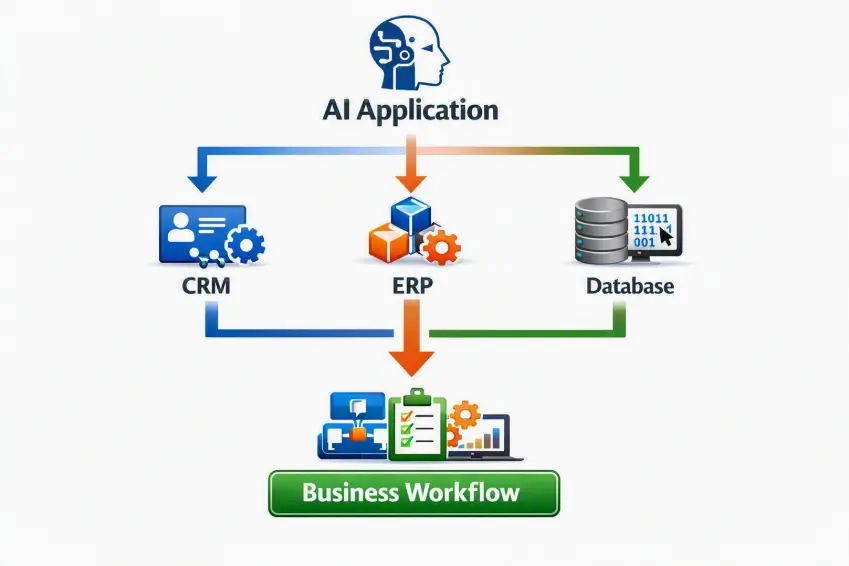
This is where traditional software engineering remains extremely important. API design, authentication, data mapping, error handling, logging, scalability, and system architecture all remain critical.
AI does not remove these engineering requirements. It adds another layer to them.
5. AI Application Architecture
A production AI application typically contains multiple layers rather than simply: User → AI Model → Response
A more realistic enterprise architecture might look like:
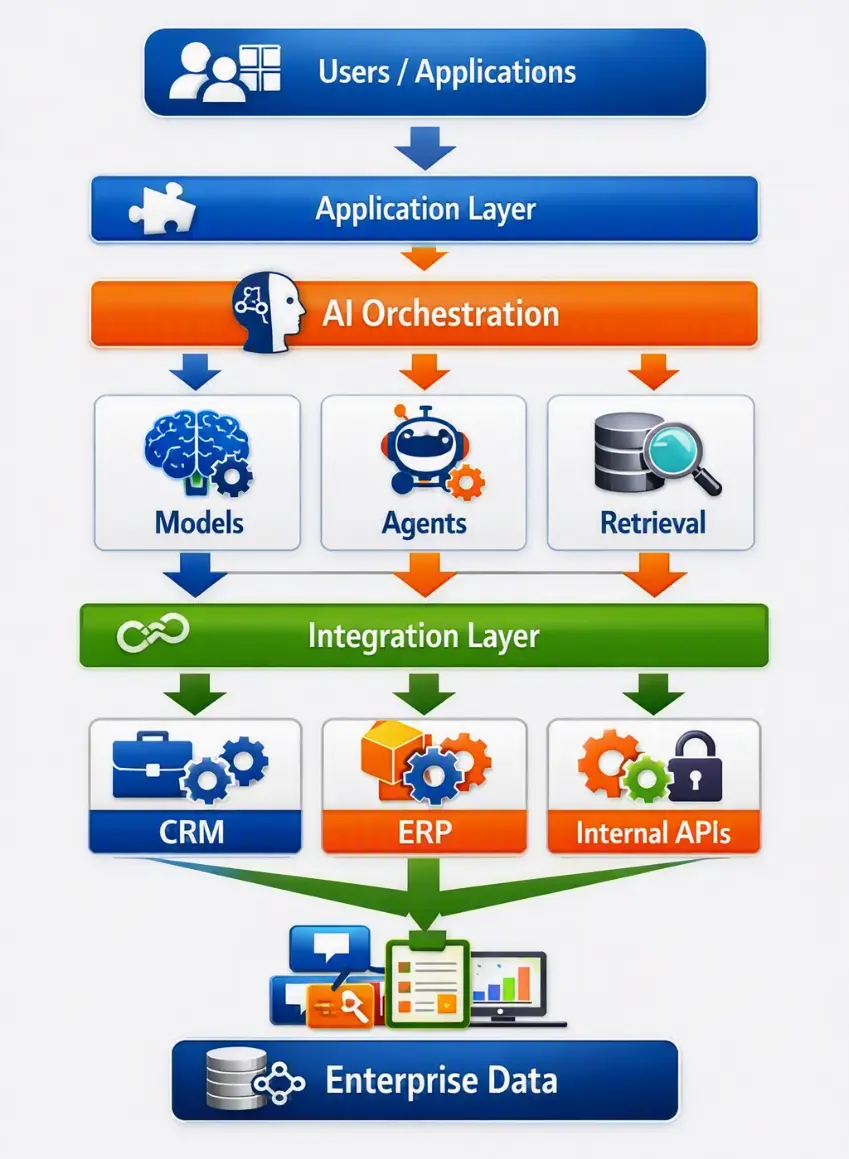
The exact architecture depends on the use case. The important principle is that the AI model should be considered one component of a larger software system.
6. Evaluation and Testing
Traditional software testing asks: "Does the system behave according to the expected rules?"
AI applications introduce another challenge: "How do we determine whether an AI-generated result is good enough?"
AI output can vary. A system may produce technically valid responses that are nevertheless:
- Incorrect
- Incomplete
- Irrelevant
- Inconsistent
- Unsafe
- Misleading
Therefore, AI Engineering needs evaluation mechanisms appropriate to the application. These can include:
- Automated test cases
- Evaluation datasets
- Response quality checks
- Ground-truth comparisons
- Accuracy measurements
- Hallucination detection
- Security testing
- Human evaluation
- Regression testing
The evaluation strategy should be designed alongside the AI application rather than added at the end.
7. Security and Governance
Enterprise AI introduces additional security considerations.
Organizations need to consider:
- What data can the AI access?
- Which users are authorized to access it?
- What information can an agent retrieve?
- What actions can an agent perform?
- Where is data processed?
- How are credentials managed?
- How are AI interactions logged?
- How can unauthorized actions be prevented?
For an AI agent that can only answer questions, the risk profile may be relatively limited.
For an agent that can modify customer records, create financial transactions, or interact with production systems, the requirements are much more significant.
A useful principle is: The more authority an AI system has, the stronger the controls around it need to be.
This is why enterprise AI Engineering needs to incorporate security and governance from the architecture stage.
8. Observability and Monitoring
Traditional software monitoring focuses on metrics such as:
- CPU
- Memory
- Response time
- Errors
- Availability
AI applications need additional signals. Teams may also need to monitor:
- Model usage
- Token consumption
- Response quality
- Latency
- AI failures
- Agent actions
- Tool usage
- Retrieval quality
- Cost per request
For example: AI Application ⟶ Logging Monitoring ⟶ Evaluation ⟶ Feedback ⟶ Improvement
This creates a continuous feedback loop.
A production AI system should not simply be deployed and forgotten. It should be observed and improved over time.
AI Engineering Is a Continuous Lifecycle
One of the biggest differences between building a traditional software feature and building an AI-powered system is the importance of continuous improvement.
A traditional feature may follow: Build → Test → Deploy
An AI Engineering lifecycle is closer to: Design Build Evaluate Deploy Monitor Collect Feedback Improve Evaluate Again
Models may change. Data may change. User behavior may change. Business requirements may change. Therefore, AI Engineering needs a lifecycle that can adapt.
AI Engineering and Traditional Software Engineering Work Together
AI Engineering should not be seen as a replacement for traditional software engineering. In many ways, it makes strong software engineering practices even more important.
Consider an AI application that processes customer documents. The AI model may extract information from the document. But the surrounding system still needs to:
- Receive the document.
- Authenticate the user.
- Store the file securely.
- Send it to the AI service.
- Validate the response.
- Store structured data.
- Handle failures.
- Log activities.
- Notify users.
- Integrate with other systems.
The AI capability is only one part. The complete solution requires software engineering.
That is why a strong AI Engineering capability combines: AI + Software Engineering + Data + Integration + Domain Expertise
Common Mistakes We See in AI Engineering
1. Starting With the AI Model
Some organizations begin by asking: "Which AI model should we use?"
A better starting point is: "What business problem are we trying to solve?"
The model should support the solution rather than determine it.
2. Treating a Prototype as a Production System
A prototype may demonstrate that an AI capability works. That does not mean it is ready for production.
Production systems require additional consideration for:
- Security
- Scalability
- Reliability
- Monitoring
- Cost
- Data protection
- Error handling
- Governance
3. Using AI Where Traditional Software Is Better
AI is not automatically the best solution. If a business rule can be expressed clearly and deterministically, traditional software may be faster, cheaper, and more reliable.
AI Engineering means choosing the appropriate technology for each problem.
4. Giving AI Too Much Authority
An AI agent should not automatically receive access to every system it can technically reach. Permissions should be designed according to the business risk.
5. Ignoring Enterprise Integration
An AI application that operates independently from the organization's existing systems may create another silo.
The real value often comes from connecting AI to the systems and workflows where business decisions actually happen.
6. Measuring Only Model Performance
A highly capable model does not automatically produce a successful enterprise application.
Organizations should also consider:
- Business outcomes
- Reliability
- User adoption
- Cost
- Security
- Operational performance
- From AI Experiments to AI Engineering
Many organizations follow a progression like this: AI Experiment → Proof of Concept → AI Application → Production AI System → AI Engineering Capability
- The first stages focus on proving that something is possible.
- The later stages focus on making it reliable, repeatable, scalable, and valuable.
- That final transition is where AI Engineering becomes important.
An enterprise does not gain a long-term advantage simply because it has built one AI chatbot. The stronger capability comes from developing the engineering practices, knowledge, architecture, integrations, and reusable components that allow the organization to build many AI-powered solutions.
How BHSoft Approaches AI Engineering
At BHSoft, we see AI Engineering as a natural evolution of software engineering.
Our approach is not simply to use AI to generate more code. Instead, we focus on applying AI across the software delivery lifecycle: Requirement → Development → Testing → Documentation → Delivery
- This means combining:
- Software engineering expertise
- AI models and AI agents
- Enterprise system integration
- Automation
- Domain knowledge
- Reusable engineering knowledge
- Human review and validation
The objective is to help teams solve complex software problems more efficiently while maintaining the reliability and engineering discipline required for enterprise systems.
We believe AI is a multiplier, not a replacement for engineering expertise. The strongest results come when AI capabilities are combined with people who understand the technology, the business domain, and the systems being built.
What Enterprises Should Consider Before Starting AI Engineering
Before implementing an AI Engineering initiative, organizations should consider several questions:
1. What problem are we solving?
Start with business value rather than technology.
2. What data does the solution need?
Identify the systems, documents, databases, and knowledge required.
3. What should AI do?
Determine which activities genuinely benefit from AI.
4. What should remain deterministic?
Use traditional software where predictable rules are more appropriate.
5. What systems need to be integrated?
Identify the enterprise applications and APIs involved.
6. How will we validate AI output?
Define evaluation and testing before production.
7. What level of autonomy is appropriate?
Determine when AI can act independently and when human approval is required.
8. How will the system be monitored?
Plan for observability, cost tracking, performance, and continuous improvement.
Looking for an AI Engineering Partner?
BHSoft combines software engineering expertise with AI capabilities to help organizations move from AI experiments and prototypes to practical, production-ready solutions.
Whether you are exploring AI integration, building an AI-powered product, developing intelligent automation, or connecting AI with your existing enterprise systems, our team can help you design and build the right solution.
👉 Build smarter. Engineer AI for real-world impact. Contact BHSOFT today to discuss your project