How to Build Production-Ready AI Applications
10 minutes read
September 29, 2026
Building an AI prototype is becoming easier.
With modern foundation models, APIs, AI coding tools, and ready-made frameworks, a team can build a working AI application in days or even hours.
But getting an AI application to work is only the beginning.
The harder question is: Can it work reliably in a real business environment?
A production AI application needs more than a good prompt or a powerful model. It needs reliable data, predictable behavior, security controls, observability, performance management, and a clear way to handle cases where the AI gets something wrong.
This is where AI Engineering becomes important.
At BHSoft, we see production AI not as a standalone model, but as an engineered software system that combines AI capabilities with data, business logic, infrastructure, and human oversight.
Prototype vs. Production: What Changes?
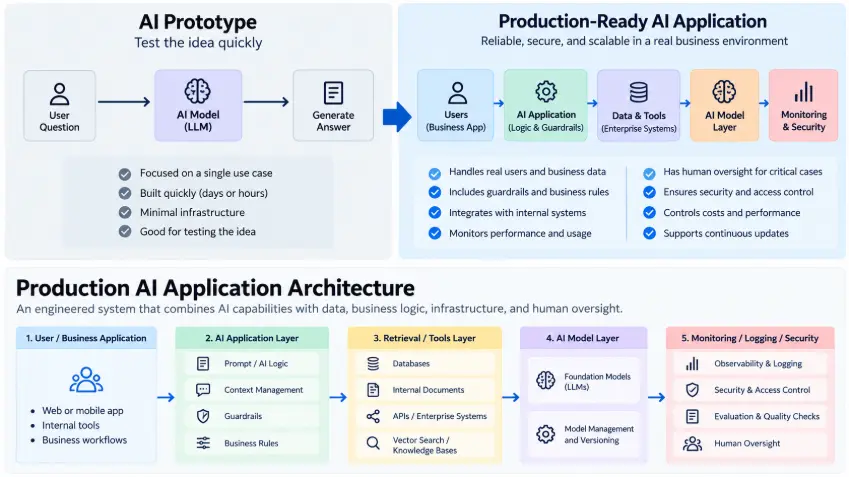
An AI prototype is usually designed to answer one question: Can this idea work?
A production system needs to answer many more:
- Can it handle real users?
- Can it process real business data safely?
- What happens when the model produces an incorrect answer?
- How do we monitor its performance?
- Can we reproduce and investigate failures?
- What happens when the AI service becomes unavailable?
- How do we control costs?
- How do we update the model without breaking existing workflows?
- How do we protect sensitive information?
This is why moving from prototype to production is not simply a matter of deploying the same application to a server. The architecture usually needs to evolve.
1. Start with the Business Problem
A production AI project should begin with the problem, not the model.
Before selecting an LLM, vector database, agent framework, or AI API, the engineering team should understand:
- What business process are we improving?
- What decision is the system supporting?
- What information does it need?
- What should happen when the AI is uncertain?
- Where does a human need to remain involved?
For example, an enterprise may want AI to help process customer requests.
The actual requirement might involve:
Customer Request ⟶ Understand Intent ⟶ Retrieve Customer Information ⟶ Check Business Rules ⟶ Generate Response ⟶ Human Review? ⟶ Update CRM ⟶ Notify Customer
The AI model is only one component in this workflow. The rest is software engineering.
2. Design the AI Application as a System
A production-ready AI application typically contains several layers.
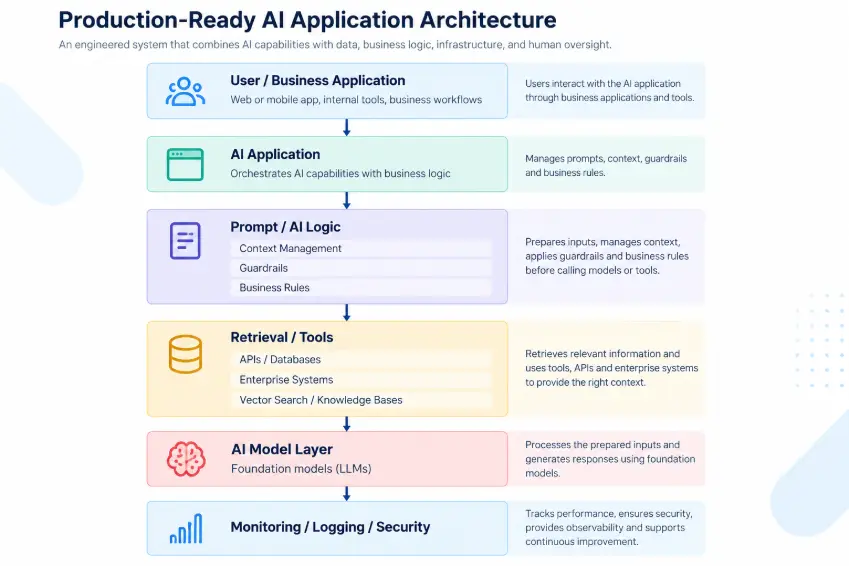
This separation is important. It allows the AI model to evolve without requiring the entire business application to be redesigned. It also makes it easier to introduce additional models, tools, retrieval mechanisms, or validation rules later.
3. Give AI Access to the Right Context
A powerful model does not automatically understand a company's business.
Enterprise AI applications often need access to:
- Internal documents
- Customer records
- Product information
- Policies
- Contracts
- Operational data
- Knowledge bases
- Business applications
But simply giving the model access to everything is not a good architecture.
The system needs to determine:
- What information does this request require?
- Which user is asking?
- What data is that user allowed to access?
- Which information should be provided to the model?
This is where techniques such as retrieval, tool calling, structured context, and access control become important. The objective is not to give AI more data. It is to give AI the right data at the right time.
4. Build Guardrails Around AI
AI systems are probabilistic.
Traditional software generally follows explicit rules:
IF condition
THEN action
AI systems can produce different outputs for similar inputs. That flexibility is powerful, but it also introduces risk. Production systems therefore need guardrails.
These can include:
- Input validation
- Output validation
- Structured response formats
- Business rules
- Permission checks
- Content filtering
- Tool restrictions
- Confidence or uncertainty handling
- Human approval
- Fallback workflows
For example, an AI assistant may be allowed to recommend an action but not execute a high-impact transaction without approval.
The important distinction is: AI can make software more capable without making business rules optional.
5. Design for Failure
A production AI application must assume that something will eventually go wrong.
The model may:
- Return an incorrect answer
- Fail to understand the request
- Receive incomplete context
- Produce an unexpected format
- Become temporarily unavailable
- Exceed a token or latency limit
- Call the wrong tool
- Return information that requires human verification
A robust system therefore needs fallback behavior.
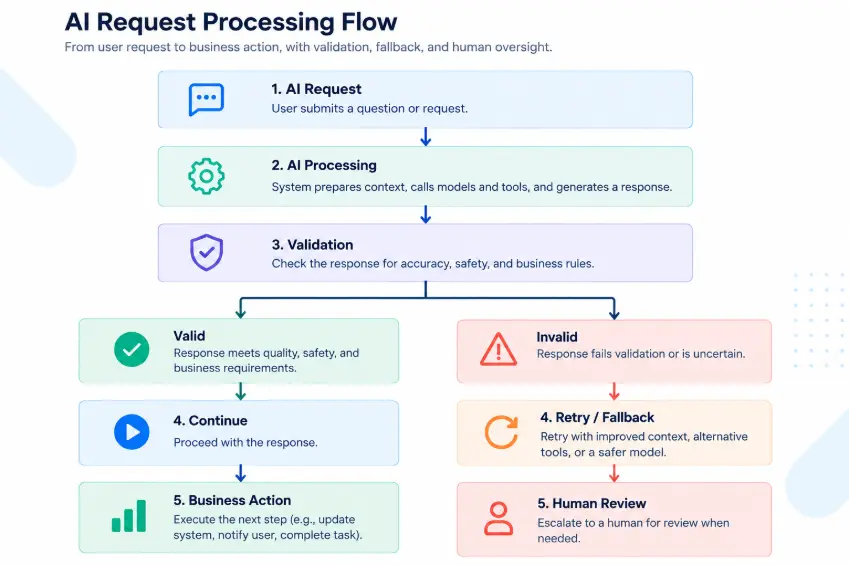
The goal is not to eliminate every possible AI error.
The goal is to contain errors and prevent them from becoming uncontrolled business failures.
6. Security Cannot Be Added Later
Enterprise AI applications may process sensitive information.
Depending on the use case, this could include:
- Customer data
- Employee information
- Financial information
- Internal documents
- Commercial contracts
- Operational data
- Intellectual property
Security therefore needs to be considered throughout the architecture. Important questions include:
- Where is data stored?
- Where is data processed?
- What information is sent to external AI services?
- Who can access AI-generated information?
- How are permissions enforced?
- What is logged?
- How long is information retained?
- Can sensitive data be removed or masked?
- How are AI tools prevented from accessing unauthorized systems?
The AI model should not become a shortcut around the organization's existing security architecture.
Instead, AI should operate within the same security and governance framework as the rest of the enterprise software environment.
7. Observability Is Essential
Traditional software can be monitored through metrics such as:
- CPU usage
- Memory
- Response time
- Error rates
- Request volume
AI applications require additional signals. Teams may need to monitor:
- Model response latency
- Token consumption
- AI service failures
- Retrieval quality
- Tool execution
- Invalid outputs
- User feedback
- Human overrides
- Cost per request
- Prompt and model changes
This creates an important engineering feedback loop: User Interaction ⟶ AI Application ⟶ Logs + Metrics + Evaluation ⟶ Engineering Analysis ⟶ Improved Prompts / Retrieval / Architecture ⟶ New Version
AI systems should therefore be treated as systems that learn operationally through continuous evaluation, even when the underlying model itself is not being retrained.
8. Evaluate AI Like Software
One of the biggest differences between conventional software and AI applications is testing.
- For deterministic software, the expected result of a given input can often be defined precisely.
- For generative AI, there may be multiple acceptable answers.
That means testing needs to consider both: Technical correctness and Business usefulness.
A production AI system may therefore require evaluation datasets containing representative real-world scenarios. The team can evaluate questions such as:
- Did the system retrieve the correct information?
- Did it follow the business rules?
- Did it use the correct tool?
- Did it produce the required format?
- Did it expose unauthorized information?
- Was the answer useful to the user?
- Did it escalate correctly when uncertain?
This evaluation process becomes part of the engineering lifecycle.
9. Control Performance and Cost
AI applications can become expensive or slow if they are not designed carefully.
For example, a workflow that repeatedly sends large amounts of context to a powerful model may work perfectly during a small prototype test.
At enterprise scale, the same design may create unacceptable latency and cost.
Engineering teams therefore need to consider:
- Model selection
- Prompt size
- Context size
- Caching
- Retrieval strategies
- Request batching
- Model routing
- Rate limits
- Asynchronous processing
Sometimes a smaller model is sufficient. Sometimes a more capable model is necessary.
The engineering objective is to use the appropriate level of intelligence for each task, rather than assuming the largest model should handle everything.
10. Keep Humans in the Loop Where They Matter
Not every AI workflow should be fully autonomous.
For many enterprise processes, the right architecture is: AI recommends → Human validates → System executes
This can be particularly important when the output affects:
- Financial transactions
- Legal decisions
- Customer commitments
- Employee actions
- Security
- Regulatory processes
Human involvement should not be treated as a failure of automation. It can be a deliberate part of the system architecture. The goal is to automate the right parts of a workflow while keeping appropriate human responsibility where it matters.
AI Engineering Is the Difference
A production-ready AI application is not simply an LLM connected to a user interface.
It is a software system. It needs:
- Architecture.
- Data.
- Integration.
- Security.
- Validation.
- Observability.
- Testing.
- Performance management.
- Human oversight.
The AI model provides an important capability, but the surrounding engineering determines whether that capability can become a dependable business solution.
This is why we distinguish AI Engineering from simply using AI coding tools or adding an AI feature to an existing application.
At BHSoft, our approach is to treat AI as part of the software architecture — not as a separate layer disconnected from the systems and workflows that businesses already depend on.
From AI Prototype to Production
Moving an AI idea into production is ultimately a process of reducing uncertainty:
- Start with the business problem.
- Validate the AI capability.
- Understand the data.
- Design the architecture.
- Introduce security and guardrails.
- Build evaluation and observability.
- Test against realistic scenarios.
- Then scale carefully.
The objective is not to build an AI demo that looks impressive. It is to build an AI application that **continues to work when real users, real data, real business rules, and real operational constraints enter the picture**.
That is the difference between an AI prototype and production-ready AI engineering.
Looking for an AI Engineering Partner?
BHSoft combines software engineering expertise with AI capabilities to help organizations move from AI experiments and prototypes to practical, production-ready solutions.
Whether you are exploring AI integration, building an AI-powered product, developing intelligent automation, or connecting AI with your existing enterprise systems, our team can help you design and build the right solution.
👉 Build smarter. Engineer AI for real-world impact. Contact BHSOFT today to discuss your project