Smart City Architecture in 2026: How AI, IoT, GIS, and IOC Work Together
15 minutes read
October 20, 2026
Building a Smart City is not simply about installing sensors, cameras, or digital dashboards.
The real challenge is connecting urban systems so that information can be collected, analyzed, and used to support better decisions.
Traffic management, environmental monitoring, energy consumption, public safety, and citizen services are often managed through separate technologies and departments.
Without integration, these systems can create disconnected datasets, duplicated processes, and limited operational visibility.
A modern Smart City architecture addresses this challenge by connecting technologies through a coordinated digital platform.
What Is Smart City Architecture?
Smart City architecture is the technical framework that connects urban infrastructure, data collection systems, communication networks, analytical services, and operational applications.
It defines how information moves from the physical environment into digital systems and how that information supports city operations.
An integrated architecture typically combines:
- Internet of Things (IoT) devices and sensors
- Artificial Intelligence (AI) and computer vision
- Geographic Information Systems (GIS)
- Cloud and edge computing
- Data storage and analytics
- Intelligent Operations Centers (IOC)
- Citizen-facing digital services
The objective is not merely to collect more data. It is to enable better coordination, monitoring, and decision-making.
The Six Layers of a Smart City Architecture
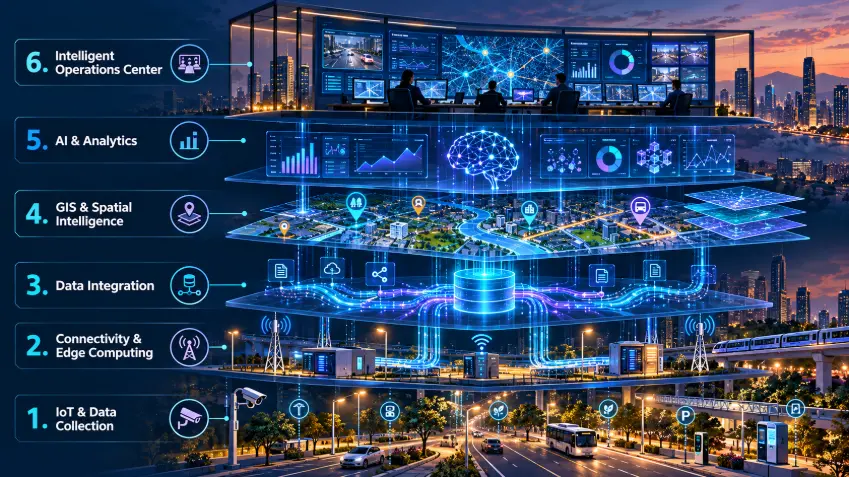
1. IoT and Data Collection Layer
This layer connects the physical city to digital infrastructure.
Examples include environmental sensors measuring air pollution and water conditions, connected streetlights, traffic cameras, energy meters, and other infrastructure devices.
Data quality, device identity, maintenance, and connectivity are essential considerations.
2. Connectivity and Edge Computing Layer
Data travels through communication networks such as fiber, cellular connectivity, or specialized IoT networks.
Edge computing can process selected information closer to the source.
For example, a traffic camera may analyze video locally and send traffic counts or authorized event alerts rather than transmitting all raw footage.
This can reduce bandwidth demand and support time-sensitive processing.
3. Data Integration Layer
Different urban systems frequently use different formats, identifiers, and communication protocols.
A data integration layer helps normalize incoming information and connect it to relevant assets and operational workflows.
APIs, event streams, data pipelines, and common identifiers help improve interoperability.
4. GIS and Spatial Intelligence Layer
GIS provides geographic context.
It enables city operators to understand not only what is happening, but where it is happening.
For example, instead of receiving an isolated flood-risk alert, an operator could identify the affected area and inspect nearby infrastructure or services.
5. AI and Analytics Layer
AI and analytics help identify patterns, detect anomalies, and support forecasting.
Possible applications include traffic congestion analysis, environmental incident detection, and infrastructure condition monitoring.
AI results require appropriate validation and operational controls, particularly when they influence public services or safety-related decisions.
6. Intelligent Operations Center Layer
The Intelligent Operations Center provides a coordinated operational view.
It may combine maps, dashboards, notifications, historical data, incident tracking, and reporting.
An IOC can support cooperation between different agencies and teams, helping them prioritize and respond to events.
How These Technologies Work Together
Consider an example involving urban flooding.
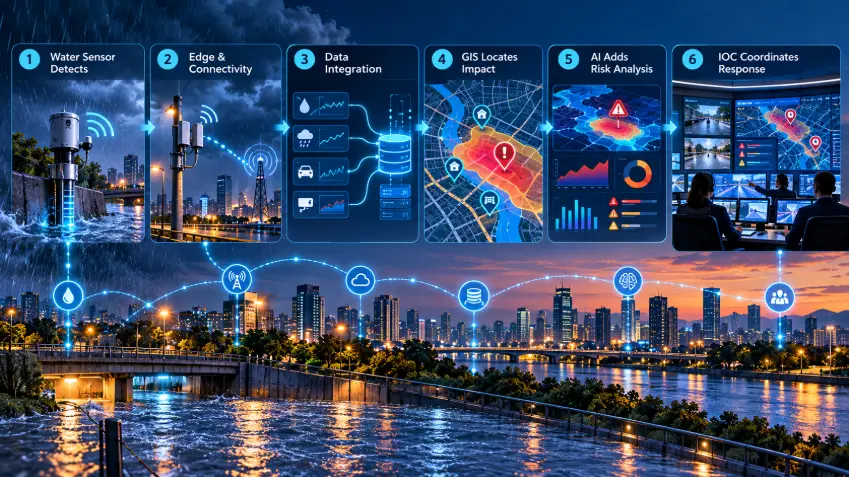
An IoT monitoring system detects a rising water level in a drainage area. The system validates the measurement and identifies whether a configured threshold has been exceeded.
A GIS platform displays the affected location and associated infrastructure.
Analytical services may add rainfall information, historical patterns, or risk indicators.
An IOC dashboard then presents the alert to authorized operators, who can evaluate the situation and coordinate a response.
This demonstrates an important principle:
The value of a Smart City comes from connecting observations to informed operational action.
What Are the Benefits of Integrated Smart City Architecture?
Centralized Operational Visibility
Teams can monitor multiple urban systems using a coordinated set of applications rather than switching between disconnected platforms.
Better Decision Support
Real-time information combined with geographic context can help operators understand incidents and allocate resources.
Flexible Expansion
Modular architecture allows organizations to begin with high-priority services and introduce additional functionality over time.
More Effective Data Management
Shared integration methods can reduce duplicated processes and support consistent data governance.
Improved Urban Services
When operational workflows are well designed, digital systems can help agencies coordinate maintenance, incident management, and citizen-facing services.
Key Challenges in Smart City Integration
Interoperability
Legacy systems may use proprietary technologies or inconsistent data formats.
Cybersecurity
Connected urban infrastructure introduces risks involving device access, networks, APIs, and operational platforms.
Data Governance
Organizations need defined responsibilities for data ownership, access, retention, sharing, and quality.
Long-Term Maintenance
Smart City platforms require ongoing updates, monitoring, infrastructure maintenance, and technical support.
Organizational Coordination
Technology alone cannot resolve unclear responsibilities between departments.
Operating procedures and governance models must evolve alongside the platform.
How BHSoft Approaches Smart City Integration
BHSoft's Smart City solution brings together IoT, AI/computer vision, Big Data, GIS, Cloud/Edge computing, and IOC capabilities in one integrated platform.
Its modular structure supports several urban management areas, including environmental monitoring, security, citizen services, smart lighting, traffic management, and public information stations.
The architecture is designed to support deployment across different urban environments, including cities, residential developments, industrial parks, and mixed-use complexes.
Rather than requiring every capability to be deployed at once, modular implementation allows organizations to prioritize operational needs.
Frequently Asked Questions
What are the main components of Smart City architecture?
Common components include IoT sensors, connectivity networks, data integration, cloud or edge infrastructure, GIS, analytical services, operational dashboards, and security controls.
What is the role of GIS in a Smart City?
GIS provides location-based visualization and spatial analysis. It helps operators associate incidents, assets, and service information with specific geographic areas.
Why does a Smart City need an IOC?
An IOC can consolidate information from multiple systems and provide a coordinated interface for monitoring, reporting, and incident management.
Can Smart City platforms integrate with existing systems?
Yes, when compatible interfaces, integration methods, and data-access arrangements are available. Legacy integration requirements should be assessed early.
Conclusion
Effective Smart City architecture is not defined by the number of connected devices or dashboards.
Its success depends on how reliably data, technology, people, and operational processes work together.
By integrating IoT, AI, GIS, and an Intelligent Operations Center, cities and infrastructure operators can establish a stronger digital foundation for coordinated urban management.
Ready to Explore an AI-Powered IoT Solution?
Whether you're building a connected product, modernizing an industrial system, or adding AI capabilities to an existing IoT platform, the right architecture matters.
Explore the BHSoft Smart City solution: https://bhsoft.vn/smartcity
Connect with BHSoft to discuss your IoT development requirements, Edge AI integration opportunities, and scalable software architecture.