Intelligent Operations Center (IOC): The Brain of a Smart City
15 minutes read
October 20, 2026
Intelligent Operations Center (IOC): The Brain of a Smart City
Modern cities generate large amounts of operational information every day.
Traffic cameras monitor roads, environmental sensors measure air quality, connected devices report infrastructure conditions, and public service systems record citizen requests.
However, when this information remains separated across departments, it becomes difficult to coordinate responses or understand the complete operational situation.
An Intelligent Operations Center (IOC) helps address that challenge.
By bringing information from different systems into a coordinated environment, an IOC can support urban monitoring, incident management, reporting, and data-driven decisions.
What Is an Intelligent Operations Center?
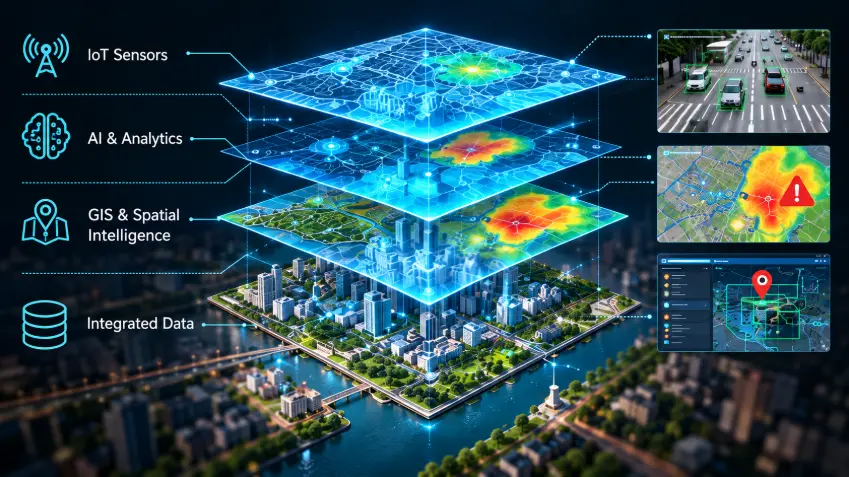
An Intelligent Operations Center is a centralized or coordinated digital environment used to monitor, analyze, and support the management of multiple operational systems.
Within a Smart City, an IOC can connect information from public infrastructure, IoT networks, GIS platforms, video systems, and administrative services.
An IOC is more than a collection of dashboards. Its value depends on the operational processes it supports.
Effective systems help authorized personnel understand conditions, investigate issues, communicate with relevant teams, and track responses.
How Does an IOC Work?
An IOC typically follows a connected operational process.
Step 1: Collect Data
Information arrives from cameras, IoT sensors, geographic databases, and administrative applications.
Step 2: Integrate Information
Backend services transform and organize data so that it can be interpreted across different systems.
Step 3: Analyze Conditions
Rules, analytics, and AI models help identify important events and patterns.
For instance, unusually high pollution readings may trigger investigation, subject to sensor validation and defined thresholds.
Step 4: Visualize Information
An operational dashboard displays indicators, events, historical trends, and geographic information.
GIS can show where incidents are occurring and which assets may be involved.
Step 5: Coordinate Responses
Authorized personnel can review incidents, assign responsibilities, and track actions.
The system can provide relevant information, but human judgment remains important in consequential operational decisions.
Five Important IOC Capabilities
1. Multi-System Monitoring
An IOC can provide a coordinated view of environmental conditions, infrastructure, public services, and other operational domains.
This reduces the need for operators to consult multiple disconnected interfaces.
2. GIS-Based Incident Visualization
Geographic maps allow operators to locate incidents, inspect nearby assets, and understand geographic relationships.
Location information can be particularly useful for coordinating field teams.
3. AI-Assisted Event Analysis
Computer vision and other AI techniques can support the analysis of video, sensor, or operational data.
Model accuracy, authorized usage, and appropriate safeguards are necessary.
4. Alerts and Operational Workflows
An IOC may generate alerts based on configured thresholds or detected events.
Operational workflows should define who receives an alert, how it is verified, and what actions follow.
5. Analytics and Reporting
Historical records can help teams evaluate recurring incidents, response performance, infrastructure conditions, and service quality.
IOC Use Cases Across Smart City Operations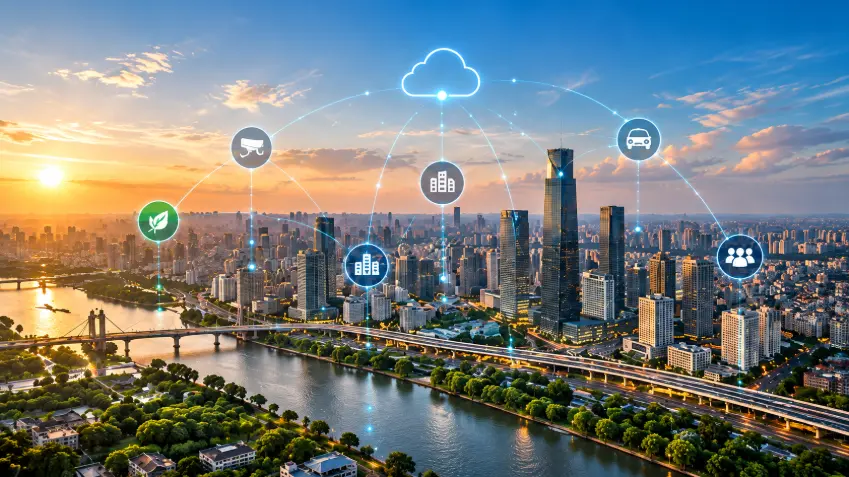
Environmental monitoring: Display air quality, noise, water conditions, and other sensor readings in one operational interface.
Urban security: Consolidate authorized security feeds, AI-assisted alerts, and incident information.
Traffic management: Monitor selected traffic indicators, congestion events, and road-network conditions.
Energy management: View connected lighting infrastructure, equipment status, and energy usage.
Public services: Track citizen-submitted issues and service requests through defined response workflows.
Industrial park operations: Coordinate utilities, environmental monitoring, security, and infrastructure maintenance across a defined geographic area.
What Is the Difference Between an IOC and a Traditional Monitoring Center?
A traditional monitoring center may focus on a single operational domain, such as surveillance or infrastructure status.
An IOC aims to provide a broader, integrated operational perspective.
However, integration alone does not guarantee better outcomes.
An effective IOC needs reliable data, defined responsibilities, suitable workflows, and regular performance evaluation.
Challenges of Implementing an IOC
Integrating Legacy Systems
Existing cameras, sensors, databases, and software applications may use different interfaces and protocols.
Managing Large Data Volumes
Video, sensor streams, and historical records can place significant demands on infrastructure.
Avoiding Alert Overload
Excessive or inaccurate alerts may reduce operational effectiveness.
Alert thresholds, prioritization, and workflows should be tested and refined.
Protecting Sensitive Information
Security feeds, infrastructure data, and citizen records require carefully managed access, retention, and protection.
Supporting Continuous Operations
Operational centers may require dependable availability, monitoring, incident recovery, and maintenance.
How to Implement an IOC Successfully
A practical implementation approach includes:
- Identify high-priority urban operations and challenges.
- Review available systems and data sources.
- Define operational workflows and responsibilities.
- Design a secure, scalable integration architecture.
- Develop a focused dashboard and incident management pilot.
- Test actual operational scenarios.
- Evaluate results using measurable indicators.
- Expand progressively to other departments and services.
Useful performance indicators may include incident acknowledgment time, data availability, alert accuracy, and workflow completion time.
The Role of BHSoft's Smart City Platform
BHSoft positions its IOC capability as part of a broader Smart City platform that integrates IoT, AI, GIS, Big Data, and Cloud/Edge computing.
The solution brings urban monitoring functions together with modular applications for environmental monitoring, security, traffic, lighting, citizen services, and public information.
This approach is relevant for organizations seeking a unified operational environment rather than multiple isolated technology deployments.
Frequently Asked Questions
What does IOC stand for in Smart City technology?
IOC stands for Intelligent Operations Center, a coordinated environment for monitoring and managing operational information from multiple urban systems.
Is an IOC the same as a GIS dashboard?
No. A GIS dashboard primarily presents geographic information. An IOC may incorporate GIS alongside analytics, alerts, incident workflows, and other operational capabilities.
Does an IOC require AI?
Not necessarily. An IOC can operate with conventional data processing and monitoring tools. AI can add capabilities such as anomaly detection and automated analysis.
Can an IOC support industrial parks?
Yes. An IOC architecture can be adapted to industrial parks, urban developments, campuses, and other infrastructure environments.
Conclusion
An Intelligent Operations Center can become an important coordination layer for modern urban infrastructure.
By connecting real-time information, geographic context, analytical capabilities, and operational workflows, an IOC can help organizations understand conditions and respond more effectively.
The most important design principle is to connect technology with practical operational needs.
Ready to Explore an AI-Powered IoT Solution?
Whether you're building a connected product, modernizing an industrial system, or adding AI capabilities to an existing IoT platform, the right architecture matters.
Explore the BHSoft Smart City solution: https://bhsoft.vn/smartcity
Connect with BHSoft to discuss your IoT development requirements, Edge AI integration opportunities, and scalable software architecture.