AI Agents vs. Traditional Automation: What's the Difference?
10 minutes read
Sep 07, 2026
Automation has been part of enterprise software for decades.
Businesses use scheduled jobs, workflow engines, scripts, RPA bots, and integration platforms to automate repetitive processes and reduce manual work. These technologies remain highly effective. But a new category of software is changing what can be automated: AI agents.
Unlike traditional automation, which generally follows predefined rules and execution paths, AI agents can interpret context, make decisions, use tools, and adapt their actions based on what they discover during a task. This creates an important question for enterprises:
Should we use traditional automation, AI agents, or a combination of both?
The answer is rarely "AI agents replace automation."
In many enterprise environments, the strongest architecture combines the predictability of traditional automation with the flexibility of AI.
Understanding where each approach fits is therefore an important part of AI Engineering.
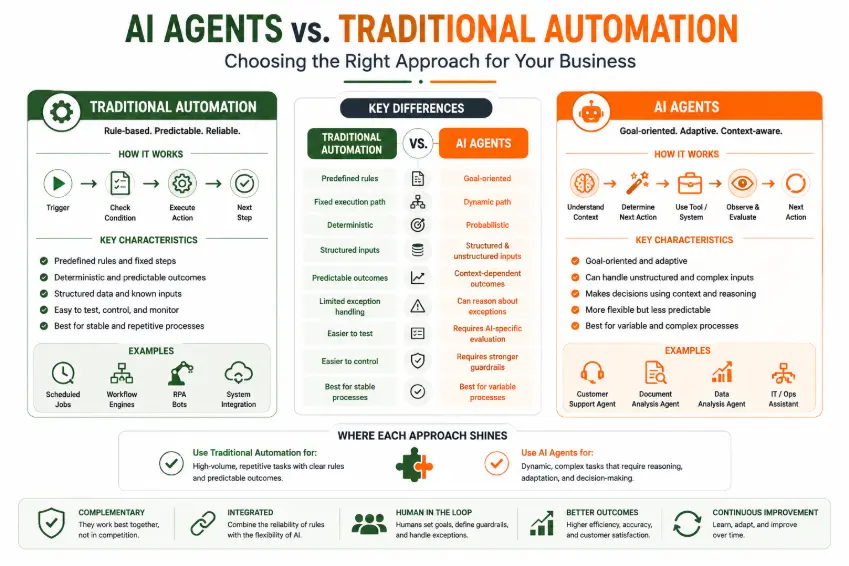
Traditional Automation: Reliable, Predictable, and Rule-Based
Traditional automation works by defining the process in advance.
A developer or business analyst specifies:
- What triggers the process.
- What conditions need to be checked.
- What actions should be performed.
- What happens when a condition is met.
- What happens when an error occurs.
A simplified workflow might look like this: Trigger ⟶ Check Condition ⟶ Execute Action ⟶ Check Result ⟶ Next Step
For example: New Customer Created ⟶ Check Customer Type ⟶ IF Enterprise ⟶ Assign Enterprise Sales Team ⟶ Send Notification
The system does not need to determine what to do. The rules have already been defined.
This makes traditional automation highly predictable and well suited to processes where the inputs, rules, and expected outcomes are clearly understood.
What Is an AI Agent?
An AI agent approaches a task differently.
Instead of defining every possible step in advance, the system receives an objective, evaluates the available context, determines what actions may be required, and uses available tools to work toward the objective.
A simplified AI agent loop looks like this: Goal ⟶ Understand Context ⟶ Determine Next Action ⟶ Use Tool / System ⟶ Observe Result ⟶ Evaluate ⟶ Next Action
For example, imagine a customer sends: "I was charged twice for my subscription this month. Can you check what happened and help me resolve it?"
- A traditional workflow would require predefined rules for every possible variation. An AI agent could instead:
- Understand the customer's request.
- Identify the relevant customer.
- Retrieve subscription information.
- Check transaction history.
- Compare the transactions.
- Determine whether a duplicate charge occurred.
- Follow the appropriate business policy.
- Initiate or recommend the next action.
- Escalate to a human when required.
The agent is not simply executing one predefined sequence. It is interpreting the situation and determining the next step within defined boundaries.
The Fundamental Difference: Rules vs. Decisions
The simplest way to understand the difference is: Traditional automation executes predefined instructions. AI agents determine how to accomplish a goal based on context.
This difference affects almost everything else.
| Traditional Automation | AI Agents |
|---|---|
| Predefined rules | Goal-oriented instructions |
| Fixed execution paths | Dynamic execution paths |
| Deterministic | Probabilistic |
| Structured inputs | Can handle unstructured inputs |
| Predictable outcomes | Context-dependent outcomes |
| Limited exception handling | Can reason about exceptions |
| Easier to test | Requires AI-specific evaluation |
| Easier to control | Requires stronger guardrails |
| Best for stable processes | Best for variable processes |
Traditional automation is not "old technology" that AI agents need to replace. It is a different engineering approach designed for a different class of problems.
When Traditional Automation Is the Better Choice
There is a tendency to assume that AI should be introduced into every new automation project. That is not good engineering.
If a process is predictable and can be expressed clearly using business rules, traditional automation may be the better solution.
Typical examples include:
Scheduled Reports
Every Monday at 08:00 ⟶ Generate Report ⟶ Send Email
There is no reason to introduce an AI agent simply to determine that Monday comes after Sunday.
Rule-Based Lead Routing
IF Country = Vietnam → Assign Vietnam Sales Team
IF Country = Japan → Assign Japan Sales Team
When the routing rules are clear, deterministic automation provides predictable behavior.
Payroll Calculations
Payroll often contains strict rules, formulas, approval requirements, and regulatory constraints.
Deterministic systems are generally more appropriate for calculations where exact and repeatable results are required.
Data Synchronization
For example: CRM Contact Updated ⟶ Update Internal Database
If the mapping is known and deterministic, a traditional integration workflow can perform this task efficiently.
System Notifications
Invoice Approved ⟶ Send Notification
Again, there is no need for an AI agent to make a decision that has already been defined by the business.
When AI Agents Add Value
AI agents become more useful when the process involves ambiguity, unstructured information, exceptions, or decisions that cannot easily be expressed as fixed rules. For example:
- Understanding customer emails.
- Summarizing documents.
- Classifying complex requests.
- Investigating incidents.
- Analyzing unstructured feedback.
- Researching information across multiple systems.
- Determining which workflow should be followed.
- Handling exceptions in otherwise automated processes.
Consider customer support: A traditional automation system might route tickets based on predefined keywords.
- "Invoice" = Finance
- "Password" = IT Support
- "Sales" = Sales Team
An AI agent can potentially interpret a much more complicated request: "I can't log into the portal, and I also noticed that the invoice for our latest renewal seems to contain the wrong number of licenses."
This request involves multiple issues. The system may need to:
- Understand the customer's intent.
- Identify multiple problems.
- Retrieve account information.
- Determine which systems to query.
- Decide which issue should be handled first.
- Escalate part of the request to the appropriate team.
This is where AI agents can provide capabilities beyond simple rule-based routing.
AI Agents and Unstructured Data
One of the strongest use cases for AI agents is working with information that does not fit neatly into predefined fields.
Enterprise information is often distributed across:
- Emails
- PDFs
- Contracts
- Support conversations
- Meeting notes
- Documents
- Chat messages
- Knowledge bases
Traditional automation can process structured data extremely well. But processing unstructured information often requires additional rules, parsers, templates, and exception handling.
AI systems can interpret natural language and other unstructured inputs, making them useful when the information itself is variable.
For example: Customer Email ⟶ AI Agent ⟶ Understand Intent ⟶ Retrieve Customer Data ⟶ Determine Next Action ⟶ CRM / ERP / Ticketing System
This does not mean the AI should have unrestricted access to every system. The agent should operate within clearly defined tools, permissions, policies, and guardrails.
AI Agents Do Not Mean Unlimited Autonomy
The word "agent" can create the impression that an AI system should operate independently without human involvement. That is not necessarily the right enterprise model.
A production AI agent should have clearly defined:
- Goals
- Permissions
- Available tools
- Business rules
- Data access
- Approval requirements
- Escalation conditions
- Monitoring
- Audit logging
For example, an AI agent might be allowed to automatically:
- Read customer information.
- Search documentation.
- Draft responses.
- Categorize support tickets.
But it may need human approval before:
- Issuing a large refund.
- Changing contractual information.
- Deleting customer data.
- Approving financial transactions.
- Modifying production infrastructure.
The appropriate level of autonomy depends on the business risk. Recent enterprise discussions around agentic workflows increasingly emphasize human checkpoints for high-risk decisions and actions.
AI Agents vs. Automation: A Practical Comparison
The choice becomes clearer when we compare the characteristics of each approach.
| Factor | Traditional Automation | AI Agent |
|---|---|---|
| Process | Predictable | Variable |
| Logic | Predefined | Dynamically determined |
| Input | Mostly structured | Structured + unstructured |
| Exceptions | Explicitly programmed | Can interpret and respond |
| Decision-making | Rule-based | Context-based |
| Execution | Fixed workflow | Dynamic workflow |
| Testing | Conventional testing | Conventional + AI evaluation |
| Cost predictability | Usually high | Can vary with model usage |
| Explainability | Generally straightforward | Requires additional controls |
| Governance | Established | Requires AI-specific controls |
| Best use case | Repetition | Judgment and adaptation |
The important point is not that one column is better. The important point is matching the architecture to the problem.
The Hybrid Approach: Where AI and Automation Work Together
In real enterprise environments, the best solution is often not AI versus automation. It is: AI + Automation.
Consider a purchase invoice workflow. A traditional automation system might already handle: Invoice Approved ⟶ Create ERP Record ⟶ Update Accounting System ⟶ Send Notification
This is predictable and should remain deterministic.
But what happens when invoices arrive as PDFs with different layouts? An AI component could be introduced at the beginning: Invoice PDF ⟶ AI Document Understanding ⟶ Extract Information ⟶ Validate Data ⟶ Traditional Workflow ⟶ ERP ⟶ Accounting
Here, AI handles the ambiguous part. Traditional automation handles the deterministic part.
This hybrid architecture can provide a strong balance between flexibility and reliability.
AI Agents as the Decision Layer
Another useful architecture is to treat the AI agent as a reasoning or orchestration layer above existing systems.
For example:
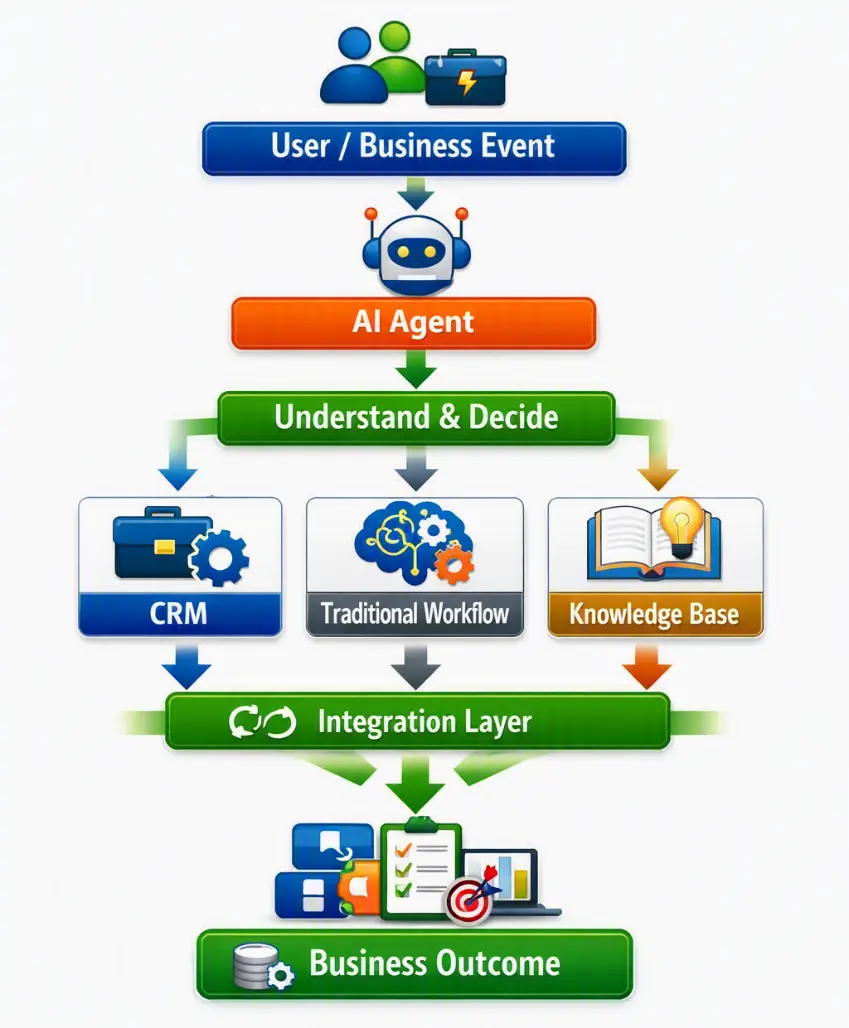
The agent does not need to replace the existing systems. Instead, it can determine: "What needs to happen next?" The existing systems can continue to execute the operations they are already good at.
This is particularly relevant for enterprises that have already invested heavily in ERP, CRM, workflow, and integration infrastructure.
What About Agentic AI?
AI agents and agentic AI are related but not always identical concepts.
- An AI agent may perform a specific goal-oriented task.
- Agentic AI generally refers to systems with greater autonomy across multi-step processes, where AI can plan, coordinate actions, use multiple tools, and adapt as the workflow progresses.
For example:
| AI Agent | More Agentic Workflow |
|---|---|
Analyze Customer Request ↓ Classify Request ↓ Return Result | Customer Request ↓ Understand Objective ↓ Search Customer Data ↓ Analyze Situation ↓ Determine Required Actions ↓ Call Multiple Systems ↓ Check Results ↓ Escalate if Necessary ↓ Complete Task |
As autonomy increases, so do the engineering requirements. This includes stronger:
- Access controls
- Observability
- Evaluation
- Error handling
- Human oversight
- Auditability
Common Mistakes We See
1. Using AI Because It Is New
Not every workflow needs AI. If a simple rule can solve the problem reliably, adding an AI agent may increase complexity without creating meaningful value.
2. Trying to Replace Existing Automation
Enterprises may already have years of investment in workflow engines, APIs, RPA, integration platforms, and business applications. Replacing everything with AI is rarely necessary. In many cases, AI should work with existing automation rather than replace it.
3. Giving Agents Too Much Access
An AI agent that can read data is very different from an AI agent that can modify production systems. Permissions should be limited to the minimum tools and actions required for the task.
4. Ignoring the Cost of Non-Determinism
Traditional automation usually follows the same path every time. AI agents may take different paths depending on context. That changes how teams need to approach:
- Testing
- Debugging
- Monitoring
- Cost management
- Reliability
5. Automating the Wrong Process
AI cannot fix a fundamentally broken business process. Before introducing an AI agent, organizations should understand:
- What the current process is.
- Where the bottlenecks are.
- Which decisions require human judgment.
- Which steps are already deterministic.
- What outcome the business actually wants.
A Simple Decision Framework
Before choosing between traditional automation and an AI agent, ask five questions.
Question 1: Can the process be completely described with rules?
- Yes → Traditional automation may be sufficient.
- No → Consider AI.
Question 2: Are the inputs highly structured?
- Yes → Traditional automation is often effective.
- No → AI may help interpret unstructured information.
Question 3: Does the process require judgment?
- No → Traditional automation may be preferable.
- Yes → An AI agent may add value.
Question 4: Does the process require multiple dynamic steps?
- No → A conventional workflow may be enough.
- Yes → Consider an AI agent or agentic workflow.
Question 5: Can the AI safely perform the required actions?
If the answer is no, the system may need:
- Human approval.
- More restricted permissions.
- Additional validation.
- A hybrid architecture.
A Better Enterprise Architecture: Deterministic Where Possible, Intelligent Where Necessary
The goal of AI Engineering is not to maximize the amount of AI in a system. The goal is to build the right system.
A well-designed enterprise workflow might therefore look like:
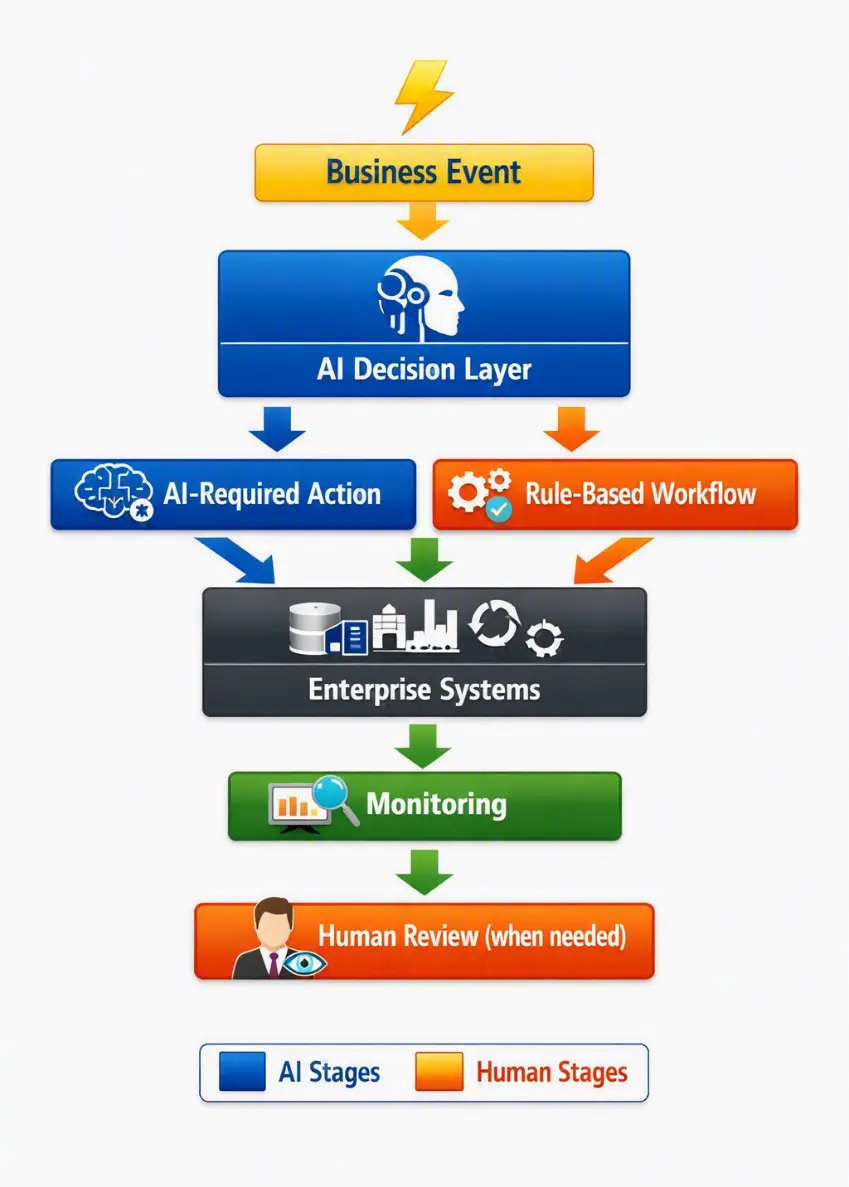
This architecture recognizes the strengths of both approaches.
- AI handles ambiguity.
- Automation handles predictability.
Software engineering connects everything together.
How BHSoft Approaches AI Agents and Automation
At BHSoft, we see AI agents as part of a broader AI Engineering approach—not as a replacement for software engineering or traditional automation.
Our focus is on identifying where AI genuinely adds value within an existing software ecosystem. That may mean:
- Adding an AI layer to an existing workflow.
- Connecting an AI agent with enterprise APIs.
- Using AI to process unstructured business information.
- Combining AI decision-making with deterministic workflows.
- Introducing human approval at critical points.
- Integrating AI capabilities into existing CRM, ERP, or business applications.
The objective is not to make every workflow autonomous. It is to make the overall system more capable, more efficient, and better aligned with the way the business actually operates.
We don't start with "Where can we put an AI agent?".
We start with "Where can AI create meaningful value, and what is the right engineering architecture to deliver it reliably?".
Conclusion
AI agents and traditional automation are not competing technologies. They solve different types of problems:
- Traditional automation is strongest when processes are predictable, structured, and governed by clearly defined rules.
- AI agents become valuable when processes involve ambiguity, unstructured information, contextual reasoning, exceptions, or dynamic decision-making.
And in many enterprise environments, the best answer is a hybrid approach:
- Use AI where judgment and adaptability are required.
- Use traditional automation where deterministic execution is the better engineering choice.
Connect both through strong software architecture, security, integration, monitoring, and governance.
Looking for an AI Engineering Partner?
BHSoft combines software engineering expertise with AI capabilities to help organizations move from AI experiments and prototypes to practical, production-ready solutions.
Whether you are exploring AI integration, building an AI-powered product, developing intelligent automation, or connecting AI with your existing enterprise systems, our team can help you design and build the right solution.
👉 Build smarter. Engineer AI for real-world impact. Contact BHSOFT today to discuss your project