Home > Insight > IT Business
Why Enterprise HubSpot Integration Is More Than Connecting APIs
5 minutes read
Aug 06, 2026
New to our Enterprise HubSpot Integration series?
We recommend starting with our first article, Enterprise HubSpot Integration: Connecting CRM, Marketing Automation, CMS, and Business Systems, where we explore the foundations of building a connected HubSpot ecosystem before diving into implementation strategies.
When businesses begin adopting HubSpot, one of the first questions they ask is, "How do we integrate it with our existing systems?"
The answer often starts with APIs. HubSpot provides comprehensive APIs that allow developers to create, update, and synchronize data with external applications. A quick online search returns countless tutorials showing how to authenticate, call endpoints, or synchronize Contacts between two systems. Those tutorials are technically correct.
But after working on enterprise HubSpot implementation projects, we've learned that APIs are rarely the most challenging part of the journey. The real challenge begins after the first successful API call.
- How do you ensure customer information stays consistent across multiple systems?
- Which platform should own each piece of data?
- What happens when marketing updates a Contact in HubSpot while the sales team updates the same record in an internal CRM?
- How do you prevent duplicate records, synchronization loops, or conflicting business logic?
These questions cannot be answered by APIs alone.
At BHSoft, we've helped organizations integrate HubSpot into technology ecosystems that already include internal CRM platforms, ERP systems, custom business applications, websites, and marketing tools. Every organization operates differently, but they all share one common objective: transforming HubSpot into an integrated part of their business ecosystem rather than another isolated application.
That is why we believe successful HubSpot integration begins with architecture, not APIs.
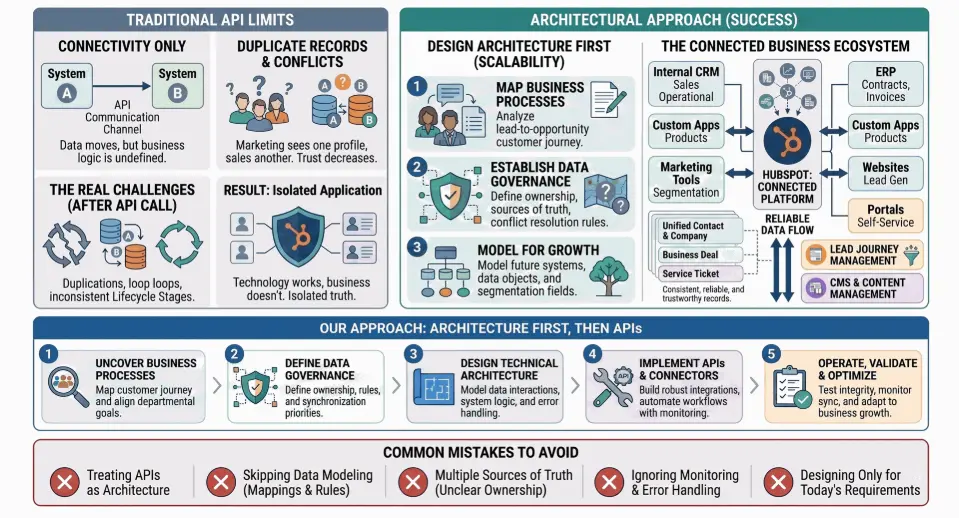
APIs Connect Systems. Architecture Connects Businesses.
An API is simply a communication channel. It enables one application to exchange information with another, but it does not determine how information should flow across an organization.
Imagine an enterprise environment where multiple systems support different departments.
- An internal CRM manages operational customer information.
- HubSpot supports marketing and sales activities.
- The company website generates new leads.
- An ERP manages contracts and invoices.
- Business intelligence platforms analyze performance across every department.
Each platform serves a different purpose, but all of them rely on customer data. Without a clear integration strategy, each system gradually develops its own version of the truth.
- Marketing sees one customer profile.
- Sales sees another.
- Customer support works with outdated information.
- Management struggles to trust reports because different systems produce different numbers.
The technology works. The business doesn't.
This is why enterprise integration is fundamentally different from simply connecting two APIs.
The objective isn't just to exchange information - it is to ensure every department operates from consistent, reliable, and trustworthy data.
The Real Challenges Start After Integration
Many integration projects begin with a simple requirement: Synchronize Contacts from our CRM into HubSpot.
From a technical perspective, this sounds straightforward.
- A developer builds the integration.
- Data starts flowing.
- The project appears complete.
Then the business grows.
- Marketing wants to synchronize Lifecycle Stages.
- Sales needs Deal information updated automatically.
- Customer support begins storing additional customer attributes.
- The website starts generating new Leads through HubSpot Forms.
- Finance requests campaign attribution for revenue reporting.
What was once a simple Contact synchronization project gradually evolves into a complex business integration involving multiple departments and multiple systems.
The APIs haven't changed. The business has.
This is one of the most common situations we encounter when organizations ask us to review or improve an existing HubSpot implementation. The integration itself works. The architecture no longer supports the business.
Enterprise Integration Is Really About Business Processes
One of the biggest misconceptions surrounding HubSpot integration is that data simply needs to move from one system to another. In reality, data exists to support business processes.
Consider a typical customer journey.
- A visitor downloads a whitepaper from the company's website.
- HubSpot captures the submission through a form.
- The visitor immediately enters a marketing automation workflow.
- Sales receives a notification after the Lead reaches a predefined score.
- A salesperson schedules a meeting and updates the opportunity.
- Additional operational information is entered into the company's internal CRM.
- Eventually, finance generates a quotation and later an invoice within the ERP system.
Throughout this journey, customer information passes through several platforms. Each department depends on accurate information to perform its role effectively. If synchronization fails at any stage, downstream processes become less reliable.
- Marketing campaigns target outdated audiences.
- Sales contacts the wrong customer.
- Reports become inconsistent.
- Decision-making becomes slower.
From our experience, successful integration projects focus first on understanding these business processes before discussing technology.
Once the business flow is clearly defined, the technical implementation becomes significantly easier.
Data Governance Is More Important Than Most Organizations Expect
Technology alone cannot maintain high-quality enterprise data. Every successful HubSpot implementation also requires strong governance.
One of the first questions we ask during implementation workshops is surprisingly simple: Who owns the data?
For example:
- Should Contact information be maintained in HubSpot or the internal CRM?
- Which system controls Lifecycle Stage?
- Can both systems update Company information?
- Which application becomes the source of truth for customer records?
- How should conflicting updates be resolved?
Without clear ownership rules, synchronization quickly becomes unpredictable.
- A Contact updated in HubSpot might immediately be overwritten by the CRM.
- Marketing may segment audiences using outdated information.
- Duplicate records begin appearing across multiple systems.
These problems are rarely technical failures. They are governance failures.
Defining ownership, synchronization priorities, validation rules, and change management processes early helps organizations avoid significant operational issues later.
Designing for Growth Instead of Today's Requirements
Another common mistake is designing integrations solely around current business needs.
A project may initially require synchronizing only Contacts. Six months later, the business expands.
- Marketing introduces additional segmentation fields.
- Sales adopts new qualification criteria.
- The organization launches another website.
- A second CRM is introduced after an acquisition.
Suddenly, the original integration must support requirements that were never considered during the initial design.
At BHSoft, we encourage clients to think beyond immediate project requirements.
A scalable integration architecture should make it easier, not harder to introduce new workflows, new business systems, and additional data objects as the organization grows.
Planning for change from the beginning significantly reduces future implementation costs and minimizes disruption to business operations.
Lessons from the Field
Across different HubSpot implementation projects, one lesson consistently stands out.
The most successful projects rarely begin with technical discussions. Instead, they begin with conversations about business operations.
We spend time understanding how marketing generates leads, how sales manages opportunities, how customer support interacts with clients, and how operational teams maintain customer information.
Only after those processes are clearly understood do we begin designing the technical architecture.
This approach often uncovers inconsistencies that existed long before HubSpot entered the picture.
- Different departments may define customers differently.
- Systems may use different identifiers.
- Business rules may vary depending on where information originated.
HubSpot doesn't create these challenges. It simply brings them into focus.
Once organizations establish a shared understanding of their business processes, the technology becomes much easier to implement.
Common Mistakes We See
While every implementation is unique, several patterns appear repeatedly across enterprise projects.
Treating APIs as the architecture
APIs are only one component of a successful integration strategy. Without governance and business process design, API integrations become increasingly difficult to maintain.
Skipping data modeling
Beginning development before defining the business data model often leads to inconsistent mappings and unnecessary rework.
Multiple sources of truth
Allowing several systems to update the same information without clear ownership creates synchronization conflicts that become increasingly difficult to resolve.
Ignoring monitoring and error handling
Every integration experiences failures at some point. Organizations should plan for retries, logging, notifications, and recovery rather than assuming synchronization will always succeed.
Designing only for current requirements
Enterprise systems evolve continuously. Integration architecture should support future business growth rather than only today's workflows.
Avoiding these mistakes early often saves organizations months of redevelopment as their HubSpot implementation expands.
Conclusion
At BHSoft, we help organizations integrate HubSpot into complex business environments where CRM, websites, marketing automation, and enterprise systems must operate as one connected ecosystem.
Our approach goes beyond API development. We focus on designing scalable integration architectures, establishing reliable data governance, and building solutions that support long-term business growth.
Looking for an Enterprise HubSpot Partner? Contact BHSOFT today to discuss your project!