Home > Insight > IT Business
5 minutes read
Aug 03, 2026
Enterprise HubSpot Integration: Connecting CRM, Marketing Automation, CMS, and Business Systems
For many organizations, adopting HubSpot begins with a clear objective: improve marketing performance, generate more qualified leads, and strengthen customer relationships.
But as businesses grow, another challenge quickly emerges. HubSpot is no longer the only system involved in customer operations.
Sales teams rely on internal CRM platforms. Marketing teams manage campaigns through HubSpot. Customer support may work in another platform. Finance operates inside an ERP system. Product data often resides in custom applications, while websites and customer portals continuously generate new information.
Without a well-designed integration strategy, every system gradually becomes its own source of truth.
The result isn't a lack of data - it is too much disconnected data.
At BHSoft, we've worked with organizations that already had mature business systems long before adopting HubSpot. Rather than replacing those systems, the objective was to integrate HubSpot into an existing technology ecosystem while allowing every platform to continue performing the role it was designed for.
Over the years, one lesson has remained remarkably consistent:
Successful HubSpot implementation is rarely about HubSpot alone. It is about designing an ecosystem where data flows seamlessly across the entire business.
This article introduces that ecosystem and the key components we believe every enterprise should consider before beginning a HubSpot implementation.
Why Enterprise HubSpot Projects Are Different
Many online tutorials demonstrate how to connect HubSpot to another application using an API.
While these examples are useful, enterprise projects are fundamentally different.
Instead of connecting two isolated applications, organizations often need to coordinate data across multiple platforms simultaneously.
A typical enterprise environment may include:
- An internal CRM managing operational customer data
- ERP or accounting systems
- Marketing automation through HubSpot
- Corporate websites and landing pages
- Customer portals
- Authentication platforms
- Business intelligence dashboards
- Third-party SaaS applications
Each system serves a different purpose. The challenge is ensuring they all operate from consistent, reliable information.
Adding another disconnected platform only increases operational complexity.
For this reason, our implementation approach always begins by understanding how information should move throughout the organization rather than focusing immediately on APIs.
The Four Foundations of Enterprise HubSpot Integration
Across multiple implementation projects, we've found that successful HubSpot ecosystems are typically built around four interconnected capabilities.
These foundations work together to transform HubSpot from a standalone CRM into an integrated business platform.
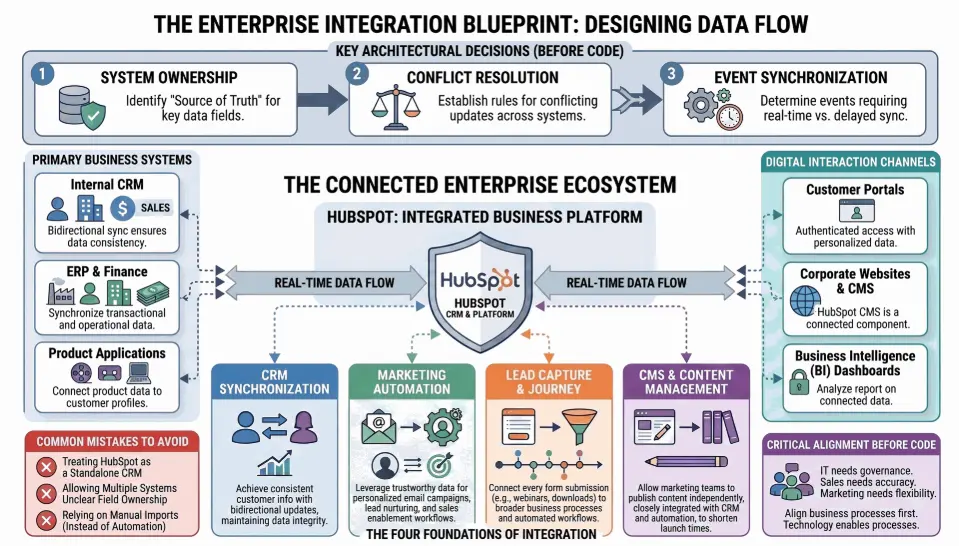
1. CRM Synchronization
The first priority is ensuring customer information remains consistent across systems.
Contacts may be updated by customer support.
Sales representatives may edit records inside HubSpot.
Marketing teams continuously enrich customer profiles through campaigns and website interactions.
Without synchronization, every department gradually begins working from different information.
Our projects typically establish bidirectional synchronization between internal CRM systems and HubSpot, allowing updates to move reliably in both directions while maintaining data integrity.
Rather than relying on scheduled imports, we favor architectures that synchronize important business events as they occur, reducing delays and minimizing manual intervention.
2. Marketing Automation
Once reliable data is available, organizations can begin transforming information into meaningful customer engagement.
HubSpot provides powerful automation capabilities, but automation is only effective when it operates on trustworthy data.
This includes:
- Personalized email campaigns
- Customer segmentation
- Lifecycle management
- Lead nurturing
- Automated notifications
- Sales enablement workflows
Instead of requiring developers to launch every campaign, marketing teams can independently manage much of their daily activity while remaining connected to enterprise data.
Automation becomes significantly more valuable when customer information remains synchronized across every business system.
3. Lead Capture and Customer Journey Management
For many organizations, the customer journey begins long before a sales conversation.
- Visitors download resources.
- Register for webinars.
- Request demonstrations.
- Complete contact forms.
- Subscribe to newsletters.
Each interaction represents valuable business intelligence. HubSpot Forms allow these interactions to become structured customer records that immediately enter automated workflows.
Rather than simply collecting leads, modern implementations connect every form submission to broader business processes including CRM synchronization, marketing automation, lead qualification, and sales assignment. The objective is not collecting more data. It is ensuring every interaction contributes to a connected customer journey.
4. Website and Content Management
Increasingly, organizations are choosing HubSpot CMS as more than a marketing website platform. When implemented effectively, HubSpot CMS becomes another connected component within the enterprise ecosystem.
Marketing teams can publish content, launch landing pages, update campaigns, and manage structured information without waiting for development resources. Meanwhile, websites remain closely integrated with CRM data, marketing automation, analytics, and customer behavior tracking.
This allows organizations to shorten campaign launch times while improving consistency across digital channels.
Designing an Integration Strategy Before Writing Code
One misconception we frequently encounter is the assumption that HubSpot integration begins with API development.
In reality, API implementation is often one of the final technical steps. Long before developers begin writing integration code, several architectural decisions must already be made.
Questions such as:
- Which system owns each piece of data?
- Which platform serves as the source of truth?
- How should conflicting updates be handled?
- How should duplicate records be identified?
- Which business events require synchronization?
- What happens if one platform becomes temporarily unavailable?
Answering these questions early dramatically reduces implementation complexity later. In our experience, organizations that invest time designing data architecture before implementation typically experience smoother deployments, fewer synchronization issues, and a platform that scales more effectively as business requirements evolve.
Lessons from the Field
One observation has remained consistent across nearly every enterprise implementation.
The technical integration is rarely the biggest obstacle. More often, the challenge is organizational.
- Marketing wants flexibility.
- Sales needs accurate customer information.
- IT prioritizes stability and governance.
- Each team views HubSpot from a different perspective.
Successful implementations begin by aligning business processes before connecting systems. Technology simply enables those agreed-upon processes.
Common Mistakes We See
Several implementation challenges appear repeatedly across enterprise projects.
- Treating HubSpot as an isolated CRM rather than part of a larger business ecosystem.
- Beginning API development before designing the data model.
- Allowing multiple systems to update the same fields without clear ownership.
- Relying on manual imports instead of automated synchronization.
- Building workflows that become difficult to maintain as business processes evolve.
- Assuming marketing automation can compensate for inconsistent customer data.
Avoiding these mistakes early often saves significant time as implementations grow.
Conclusion
At BHSoft, we help organizations integrate HubSpot into complex business environments where CRM, websites, marketing automation, and enterprise systems must operate as one connected ecosystem.
From solution architecture and system integration to HubSpot CMS development and workflow automation, our team combines enterprise software engineering expertise with practical implementation experience to deliver scalable, future-ready solutions.
Looking for an Enterprise HubSpot Partner? Contact BHSOFT today to discuss your project!