
Ngoc Nguyen
SEO Engineer
Home > Insight > Technology
What is an API (Application programming interface)?
5 minutes read
Audio description available
Mar 29, 2026
If you look under the hood of almost any modern application—AI tools, mobile apps, SaaS platforms—you’ll find one common thread: APIs are doing the heavy lifting behind the scenes.
Think about how Uber matches riders with drivers in real time, how Stripe processes payments globally, or how ChatGPT plugins connect to external tools. None of that works without APIs. They’re not just part of the system—they are the system.
Why Every Modern App Depends on APIs
Today’s software isn’t built in isolation. It’s assembled. Teams pull together services for authentication, payments, maps, AI, messaging, and more. APIs are what make that possible.
Instead of reinventing the wheel, developers use APIs to:
- Connect microservices in a scalable architecture
- Integrate third-party platforms quickly
- Enable real-time data exchange across systems
- Power AI-driven applications and automation workflows
That’s why searches for terms like “what is an API in software development”, “how APIs work in microservices architecture”, and “API integration for SaaS platforms” keep growing. APIs are no longer optional—they’re foundational.
APIs Power Digital Transformation
APIs have become the backbone of digital transformation and enterprise ecosystems. Companies aren’t just building products—they’re building platforms.
+ Enterprises use APIs to connect legacy systems with cloud services
+ Startups use APIs to launch faster with fewer resources
+ Tech companies monetize APIs as standalone products
Learn more: Real-world API implementation
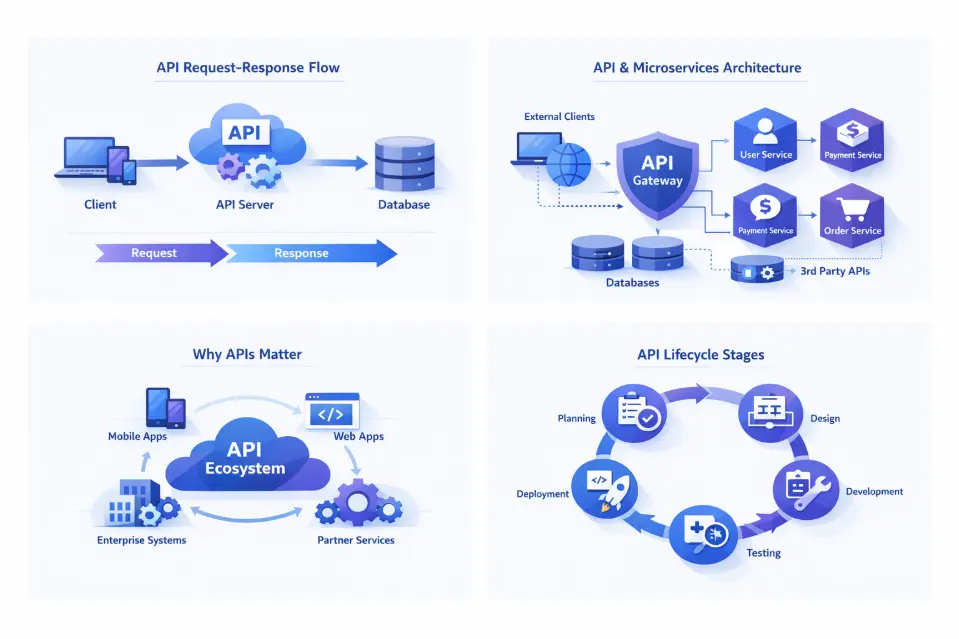
What is an API (Application Programming Interface)?
At its core, an API is a bridge that lets different software systems talk to each other.
For example, when a weather app shows today’s forecast, it doesn’t collect the data itself. It simply calls a weather API to fetch the latest information and displays it to you.
API connects systems so they can share data and functionality without needing to know how each one works internally.
From a technical perspective, an API (Application Programming Interface) is a software interface that enables systems to communicate through structured request and response mechanisms.
A modern API typically includes:
Endpoints – specific URLs where services can be accessed
Methods – actions like GET, POST, PUT, DELETE
Protocols – communication standards such as HTTP, REST, or gRPC
In short, APIs let you use powerful systems without needing to understand how they’re built under the hood—which is exactly why they scale so well in today’s API-first world.
How APIs Work
At a high level, APIs follow a simple request-response cycle:
- Client sends a request: This could be a mobile app, web app, or another service making a call to an API endpoint
- API processes the request: The API validates input, applies business logic, and interacts with backend systems if needed
- Server returns a response: The API sends back data (usually in JSON) or a status message
This flow is the core of “how APIs work in web applications” and “API request-response lifecycle explained.”
Real-World Example
- When you search for flights, the app calls multiple APIs to fetch airline data, prices, and availability
- When you pay, a payment gateway API (like Stripe) securely processes the transaction and returns a success or failure response
All of this happens in seconds through seamless API communication—no manual steps involved.
Key Components
Every API interaction is built on a few core elements:
- Endpoint: A specific URL where the API can be accessed
- Request & Response: The request includes parameters, headers, and sometimes a body; the response returns data or status codes
- Authentication: Ensures secure access using methods like API keys, OAuth tokens, or JWT
These components form the backbone of “secure API integration in modern applications” and “API authentication methods best practices.”
Read more: API development and DevOps
API Integration & API Management
API Integration and API Management are two essential aspects of working with APIs—one focuses on connecting systems and enabling data flow, while the other ensures those APIs remain secure, reliable, and scalable over time.
API Integration
API integration is the process of connecting applications through APIs so they can exchange data and work together automatically.
It involves sending API requests, handling responses (JSON/XML), managing authentication, and transforming data between systems.
For example, a business might connect Salesforce with Mailchimp to automatically sync customer data between sales and marketing teams.
API Management
API management refers to the tools and practices used to monitor, secure, and control APIs throughout their lifecycle.
It includes traffic control (rate limiting), authentication (API keys, OAuth), analytics, and documentation for developers.
For example, a bank offering APIs to partners must implement API management to control how those APIs are used. It may limit each partner to a certain number of requests per minute, monitor usage patterns, and enforce strict security policies to protect sensitive financial data.
Types of APIs
APIs aren’t one-size-fits-all. Different use cases call for different designs, especially as systems move toward AI, microservices, and real-time architectures.
By Architecture
REST (Representational State Transfer)
Still the most widely used standard. Simple, reliable, and built on HTTP—ideal for web and mobile apps.
Common in “REST API development for SaaS platforms”.
GraphQL
Lets clients request exactly the data they need—nothing more, nothing less. Reduces over-fetching and improves performance.
Popular for “flexible API queries in modern frontend applications.”
gRPC
Designed for high performance and low latency using binary data and HTTP/2. A strong fit for microservices and internal communication.
Often used in “high-performance API communication in microservices architecture.”
By Usage
Open APIs (Public APIs)
Available to external developers. Used to build ecosystems and drive adoption (e.g., payment, maps, social platforms).
Internal APIs (Private APIs)
Used within an organization to connect services and systems. Critical for scaling microservices and internal tools.
Partner APIs
Shared with specific business partners. Enable secure integrations without exposing everything publicly.
Common in “B2B API integration and partner ecosystem development.”
Emerging API Types
AI-Ready APIs (for LLM agents)
Designed for AI systems to consume and act on—structured, predictable, and optimized for automation workflows.
Growing fast in “API design for AI agents and autonomous systems.”
Event-Driven APIs
Instead of request-response, these APIs react to events in real time (e.g., webhooks, streaming data).
Ideal for “real-time API architecture and event-driven systems.”
Serverless APIs
Built on functions-as-a-service (FaaS), scaling automatically without managing infrastructure.
Widely used in “serverless API development on cloud platforms.”
Read more: APIs in cloud computing
API Lifecycle
A modern API isn’t just built—it’s continuously managed and improved. Here’s how the lifecycle typically looks:
|
Stage |
Description |
|
Planning |
Define business goals, use cases, and target consumers (internal teams, partners, or public developers) |
|
Design |
Structure endpoints, data models, and API contracts before writing any code |
|
Development |
Implement the API, integrate with backend services, and follow coding standards |
|
Testing |
Validate functionality, performance, and security (unit, integration, and load testing) |
|
Deployment |
Release the API to production using CI/CD pipelines |
|
Monitoring |
Track performance, errors, and usage in real time to ensure reliability and scalability |
Design Standards
OpenAPI / Swagger: Industry-standard specifications for documenting and designing APIs
Schema-First Approach: Define the API contract (schema) before implementation to ensure consistency across teams
API Security Best Practices
Security is non-negotiable in any API strategy. A few must-have practices:
- Authentication & Authorization: Use API keys, OAuth 2.0, or JWT to verify identity and control access
- Rate Limiting: Prevent abuse and ensure system stability by limiting request frequency
- Encryption (HTTPS): Protect data in transit using secure protocols
- API Gateway Usage: Centralize security policies, routing, and traffic control
API Management & Tools
API Gateways
Amazon API Gateway (AWS API Gateway): Fully managed service for creating, deploying, and scaling APIs in the cloud
Kong / Apigee: Popular platforms for managing API traffic, security, and performance across environments
Widely used in “cloud API gateway solutions for scalable applications.”
API Management Platforms
Modern API management goes beyond deployment:
Monitoring: Track uptime, latency, and error rates
Versioning: Manage API updates without breaking existing integrations
Analytics: Understand usage patterns and optimize performance
These capabilities are essential for “enterprise API management platforms and analytics solutions” and help turn APIs into measurable business assets.
Why APIs Are Important
For Developers
Faster Development
APIs let developers plug into existing services instead of building everything from scratch. This speeds up delivery and reduces time-to-market—especially in “API integration for modern web and mobile applications.”
Reusability
Well-designed APIs can be reused across multiple projects, teams, and products, making them a core part of “scalable software architecture with reusable APIs.”
For Businesses
Enable Integrations
APIs connect systems—CRMs, payment gateways, cloud services—into one seamless workflow.
Create Ecosystems
Companies can open their platforms to partners and developers, turning products into platforms.
Monetization (API Economy)
APIs themselves can generate revenue through usage-based pricing, subscriptions, or marketplaces.
For Digital Transformation
APIs are the foundation for connecting systems and data across organizations.
They enable:
Legacy system modernization
Cloud and SaaS integration
Real-time data sharing
That’s why APIs are central to “digital transformation strategy using API-first architecture.”
API vs Web Services vs Microservices
These terms are often used interchangeably, but they’re not the same. Understanding the difference is key for designing modern systems and choosing the right architecture.
|
Aspect |
API |
Web Service |
Microservices |
|
Definition |
Interface that allows software systems to communicate |
A type of API that works over the web |
An architectural style for building applications |
|
Scope |
Broad concept (can be local or remote) |
Subset of APIs (web-based only) |
System design approach |
|
Purpose |
Enable communication between systems |
Enable communication over HTTP/Internet |
Break application into small, independent services |
|
Protocols |
HTTP, gRPC, WebSocket, etc. |
HTTP (SOAP, REST) |
Typically HTTP/gRPC via APIs |
|
Data Format |
JSON, XML, binary, etc. |
XML (SOAP), JSON (REST) |
Usually JSON (via APIs) |
|
Usage |
Used everywhere (frontend-backend, service-to-service) |
Common in enterprise & web integrations |
Used in scalable, cloud-native systems |
SOAP vs REST (Web Services Comparison)
|
Aspect |
SOAP |
REST |
|
Type |
Protocol |
Architectural style |
|
Format |
XML only |
JSON (mostly), XML optional |
|
Complexity |
High (strict standards) |
Low (lightweight, flexible) |
|
Performance |
Slower |
Faster |
|
Use Case |
Enterprise, banking, legacy systems |
Web, mobile, SaaS apps |
|
Best For |
“secure SOAP web services in enterprise systems” |
“REST API development for modern applications” |
SOAP is more rigid and enterprise-focused, while REST is simpler, faster, and better suited for today’s web and mobile apps.
Conclusion:
APIs are no longer just technical connectors—they are the backbone of modern digital ecosystems, powering everything from mobile apps to AI-driven platforms. By enabling seamless integration, faster development, and new revenue opportunities, APIs play a critical role in business growth and innovation. With deep expertise in software development and digital transformation, Bachasoftware helps businesses design, build, and scale secure, high-performance API solutions for the future.