
Ngoc Nguyen
SEO Engineer
Home > Insight > IT Business
Comparison between Software Developer and Software Engineer
5 minutes read
Audio description available
DEC 11, 2025
Many people often use the terms software developer and software engineer interchangeably when searching for software development services, yet the two roles differ significantly in scope and responsibilities. Understanding these differences is crucial, especially as both positions share overlapping skills but follow distinct approaches to building digital products. In this comparison guide, we clarify what sets software developers and software engineers apart—from their day-to-day tasks to their methodologies and areas of specialization.
For businesses, recognizing these differences also ensures choosing the right expertise for each phase of a project. As a trusted technology partner, BHSOFT provides both software engineering and software development services, enabling clients to leverage the right talent for their unique needs. In the following sections, we will break down each role in detail to give you a clear and practical understanding of how they compare.
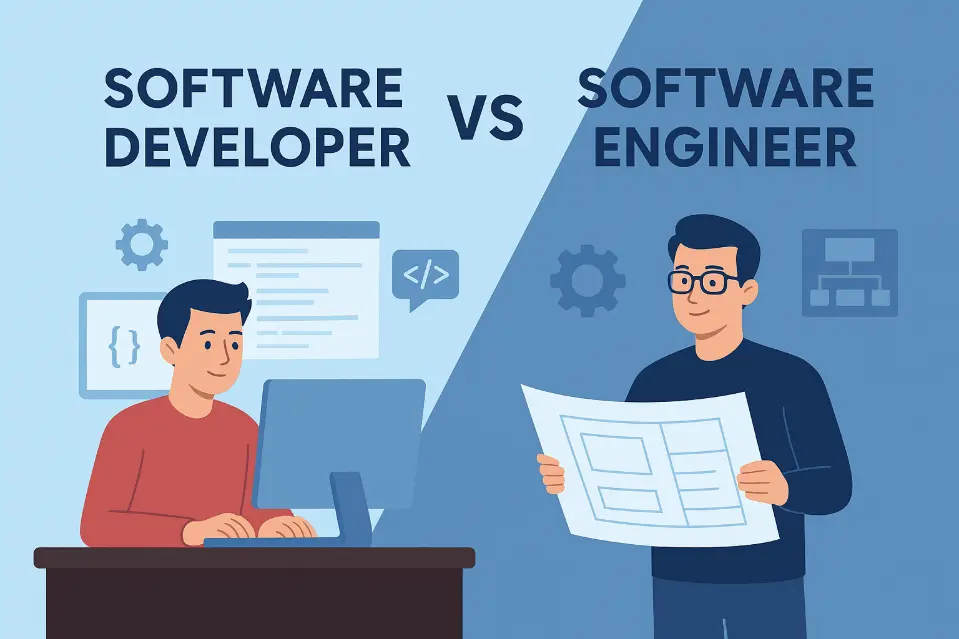
Definition & Nature of Work
A. Software Developer
A Software Developer is a professional responsible for writing code and building software applications for specific platforms such as web, mobile, or desktop. Their primary focus is to transform designs and concepts into functional products through activities like implementing features, testing, debugging, and performance optimization. The scope of a developer’s work is usually more specialized and narrower, often centered on a single application or a specific module within a system. With strong knowledge of programming languages, frameworks, and user requirements, Software Developers play a crucial role in turning ideas into ready-to-deploy software solutions.
B. Software Engineer
A Software Engineer applies established software engineering principles to design, build, and maintain entire software systems—not just individual applications. This role requires a broader, system-level perspective, taking responsibility for system architecture, scalability, stability, and long-term maintainability. Software Engineers are involved throughout the entire software development lifecycle (SDLC), from requirements analysis and architecture design to implementation, testing, deployment, and continuous improvement. They typically work in larger, cross-functional teams and collaborate closely with other engineers, QA specialists, testers, stakeholders, and clients to ensure that the system meets both technical and business objectives.
Read more: The Most Common Types of Outsourcing Models
Skills & Requirements
A. Common Skills
Both roles share a strong technical foundation and require several essential skills to perform effectively. Professionals in these fields must demonstrate logical thinking, problem-solving abilities, and solid programming skills. A strong understanding of algorithms and data structures is crucial for writing efficient and scalable code. In addition, both developers and engineers need effective teamwork and communication skills, especially when collaborating with cross-functional teams or working on large, multi-stakeholder projects.
Comparison Table: Skills & Requirements
|
Category |
Software Developer |
Software Engineer |
|
Primary Focus |
Builds specific applications and features |
Designs and maintains large-scale software systems |
|
Technical Foundation |
Strong in programming languages and frameworks |
Broader CS foundation: OS, algorithms, systems design |
|
Core Responsibilities |
Writing, testing, debugging, and optimizing code |
Architecting, scaling, and maintaining full systems |
|
Specialization |
Front-end, back-end, mobile, full-stack |
System design, infrastructure, tooling |
|
Working Style |
Often works independently on assigned components |
Works cross-functionally and leads system-wide decisions |
|
Additional Requirements |
Deep coding expertise |
Leadership, project management, long-term planning |
|
Tools & Deliverables |
Application features, user-facing modules |
Frameworks, pipelines, internal tools, system architecture |
Scope of Work & Work Environment
Scope & Approach
Software Developer
Software Developers typically work on individual applications or standalone software components, focusing on building specific features rather than managing an entire system. Their responsibilities usually revolve around writing and refining code for a single product, meaning they do not need to oversee the broader system architecture. Developers may work independently or within small teams, especially on projects with limited complexity. Because their role is more task-oriented and focused on feature delivery, they are not always required to collaborate extensively across multiple departments.
Software Engineer
Software Engineers operate on a much broader scope, managing multiple modules and layers of a complete software system, including frontend, backend, databases, infrastructure, and integration layers. They must ensure that every part of the system works cohesively and scales effectively. This role requires regular collaboration with QA teams, UI/UX designers, product stakeholders, clients, and sometimes even hardware teams when systems need cross-platform or embedded integration. Their approach is more holistic and system-driven, emphasizing long-term stability and scalability.
Career Path & Professional Growth
According to insights from Coursera and Indeed, the career trajectories of Software Developers and Software Engineers can differ significantly.
Software Engineer Career Path
Becoming a Software Engineer often opens the door to higher-level technical and leadership roles, thanks to the strong emphasis on system design and engineering principles. Engineers can progress into positions such as:
- Senior Software Engineer
- Tech Lead / Lead Engineer
- Engineering Manager
- Architect (System, Solution, or Enterprise)
- CTO (Chief Technology Officer)
These roles involve responsibilities such as managing engineering teams, overseeing large-scale architectures, and making strategic technology decisions for the organization.
Software Developer Career Path
Software Developers also have flexible and diverse career options. They can choose to specialize deeply in a technical area or grow toward leadership roles depending on their interests:
- Front-end, Back-end, Mobile, or Full-stack Specialist
- Lead Developer
- Technical Architect (depending on skill progression)
- Product-focused or smaller management roles
Developers often thrive in environments that allow them to focus on coding, building applications, freelancing, or remote work, making the role attractive for those who prefer hands-on programming rather than system-wide responsibilities.
Read more: Website or Web App: Which solution helps your business accelerate?
Advantages – Disadvantages & When to Choose a Developer or Engineer
|
Criteria |
Software Developer |
Software Engineer |
|
Main Strengths |
Flexible, coding-focused, beginner-friendly, suitable for freelance/remote |
System-level understanding, strong architecture & design skills, high career growth |
|
Advantages |
Easier to start, clear tasks, low pressure from system design |
Works on large, complex systems, strong leadership path, greater influence |
|
Disadvantages |
Limited system-wide exposure, slower advancement if not upskilling |
Requires broad, advanced knowledge; higher responsibility and pressure |
|
Work Style |
Independent, small teams, feature-focused |
Cross-team collaboration, holistic system thinking |
|
Career Fit |
Best for those who love coding, specialization, flexibility |
Best for those who enjoy system design, leadership, long-term planning |
|
Ideal Scenarios |
Building standalone apps, freelance projects, rapid implementation |
Enterprise systems, scalable architectures, multi-team projects |
Read more: Hire the best App Developers from Vietnam
Differences & Overlaps: Why Many Companies Still Use the Terms Interchangeably
Although Software Developers and Software Engineers are distinct roles in theory, the two positions often appear interchangeable in real-world job descriptions. One reason is that both roles share significant overlap in skills and daily tasks. Whether titled “developer” or “engineer,” professionals in both positions typically write code, debug issues, test features, and build software applications. Because their responsibilities intersect at many stages of the development process, the distinction can become blurred.
In practice, many companies use these titles based on internal preference rather than strict definitions. There is no universal or internationally standardized rule that clearly separates the two roles. As a result, job titles may vary widely across industries, organizations, or even specific teams.
In some cases, the title “software engineer” is used as a branding or marketing choice to convey higher expertise or prestige. This leads to scenarios where a “developer” and an “engineer” perform essentially the same day-to-day work, differing only in title rather than actual responsibilities. Community discussions frequently highlight this reality, noting comments on Reddit such as:
“Usually companies use the role of ‘engineer’ for a developer, because it sounds fancy and makes you feel smart. A developer writes and maintains code, an engineer designs solutions…”
“In many contexts, they refer to the same role.”
Because of these inconsistencies, it’s essential not to rely solely on the job title. Instead, professionals should evaluate the actual responsibilities, expectations, and system-level involvement described in the job listing or role definition. What truly matters is what you do, which parts of the system you handle, and the level of ownership you are expected to take—rather than the label printed on your business card.
Career Path Recommendations
When starting out: If you want to quickly dive into building applications, learning to code, and developing projects, beginning as a Software Developer is a great choice.
If you enjoy deeper technical foundations: When you study computer science or engineering in depth, enjoy system design, teamwork, and long-term projects, you may be better suited for a Software Engineer role.
Check the job description carefully: Instead of relying on the job title alone, focus on the “Responsibilities / Duties.” If the role requires system architecture design, overall system planning, scalability, and large-scale solutions, it is essentially an engineering role.
Transition is possible: Many developers eventually become engineers once they have gained enough skills, system-level understanding, and the desire to expand their impact and responsibilities.
Conclusion
While the titles “Software Developer” and “Software Engineer” are sometimes used interchangeably, they represent different approaches and scopes of work. If you need someone to build a specific application or a feature quickly, a developer is often the right choice. On the other hand, for designing, architecting, and maintaining robust, scalable systems — especially with long-term vision — an engineer brings broader system-level thinking and deeper technical foundation.
Whether you need a dedicated development team for web or mobile apps, custom SaaS solutions, cloud and DevOps infrastructure, QA and testing, or even AI/ML and GIS projects — the experts at BHSOFT are ready to support you. Contact us to hire developers or engineers who match your project’s complexity and long-term goals.
Contact us today!