
Phuong Thao Do
Content Marketing
Home > Insight > IT Business
The Best HR Software for Small Businesses in 2026: A Comprehensive Guide
5 minutes read
Audio description available
February 5, 2025
Managing a growing team in 2026 requires more than just a spreadsheet. As small businesses navigate the complexities of hybrid work, AI-driven recruitment, and evolving labor laws, the right Human Resources Information System (HRIS) becomes a competitive advantage.
This guide breaks down the essential features and top-rated HR software solutions designed to help small businesses scale efficiently.
What is HR Software for small business?
HR software for small business is a digital solution that automates and manages human resources tasks such as payroll, recruitment, attendance tracking, and compliance management. It helps small businesses streamline operations, reduce errors, and improve workforce management.
Without an efficient HR system, small businesses often struggle with manual processes, compliance risks, and administrative overload. Setting up HR software for small business ensures accurate record-keeping, smooth payroll processing, and better employee engagement. It allows business owners to focus on growth rather than time-consuming HR tasks.
Why Small Businesses Need Modern HRIS in 2026
Traditional HR tasks—payroll, benefits, and compliance—are now the bare minimum. Modern platforms offer:
- Automated Onboarding: Reducing administrative friction for new hires.
- AI-Powered Analytics: Predicting turnover and tracking employee engagement.
- Global Compliance: Managing taxes and labor laws for remote teams across different states or countries.
Learn more: BHSoft Secures ISO/IEC 27001:2013 and ISO 9001:2015 Certifications
Key Features to Look for in HR Software
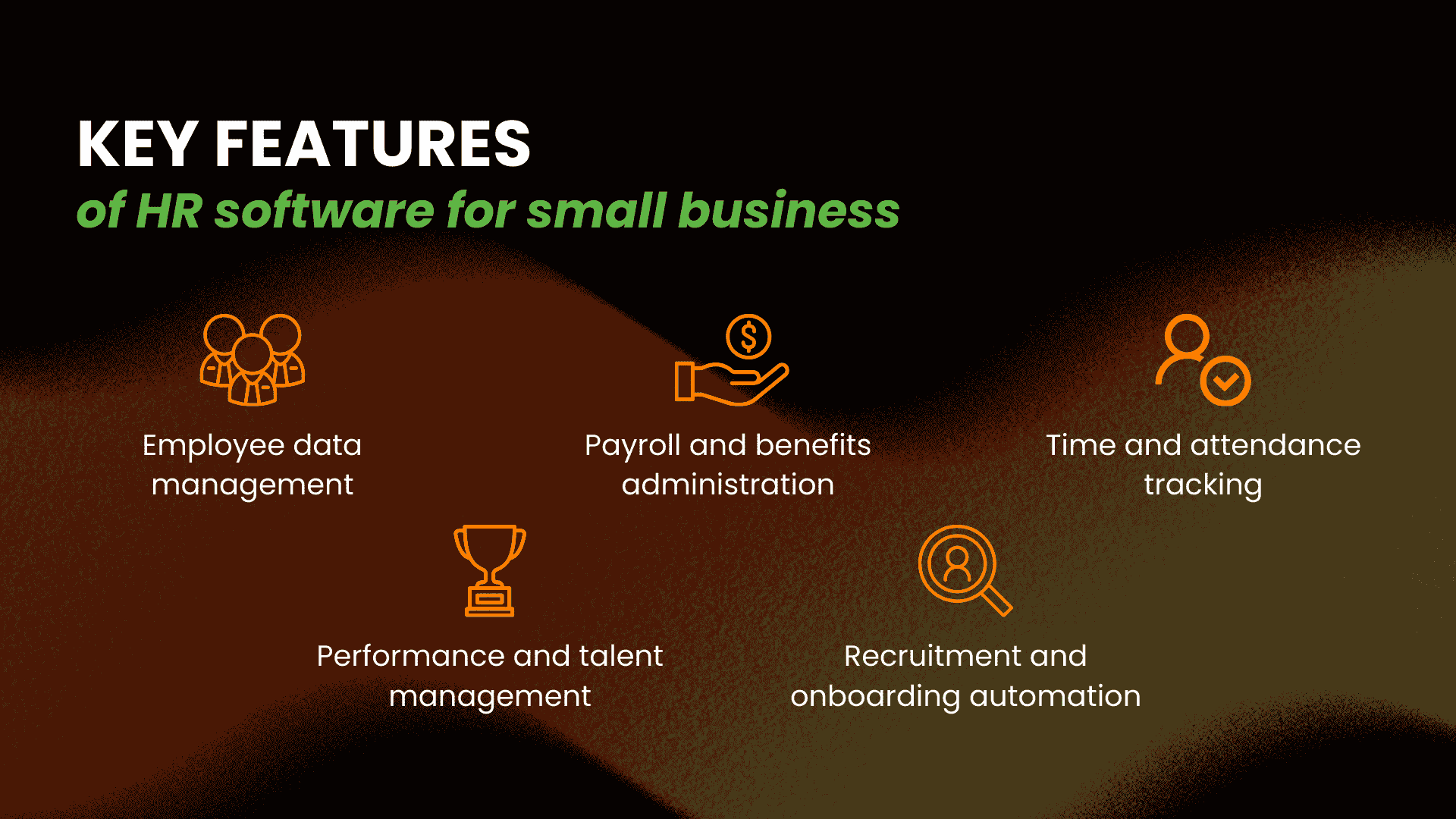
When selecting a platform, prioritize these five pillars to ensure long-term ROI:
1. Centralized Employee Records
A single source of truth for all employee data, from contracts to performance reviews, ensuring data integrity and easy access.
2. Seamless Payroll & Benefits Integration
The software should automate tax filings, direct deposits, and health insurance administration to eliminate manual entry errors.
3. Performance Management & Feedback Loops
Move beyond annual reviews with tools for continuous feedback, goal setting (OKRs), and professional development tracking.
4. Self-Service Portals
Empower employees to update their own information, request time off, and access pay stubs via mobile-friendly interfaces.
5. AI-Driven Recruitment (ATS)
An integrated Applicant Tracking System (ATS) that uses AI to screen resumes and schedule interviews, saving hours of manual labor for small teams.
Read more: Fleet Management Software For Small Businesses: A Complete Guide
How HR software boosts business growth
Manual HR management is a bottleneck that triggers errors and stalls momentum. By adopting digital HR solutions, small companies can automate administrative burdens, elevate the employee experience, and build a compliant, scalable foundation for the future.
1. Saves time and reduces administrative burden
Manual tasks like payroll and attendance tracking are "growth killers" for small business owners. HR automation software transforms these repetitive workflows into one-click operations.
Efficiency Gain: Cloud-based platforms eliminate manual data entry and paperwork.
Strategic Focus: By offloading administrative tasks, leadership can pivot from "managing spreadsheets" to "scaling the business."
2. Improves employee engagement and retention
In the modern workplace, autonomy is key to retention. A centralized digital HR platform empowers your team through transparency.
Self-Service Portals: Employees can access paystubs, benefits, and leave balances independently, reducing internal bottlenecks.
Clear Career Paths: Integrated performance management ensures evaluations and feedback are transparent, fostering a culture of trust. Engaged teams aren't just happier—they are significantly more profitable.
3. Enhances compliance and reduces risks
Labor laws and tax regulations are moving targets. HR compliance software acts as a built-in safeguard against costly legal pitfalls.
Real-time Updates: Systems automatically adjust for new tax codes and labor regulations.
Audit Readiness: Automated record-keeping ensures that your business is always "audit-proof," building long-term institutional trust.
4. Scales with business expansion
Your software should be an engine for growth, not a constraint. Cloud-native HRIS adapts as your headcount increases.
Seamless Expansion: Easily add new departments, locations, or international hires without disrupting core operations.
Data-Driven Decisions: Real-time analytics provide the insights needed to manage a larger workforce effectively, ensuring you stay agile as you scale.
Read more: Benefits of Applicant Tracking System
Top HR Software Contenders for 2026
While the "best" choice depends on your specific needs, these platforms lead the market for small-to-medium enterprises (SMEs):
- BambooHR: Best for culture-focused companies needing an all-in-one intuitive interface.
- Gusto: The gold standard for payroll-heavy needs and simplified benefits administration.
- Rippling: Ideal for tech-forward businesses that want to manage HR, IT, and Finance in one place.
- Deel: The go-to solution for small businesses hiring international contractors and full-time employees.
How to Choose the Right Partner for Your Business
- Assess Your Growth Map: Will the software support you when you grow from 10 to 50 employees?
- Check Integration Capabilities: Ensure it syncs with your current tools (Slack, Google Workspace, QuickBooks).
- Prioritize Support: For small businesses without a dedicated HR department, 24/7 customer support is vital.
Why a custom HR solution might be the best fit
While standard platforms cover basic administrative needs, they often lack the flexibility to handle specialized workflows or complex compliance. A tailored HR solution provides a precision-engineered environment that adapts to your business, rather than forcing your business to adapt to a rigid system.
Read more: Low-Code vs No-Code: Key Differences Explained

1. Precision Alignment vs. Rigid Frameworks
Off-the-shelf software is built for the "average" company, often resulting in cluttered interfaces with unused features or critical gaps in industry-specific logic.
- The Advantage: Custom HR development eliminates bloat and maps directly to your internal processes, resulting in a cleaner UX and higher adoption rates.
2. Deep-Tier Ecosystem Integration
Fragmented data is an efficiency killer. Unlike "closed" generic platforms, a custom solution ensures a unified data flow across your existing tech stack.
- Unified Workflow: Seamlessly sync payroll, accounting (QuickBooks/Xero), and project management tools.
- Zero Manual Entry: Automated data bridges eliminate errors in attendance tracking, tax deductions, and benefits administration.
3. Advanced Compliance & Enterprise-Grade Security
Generic software often provides "baseline" compliance that may miss industry-specific regulations or local labor law nuances.
- Proactive Protection: Custom builds include automated audit trails and real-time alerts tailored to your specific regulatory environment.
- Fortified Security: Beyond standard encryption, tailored systems implement Role-Based Access Control (RBAC) and secure infrastructure to mitigate the high risk of data breaches in SMEs.
4. Limitless Scalability for Long-Term Growth
A common pitfall for growing companies is outgrowing their HRIS within 18 months. Custom technology is designed to be future-proof.
- Elastic Infrastructure: Add new modules (e.g., international hiring, complex commission structures) as your headcount grows without the cost and headache of a full system migration.
5. AI and automation-driven HR for maximum efficiency
Modern HR is moving from "descriptive" to "predictive." Custom solutions allow you to integrate advanced AI that generic tools haven't adopted yet.
- Intelligence-Driven HR: Leverage bespoke machine learning models to predict turnover trends, automate resume screening, and optimize workforce planning.
- Actionable Insights: Transform raw employee data into strategic intelligence, helping you make data-backed decisions that drive profitability.
Conclusion
A custom HR solution gives small businesses the flexibility, automation, and scalability needed to manage HR operations efficiently. Unlike standard HR software for small business, a tailored system integrates seamlessly with payroll, accounting, and compliance tools. It ensures businesses stay ahead by reducing administrative burdens, improving employee experience, and minimizing compliance risks.
With AI-powered automation, secure data management, and scalable features, a custom HR solution helps businesses grow without software limitations. It adapts to industry-specific needs, eliminating inefficiencies and providing long-term value. Investing in the right HR software is not just about simplifying tasks - it’s about creating a foundation for sustainable business success.
At BHSoft, we specialize in custom HR Management Software Solutions designed for small businesses. Whether you're looking to automate payroll, streamline recruitment, or improve workforce management, our solutions help you scale efficiently. Contact us today to explore how our HR software can transform your business and drive growth.