Benefits companies gain from using Chatbots in Sales
5 minutes read
Dec 4, 2025
In today’s sales landscape—where customers expect instant responses, frictionless experiences, and highly personalized interactions—traditional sales processes alone are no longer enough. This is why more companies are turning to chatbots as a strategic advantage rather than a simple customer support tool. With the rise of AI, modern chatbots have evolved from scripted responders into intelligent virtual assistants capable of qualifying leads, nurturing prospects, guiding purchase decisions, and optimizing the entire customer journey.
For businesses aiming to automate engagement at scale, AI-powered chatbot development solutions offer a powerful way to accelerate sales performance. Companies like BHSOFT, with expertise in custom chatbot development services and chatbot integration and automation services, enable organizations to build conversational systems that understand intent, collect meaningful data, and deliver tailored product recommendations around the clock.
This article explores the key benefits companies gain from using chatbots in sales—and why now is the perfect time to consider implementing enterprise-grade chatbot technology.
Statistics: How Chatbots Boost Sales & Drive Business Growth
Integrating AI-powered chatbots into sales and customer engagement strategies has demonstrated significant impacts on revenue, conversion, and customer journeys across industries:
Sales & Conversion Impact
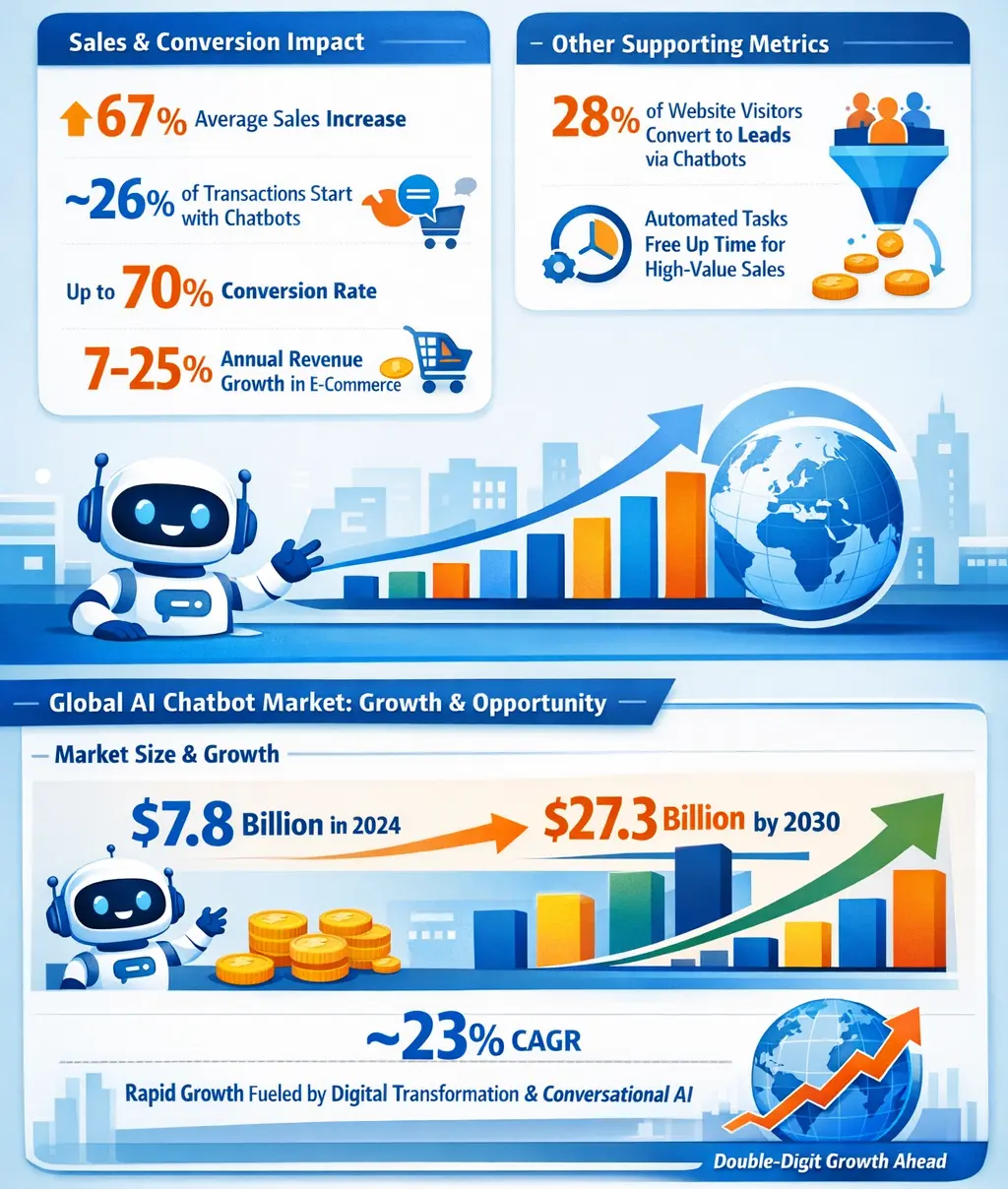
Many business leaders report that chatbots boost sales by an average of ~67%, with ~26% of transactions starting from a chatbot interaction. In optimized use cases, chatbots can achieve conversion rates up to ~70%, while e-commerce businesses typically see annual revenue growth of ~7–25% through chatbot-driven recommendations and cart support.
Other Supporting Metrics
Up to 28% of website visitors convert to leads through chatbot interactions, while automated handling of routine inquiries frees teams to focus on high-value sales activities, further improving conversion rates and CLV.
Global AI Chatbot Market: Growth & Opportunity
AI chatbot technology is one of the fastest-growing segments in enterprise software, reflecting its strategic value:
Market Size & Growth
The global AI chatbot market was valued at ~US $7.8 billion in 2024 and is expected to reach ~US $27.3 billion by 2030, growing at a ~23% CAGR. Multiple forecasts consistently point to strong double-digit growth through the late 2020s, driven by digital transformation and conversational AI adoption.
Read more: Why An AI Chatbot For Website Is Crucial To Business Success
How Sales Chatbots Work
Sales chatbots are not just automated reply tools. When designed properly, they act as a lead qualification and routing system that supports the sales funnel from the very first interaction.
1. Visitor engagement and conversation trigger
The process starts when a visitor lands on a website, landing page, or product page.
A chatbot can be triggered by:
Time on page
Scroll depth
Exit intent
A specific call-to-action (CTA)
2. Data collection through conversational flow
Once the conversation begins, the chatbot collects lead information naturally through questions, such as:
Business needs or pain points
Budget range or buying intent
Contact details (email, phone, company name)
3. Lead qualification and segmentation
Based on predefined rules or AI-driven logic, the chatbot evaluates the lead in real time.
For example:
High-intent leads → request pricing or demo
Medium-intent leads → ask for more product information
Low-intent leads → provide educational content
4. Smart handoff to the sales team
After qualification, the chatbot routes the lead to the appropriate destination:
Assigns the lead to a specific sales representative
Pushes data directly into CRM systems (e.g., HubSpot, Salesforce)
Schedules meetings or demos automatically
NLP and Machine Learning vs Keyword-Based Chatbots
Not all chatbots work the same way. The difference lies in how they understand user intent.
Keyword-based chatbots
- Traditional chatbots rely on predefined keywords and decision trees:
- They only respond when exact keywords are matched
- Conversations break easily when users phrase questions differently
- Limited flexibility and poor scalability
- These bots are suitable for simple FAQs but struggle in complex sales conversations.
AI-powered chatbots using NLP and ML
Modern sales chatbots use Natural Language Processing (NLP) and Machine Learning (ML) to understand intent rather than exact words.
Key advantages include:
- Understanding variations in user phrasing
- Detecting buying signals and intent
- Learning from past conversations to improve responses
- Handling multi-step and contextual conversations
Over time, the chatbot becomes more accurate, making it a scalable solution for growing sales teams.
Benefits Companies Gain From Using Chatbots in Sales
1. Automated Lead Generation and Qualification
Modern chatbots automate lead capture and qualification by engaging visitors instantly instead of relying on static forms or manual outreach. They ask context-aware questions, collect key details such as contactus information, budget, or interests, and quickly identify high-quality prospects.
This approach allows businesses to scale lead generation without increasing costs. With AI-driven chatbot solutions integrated into CRM and marketing tools, qualified leads can be routed to sales teams, demos can be booked automatically, and personalized follow-up journeys can be triggered in real time.
By combining chatbot technology with custom software development, organizations can customize the lead qualification framework to perfectly fit their unique sales funnel.
2. Personalized Automated Content and Experiences
Advanced chatbots personalize responses using real-time data, user behavior, and past interactions to deliver relevant recommendations. By maintaining context, supporting multiple languages, and integrating with backend systems, chatbots create more meaningful conversations that build trust, increase engagement, and drive higher conversion rates.
3. Encouraging Buying Decisions and Boosting Conversions
Chatbots increase conversion rates by addressing customer concerns at the right moment. In eCommerce, they help recover abandoned carts through reminders, recommendations, or incentives, while in service-based industries they guide prospects through complex decisions. Compared to static contactus forms, chatbots offer a more interactive experience and can automate cross-selling and upselling in real time, driving higher revenue with minimal effort.
4. Enhanced Data Collection and Customer Insights
Every interaction with a chatbot provides valuable data about customer preferences, behaviors, concerns, and decision-making patterns. This information becomes a source of actionable insight that businesses can use to refine their sales and marketing strategies.
Chatbots collect data such as:
- Frequently asked questions
- Common objections
- Peak activity times
- Preferred product categories
- Customer journey patterns
When integrated with analytics or CRM platforms, the data becomes even more powerful, supporting segmentation, personalization, and predictive analysis. Companies that invest in custom software development for sales analytics can build dashboards and automation triggers directly from chatbot insights, helping teams make more informed decisions and improving overall sales performance.
5. Stronger Customer Relationships and 24/7 Availability
In today’s fast-paced digital environment, customers expect immediate support. Chatbots help companies meet this expectation by providing instant, round-the-clock assistance. Chatbots ensure customers never feel ignored. This constant availability enhances customer satisfaction and strengthens long-term relationships.
6. Operational Efficiency and Cost Savings
Chatbots efficiently handle repetitive tasks such as answering FAQs, collecting basic information, sending reminders, or providing initial consultations. This minimizes the need to hire large support or sales teams for routine tasks.
Automation enables employees to focus on more strategic and high-value activities—such as nurturing key accounts, closing deals, or planning growth initiatives. Over time, this results in improved productivity, faster response times, and better resource allocation.
Read more: How GIS Mapping Services Support Effective Smart City Implementation
Key Considerations When Implementing a Sales Chatbot
Companies should prioritize the following factors to ensure their chatbot becomes a true revenue-driving asset rather than a barrier in the sales funnel.
1. Ensure the Chatbot Is Smart Enough to Understand Context
A high-performance sales chatbot must go beyond simple keyword matching. It should leverage AI and Natural Language Processing (NLP) to understand context, intent, and nuances in customer queries. This prevents frustrating “robotic” answers and enables the chatbot to respond accurately, maintain natural conversations, and guide users effectively throughout their buying journey.
2. Integrate Seamlessly With CRM and Backend Systems
For a chatbot to support end-to-end sales activities, seamless integration with the company’s CRM, ERP, or custom backend systems is essential. This eliminates data silos, ensures real-time synchronization, and allows sales teams to access updated lead information, conversation history, and customer insights.
3. Prioritize Continuous Training, Maintenance, and Optimization
A chatbot is not a “set-and-forget” solution. It must be trained continuously based on real user interactions to improve accuracy, add new knowledge, and refine conversation flows ensuring sustained performance and long-term ROI.
4. Focus on User Experience to Prevent Drop-Off
Even the most capable chatbot can fail if the user experience is poor. Companies should ensure the interface is intuitive, mobile-friendly, and quick to navigate. The conversation design must feel natural, helpful, and engaging—not intrusive or overly complicated.
Real-World Use Cases and Common Sales Scenarios for Chatbots
To unlock the full value of conversational automation, businesses can deploy chatbots across a wide range of practical, impact-driven scenarios. Below are some of the most common real-world applications that demonstrate how chatbots streamline sales processes and elevate customer experiences.
1. E-Commerce Websites
In online retail, chatbots play a key role in guiding shoppers to the right products through real-time recommendations, search assistance, and personalized suggestions. They can also identify when a user abandons their cart and send intelligent reminders or incentives to encourage checkout completion.
2. B2B Service or Corporate Websites
For B2B businesses, chatbots act as always-on virtual sales assistants. They can pre-qualify leads, collect essential information, and automatically sync the data with CRM systems. Many companies also use chatbots to schedule consultations, demos, or discovery calls—reducing manual workload and ensuring prospects receive instant engagement regardless of time zone.
3. Finance and Insurance Platforms
In industries where customers frequently need guidance on complex products (e.g., insurance plans, loan options, investment services), chatbots help deliver clear, consistent explanations and collect preliminary data before passing the lead to a human agent.
4. Global or Multilingual Businesses
For international companies—or any business serving diverse markets—a multilingual chatbot is invaluable. It can communicate seamlessly across languages, provide around-the-clock assistance, and ensure customers from different regions feel understood and supported.
Chatbots vs Other Sales Lead Generation Solutions
Businesses can capture and engage leads in multiple ways, but not all solutions deliver the same level of efficiency or scalability. Below is a comparison of chatbots, contactus forms, and live chat, highlighting how each performs in real sales environments.
|
Solution |
Chatbot |
Contact Form |
Live Chat |
|
24/7 automation |
✅ |
❌ |
✅ |
|
Personalization |
⚠️ |
❌ |
⚠️ |
|
Real-time interaction |
✅ |
❌ |
✅ |
|
CRM integration |
✅ |
❌ |
⚠️ |
Conclusion
As customer expectations continue to rise, companies need smarter, faster, and more scalable solutions to stay competitive. Chatbots—especially those built with advanced NLP, analytics, and automation—provide exactly that. From generating and qualifying leads to personalizing product suggestions and improving conversion rates, chatbots significantly enhance every stage of the sales funnel. Beyond boosting revenue, they allow sales teams to focus on high-value tasks while maintaining consistent, 24/7 engagement.
For organizations looking to unlock these advantages, partnering with experts like BHSOFT can accelerate adoption. Their enterprise chatbot development services and AI-powered chatbot development solutions help businesses design intelligent conversational experiences that seamlessly integrate with CRM systems, automate repetitive sales tasks, and deliver measurable impact.
By embracing modern chatbot technology today, companies can strengthen customer relationships, optimize sales operations, and build a more resilient growth strategy for the future.