Smart Street Lighting: How IoT, GIS, and Energy Monitoring Transform Urban Infrastructure
15 minutes read
October 26, 2026
Streetlights are among the most visible parts of urban infrastructure. They illuminate roads, pedestrian areas, industrial parks, and residential neighborhoods.
Yet managing a large streetlight network can be challenging.
Operators need to identify faulty lights, maintain equipment, monitor energy use, and ensure that appropriate lighting conditions are maintained across different locations.
Traditional lighting infrastructure may rely on fixed operating schedules and manual inspections. Connected technologies introduce opportunities for better visibility and more flexible management.
Smart street lighting combines connected lighting equipment, IoT communication, GIS-based asset management, and centralized software to monitor and control outdoor lighting infrastructure.
Rather than treating each light as an isolated asset, organizations can manage their lighting network as part of an integrated urban system.
What Is Smart Street Lighting?
Smart street lighting is an outdoor lighting system equipped with connected control and monitoring capabilities.
Depending on the equipment and architecture, operators may be able to:
- Turn lights on or off remotely.
- Configure lighting schedules.
- Adjust brightness within approved limits.
- Monitor equipment status.
- Collect energy consumption information.
- Identify faults and maintenance requirements.
- View lighting assets on a GIS map.
Not every smart lighting deployment includes all these capabilities. The available functionality depends on luminaire hardware, controllers, communications, and management software.
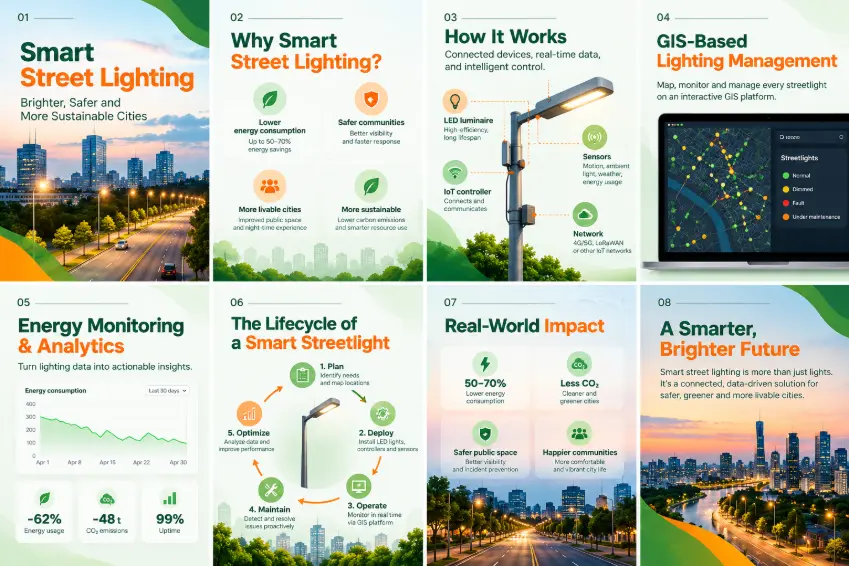
How Does a Smart Street Lighting System Work?
A typical system contains five main components.
1. Connected Streetlight Equipment
Lighting fixtures, often using LED technology, provide illumination.
Compatible controllers may enable dimming, status reporting, and remote commands.
2. IoT Communication Network
Connected lighting devices communicate with a central platform, directly or through gateways.
The appropriate network depends on geographic coverage, bandwidth, installation conditions, and reliability requirements.
3. Central Lighting Management Platform
Management software organizes information about connected equipment.
Authorized users can review device states, configure schedules, inspect events, and issue supported commands.
4. GIS-Based Asset Management
GIS connects each lighting asset to a geographic position.
Operators can locate devices, inspect maintenance information, filter equipment by status, and identify geographic areas requiring attention.
5. Energy Monitoring and Reporting
Where supported by the installed hardware, the platform can collect energy and power measurements.
Operators can analyze trends and compare equipment performance over time.
These readings should be evaluated for accuracy before they are used in formal billing or verification processes.
Why Is GIS Important for Streetlight Management?
GIS transforms a lighting inventory into a location-based asset management system.
Imagine an industrial park containing hundreds of streetlights across roads, parking areas, and shared facilities.
Without a geographic view, operators may need to search equipment lists or manually verify locations.
With GIS, each light can be connected to a map position and an asset record.
Operators can inspect:
- Asset identification numbers
- Equipment types and installation details
- Connectivity and operational status
- Fault history
- Maintenance records
- Geographic zones
- Related control groups
This can help maintenance personnel locate equipment and organize field activities more efficiently.
Smart Street Lighting Use Cases
Automated Lighting Schedules
Lighting systems can follow configured schedules that reflect local operating needs.
Some architectures can use astronomical schedules, which are based on sunrise and sunset calculations.
Adaptive Brightness Control
Compatible devices can support different brightness levels for different operating periods or conditions.
For instance, a suitable lighting design might allow reduced brightness during selected low-activity periods.
Any adjustments must comply with applicable roadway and public-safety lighting requirements.
Remote Fault Detection
Connected controllers can report selected equipment problems.
Instead of relying entirely on public complaints or scheduled inspections, operators can review fault notifications through the management platform.
Centralized Energy Monitoring
A central dashboard can display energy usage trends across connected lighting assets or groups.
This helps operators identify unexpected consumption and evaluate control strategies.
Maintenance Planning
GIS and equipment records can support work orders, maintenance scheduling, and analysis of recurring faults.
How Smart Lighting Can Improve Energy Management
Energy management is a major motivation for modernizing street lighting.
LED conversion and networked lighting controls are separate improvement measures.
LED fixtures may provide efficiency benefits compared with older lighting technologies, while connected controls offer additional opportunities through scheduling, monitoring, and dimming.
Potential benefits include reduced unnecessary lighting hours, better visibility into consumption, and improved identification of equipment problems.
However, energy savings vary according to existing equipment, lighting requirements, dimming policies, and actual operating conditions.
Organizations should measure results against an established baseline rather than assume a fixed percentage reduction.
The Lifecycle of a Connected Streetlight
A smart streetlight is managed throughout its operational life.
Stage 1: Asset Registration
The light is recorded with an identifier, equipment details, and geographic location.
Stage 2: Installation and Connection
The hardware and control components are installed, tested, and connected to the management platform.
Stage 3: Configuration
Operators assign appropriate schedules, brightness settings, and operational groups.
Stage 4: Continuous Monitoring
The platform collects supported status, fault, and energy information.
Stage 5: Issue Detection
A malfunction or abnormal condition may generate a notification.
Stage 6: Maintenance Response
Authorized personnel locate the asset and perform the appropriate inspection or repair.
Stage 7: Performance Review
Historical records and energy information help teams evaluate reliability and operational efficiency.
Stage 8: Upgrade or Replacement
Equipment can be repaired, upgraded, or replaced based on its condition and maintenance strategy.
Smart Lighting System Architecture
A simplified architecture is:
Connected Luminaire → IoT Controller → Communication Network → Management Platform → GIS Dashboard and Energy Reports
Additional components may include device management, authentication, monitoring services, APIs, and integration with maintenance systems.
The architecture should define how devices behave if communication is interrupted.
For example, local controllers may need to continue operating according to approved schedules when a central connection is unavailable.
Cybersecurity is also important because remote control systems can affect public infrastructure.
Smart Lighting Implementation Challenges
Compatibility with Existing Infrastructure
Some older fixtures may not support connected controls without additional hardware.
Connectivity Reliability
Network coverage and device communication should be validated in the intended environment.
Data Accuracy
Energy measurements and equipment status reports require appropriate quality checks.
Cybersecurity
Remote device control requires authentication, authorization, secure communication, and update management.
Public Safety
Dimming schedules and other lighting changes must follow applicable safety and illumination requirements.
Long-Term Maintenance
Connected lighting systems introduce software, controllers, networks, and monitoring components that need ongoing support.
How to Implement Smart Street Lighting
Step 1: Audit the lighting network. Review fixtures, electrical infrastructure, asset locations, maintenance history, and operating costs.
Step 2: Establish a GIS inventory. Create accurate geographic records for lighting equipment.
Step 3: Define operational requirements. Determine which monitoring, control, and reporting functions are necessary.
Step 4: Evaluate hardware compatibility. Identify required controllers, gateways, or fixture upgrades.
Step 5: Design the communications architecture. Consider reliability, security, and scale.
Step 6: Pilot in a selected zone. Test commands, fault alerts, connectivity, lighting performance, and energy reporting.
Step 7: Evaluate results. Compare performance with baseline energy and maintenance indicators.
Step 8: Expand gradually. Scale deployment using standardized asset and device management processes.
Smart Street Lighting in BHSoft's Smart City Platform
BHSoft's Smart City solution includes a Smart Lighting & Energy module with capabilities for lighting schedules, density-aware adjustments, GIS-based management, and centralized energy monitoring.
The module is positioned within a broader Smart City ecosystem combining IoT, GIS, AI, Big Data, Cloud/Edge technologies, and an Intelligent Operations Center.
This modular approach is relevant for cities, industrial parks, residential developments, and other infrastructure environments looking to integrate connected lighting with wider operational management.
Frequently Asked Questions
What is an IoT street lighting system?
An IoT street lighting system connects compatible lighting equipment to communication networks and software for monitoring and supported remote controls.
How does GIS help manage streetlights?
GIS enables operators to identify lighting assets by location, inspect equipment information, and manage faults and maintenance geographically.
Can smart streetlights reduce electricity consumption?
They can, particularly when efficient fixtures and suitable control strategies are implemented. Actual savings depend on the initial lighting infrastructure and operating conditions.
Do smart streetlights require internet connectivity?
Centralized remote monitoring generally requires communications. Some devices can retain local schedules during connectivity interruptions if designed to do so.
Can existing streetlights be upgraded?
Some can be retrofitted with compatible controllers. Feasibility depends on the fixture, electrical infrastructure, and technical requirements.
Is smart street lighting suitable for industrial parks?
Yes. Connected lighting can support geographic asset management, equipment monitoring, and centralized operations across industrial infrastructure.
Conclusion
Smart street lighting goes beyond remotely switching lights on and off.
It brings together lighting equipment, connected controls, geographic information, operational software, and energy data.
When designed and maintained appropriately, these technologies can improve infrastructure visibility, support maintenance operations, and create opportunities for more efficient lighting management.
The most effective deployments begin with accurate asset information, defined performance goals, and a controlled pilot.
Explore Smart Lighting & Energy Solutions with BHSoft
BHSoft's Smart City platform combines GIS-based lighting management, IoT connectivity, and energy monitoring within a modular urban management ecosystem.
Explore the BHSoft Smart City solution: https://bhsoft.vn/smartcity
Connect with BHSoft to discuss your IoT development requirements, Edge AI integration opportunities, and scalable software architecture.