How to Build High-Performing Software Teams in the AI Era
15 minutes read
October 14, 2026
Why Engineering Leadership Must Evolve in 2026
Software engineering has entered a new phase.
AI-powered coding assistants can help developers generate code, write tests, investigate defects, and understand unfamiliar systems. Meanwhile, businesses continue to demand faster delivery, stronger security, and lower operating costs.
For engineering leaders, this creates a difficult challenge:
How can organizations deliver software faster without compromising quality, team development, or long-term maintainability?
Traditional engineering management practices focused heavily on allocating tasks, monitoring progress, and ensuring projects met deadlines. Those responsibilities still matter.
However, modern engineering leadership requires a broader perspective. Leaders must design systems in which people, processes, and AI tools work together effectively.
According to Google's 2025 DORA research, AI acts as an amplifier of existing organizational strengths and weaknesses. This suggests that simply introducing AI tools is not enough to create a high-performing engineering organization.
The organizations that benefit most will be those that combine intelligent technology with strong engineering fundamentals.
What Is Engineering Leadership?
Engineering leadership is the practice of guiding technical teams, making architectural and organizational decisions, developing engineering talent, and aligning software development efforts with business objectives.
Effective engineering leaders focus on more than delivering features. They also build the environment that enables engineers to perform consistently, collaborate effectively, and deliver reliable software.
Engineering Leadership vs. Engineering Management
Although the terms overlap, they emphasize different responsibilities.
| Engineering Management | Engineering Leadership |
|---|---|
| Coordinates projects and resources | Establishes technical vision and direction |
| Monitors delivery commitments | Connects technical decisions to business outcomes |
| Manages team operations | Develops engineering culture and capabilities |
| Addresses immediate execution challenges | Balances short-term priorities with long-term sustainability |
| Maintains existing processes | Improves systems, practices, and decision-making |
Successful engineering organizations need both. An engineering manager may provide technical leadership, while a senior technical contributor can demonstrate leadership without holding a formal management position.
7 Engineering Leadership Strategies for High-Performing Teams
1. Build a Clear Engineering Vision
High-performing engineering teams need to understand not only what they are building, but why it matters. A clear engineering vision connects technical decisions to customer needs and business priorities.
For example, a company modernizing its platform might establish three priorities:
- Improve system reliability and availability.
- Reduce the time required to deliver customer-facing features.
- Build an architecture that supports future product growth.
These priorities guide decisions about technology selection, technical debt, infrastructure, and hiring.
Leadership recommendation: Translate business goals into a small number of engineering objectives with measurable outcomes. This helps teams avoid optimizing isolated technical metrics that provide limited business value.
2. Adopt AI Across the Software Development Lifecycle
AI is becoming an important part of software engineering workflows. However, engineering teams should avoid treating AI adoption as simply purchasing coding assistants.
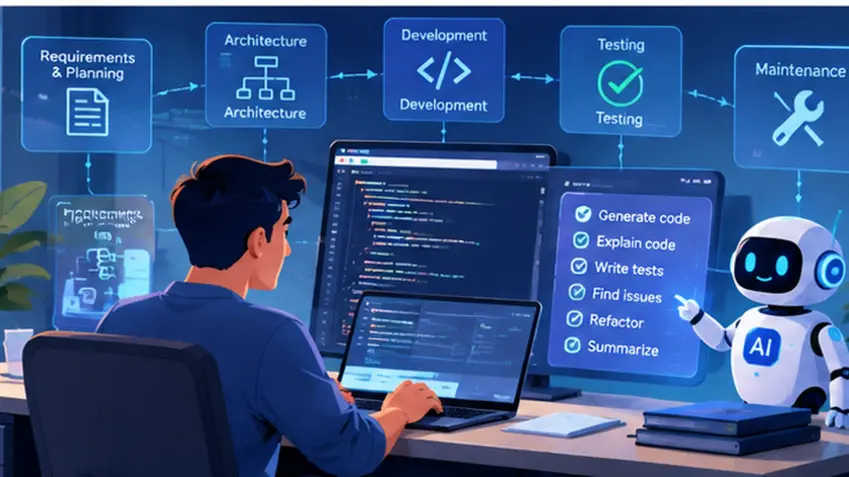
AI can potentially support multiple stages of the software development lifecycle (SDLC):
- Requirements and planning: Summarize specifications, identify missing requirements, and assist with documenting user stories.
- Software architecture: Explore design alternatives, document technical decisions, and evaluate potential trade-offs.
- Development: Generate code suggestions, automate repetitive tasks, and assist with refactoring.
- Testing: Draft test cases, identify edge cases, and help analyze test failures.
- Maintenance: Summarize incidents, investigate logs, and support troubleshooting.
Gartner's February 2026 research identifies AI adoption across the entire SDLC as a priority for software engineering leaders.
But AI-generated output still requires appropriate human review. Engineering leaders should establish policies covering code ownership, security, intellectual property, data handling, and review requirements.
Leadership recommendation: Begin with targeted AI use cases, establish baseline metrics, and evaluate the effect on overall delivery quality—not merely the amount of code generated.
3. Measure Engineering Productivity Beyond Coding Speed
One of the biggest leadership mistakes is assuming that more code means greater productivity. A developer might generate hundreds of lines of code in minutes using AI.
However, if the result introduces defects, creates unnecessary complexity, or requires extensive rework, the actual productivity improvement may be limited. Modern engineering leadership requires a balanced measurement framework.
Important Engineering Performance Metrics
| Metric | What It Measures | Why It Matters |
|---|---|---|
| Change lead time | Time from code commitment to production delivery | Indicates delivery efficiency |
| Deployment frequency | How often changes reach production | Shows release capability |
| Change failure rate | Proportion of deployments requiring intervention | Indicates delivery stability |
| Failed deployment recovery time | Time needed to recover from failed deployments | Reflects operational resilience |
| Developer satisfaction | Engineers' experience with tools and processes | Helps identify workflow friction |
| Customer outcomes | Business or user value delivered | Connects engineering work to organizational goals |
No single metric captures overall engineering performance. Leaders should also evaluate collaboration, maintainability, customer impact, and the cost of delivering and operating software.
Leadership recommendation: Use performance metrics to improve engineering systems, not to rank individual engineers by output.
4. Create a Culture of Ownership and Accountability
High-performing teams need autonomy, but autonomy without clear responsibility can create confusion.
Engineering leaders should define ownership across critical areas, including:
- Services and system components
- Technical decisions
- Software quality
- Production incidents
- Security requirements
- Documentation and knowledge sharing
When ownership is clear, engineers can make decisions more effectively and resolve problems with less unnecessary coordination.
However, accountability should not become a blame mechanism. For example, after a production incident, the goal should be to understand what happened and improve the system rather than identify someone to punish. Blameless post-incident reviews, clear escalation processes, and documented decisions can support a healthier engineering culture.
Leadership recommendation: Give teams enough authority to own outcomes while maintaining transparent communication and appropriate governance.
5. Balance Delivery Speed with Technical Excellence
Engineering leaders frequently face pressure to deliver more features in less time. But consistently prioritizing speed over quality can increase technical debt, security risks, and maintenance costs.
Strong engineering leadership requires making deliberate trade-offs. Consider a team preparing to launch a new digital platform. Shipping quickly may help the business validate demand. However, neglecting automated testing, monitoring, or essential security controls can create serious problems as adoption grows.
Effective leaders distinguish between technical debt that is strategically acceptable and risks that should not be deferred.

Practical approaches include:
- Defining minimum quality standards
- Automating critical tests
- Maintaining code review practices
- Tracking recurring sources of engineering rework
- Prioritizing reliability and security requirements
- Reviewing architectural decisions as systems evolve
Leadership recommendation: Make technical debt visible to business stakeholders and explain its impact in terms of delivery capacity, operational risk, and future costs.
6. Develop Engineering Talent in an AI-Assisted Workplace
AI is changing the skills engineers need, but it does not remove the importance of technical expertise. Engineers must still understand software design, algorithms, system behavior, debugging, testing, and security.
Without those foundations, developers may struggle to validate AI-generated solutions. The challenge is particularly important for junior engineers. If AI tools handle many traditional entry-level coding tasks, companies need new ways to help early-career developers acquire practical engineering judgment.
Engineering leaders can address this through:
- Structured mentoring: Pair less experienced engineers with senior developers for architecture discussions, debugging, and code reviews.
- AI-assisted learning: Encourage engineers to use AI tools for explanations and exploration while requiring them to verify the results.
- Rotational opportunities: Expose developers to testing, infrastructure, security, and production operations.
- Technical ownership: Gradually increase engineers' responsibility for systems and business outcomes.
- Continuous feedback: Evaluate problem-solving, communication, reliability, and technical growth.
Leadership recommendation: Invest in engineers who can both use AI effectively and recognize when its outputs are incorrect.
7. Improve Collaboration Between Engineering and Business Teams
Engineering teams do not operate in isolation. They collaborate with product management, design, operations, customer support, and business leadership.
Poor alignment between these groups can create changing priorities, unclear requirements, and unnecessary development work. Engineering leaders play an important role in translating business objectives into feasible technical strategies.
For example, when a product team proposes a new feature, engineering leadership should help evaluate:
- What customer problem does this feature solve?
- What technical dependencies exist?
- What are the major delivery and operational risks?
- Is there a simpler solution?
- How will success be measured?
These discussions help organizations make better investment decisions and avoid unnecessary complexity.
Leadership recommendation: Involve engineering leaders early in product strategy instead of waiting until implementation begins.
How AI Is Changing the Role of Engineering Leaders
AI is not simply changing how engineers write code. It is also changing how technical teams are organized and managed.
From Task Supervision to Outcome Ownership
As AI automates portions of implementation work, leaders can focus more attention on business objectives, architecture, coordination, and engineering effectiveness. Rather than measuring how many tasks are completed, leaders should evaluate whether the team is solving important problems reliably.
From Individual Productivity to Team Effectiveness
An individual developer may become faster with AI while the overall team experiences new bottlenecks in review, integration, or testing. Therefore, engineering leaders must optimize the complete development workflow.
This includes requirements quality, code review capacity, automated testing, deployment processes, and cross-team dependencies.
From Tool Adoption to Responsible AI Governance
Organizations need clear rules for how AI tools are used. Engineering leaders should collaborate with security, legal, compliance, and platform teams to define acceptable practices.
Important questions include:
- Which repositories and data can AI tools access?
- Who approves AI-generated changes?
- How are AI-generated dependencies and vulnerabilities evaluated?
- What actions can automated agents perform independently?
- How are errors investigated and traced?
The objective is not to restrict useful innovation unnecessarily, but to ensure that AI-assisted development remains secure, accountable, and maintainable.
Common Engineering Leadership Mistakes to Avoid
Even experienced leaders can encounter difficulties when adapting to modern development environments.
Mistake 1: Measuring productivity by lines of code. More code does not necessarily create more value.
Mistake 2: Introducing AI without a defined purpose. Tool adoption should address specific development problems or business objectives.
Mistake 3: Micromanaging technical decisions. Excessive approval requirements can slow teams and reduce ownership.
Mistake 4: Ignoring developer experience. Poor documentation, unstable development environments, and slow feedback loops create unnecessary friction.
Mistake 5: Neglecting junior engineer development. Organizations need sustainable approaches to transferring knowledge and building future technical leaders.
Mistake 6: Prioritizing speed at the expense of reliability. Short-term acceleration can lead to long-term operational problems.
The strongest engineering leaders continuously evaluate how their management practices affect delivery, quality, and employee development.
Frequently Asked Questions About Engineering Leadership
What makes a good engineering leader?
A good engineering leader combines technical understanding, clear communication, strategic thinking, people development, and the ability to connect engineering decisions to business outcomes.
What are the most important engineering leadership skills in 2026?
Important skills include technical judgment, AI literacy, software architecture understanding, team development, cross-functional collaboration, risk management, and data-informed decision-making.
How can engineering leaders improve developer productivity?
Engineering leaders can improve productivity by reducing workflow bottlenecks, clarifying priorities, investing in developer experience, automating repetitive processes, and measuring delivery outcomes alongside software quality.
Will AI replace engineering managers?
AI may automate some reporting, documentation, analysis, and coordination activities. However, engineering leadership still requires human judgment, organizational accountability, mentoring, negotiation, and decision-making in uncertain situations.
How should engineering leaders measure AI adoption success?
Leaders should evaluate AI adoption through changes in delivery performance, defect rates, developer satisfaction, operating costs, security outcomes, and business value rather than tool usage alone.
What is the difference between a tech lead and an engineering manager?
A tech lead typically focuses on technical direction, architecture, and implementation guidance. An engineering manager is generally accountable for team effectiveness, people development, delivery coordination, and organizational responsibilities. The exact division varies by company.
Conclusion: Great Engineering Leadership Is About Enabling Better Outcomes
Engineering leadership in 2026 is not about managing more developers or generating more code. It is about creating an environment where engineering teams can solve meaningful problems, deliver reliable software, and continuously improve.
AI introduces powerful opportunities to streamline development, but it also makes strong leadership more important. Organizations need leaders who can balance innovation with engineering discipline, individual autonomy with accountability, and delivery speed with sustainable quality.
Ultimately, high-performing software engineering teams are built through clear direction, strong technical foundations, continuous learning, and effective collaboration.
Build Stronger Software Engineering Capabilities with BHSoft
Successful software delivery requires the right combination of technical expertise, development practices, and collaboration. BHSoft supports businesses seeking software development expertise, dedicated engineering capacity, and technology solutions aligned with their operational goals.
Contact BHSoft to discuss your software engineering requirements and explore how an experienced development partner can support your next project.