Edge AI and IoT in 2026: How Intelligent Connected Devices Are Transforming Businesses
15 minutes read
October 13, 2026
Why Edge AI and IoT Matter in 2026?
Imagine a manufacturing machine detecting an unusual vibration and alerting a maintenance team before a costly breakdown occurs. Or a warehouse camera identifying a safety hazard immediately, without sending every video frame to a distant cloud server.
These are practical examples of how Edge AI and the Internet of Things (IoT) can work together.
Traditional IoT systems focus on collecting data from connected devices. Artificial intelligence makes that data more useful by identifying patterns, predicting outcomes, and supporting decisions.
Edge computing brings processing closer to the devices generating the information.
By combining these technologies, businesses can build more responsive, data-driven operations.
In 2026, the conversation is shifting from simply connecting devices to developing intelligent systems that can respond to real-world conditions.
What Is Edge AI in IoT?
Edge AI in IoT is the use of artificial intelligence to process and analyze data locally on connected devices or nearby computing infrastructure, rather than relying entirely on centralized cloud servers.
It combines three technologies:
- Internet of Things (IoT): Physical devices equipped with sensors, software, and connectivity that collect or exchange data.
- Artificial Intelligence (AI): Algorithms and models that identify patterns, classify events, generate predictions, or support automated decisions.
- Edge Computing: Processing and storage located closer to data sources, such as sensors, machines, gateways, or local servers.
Together, these technologies enable intelligent connected systems, often described as the Artificial Intelligence of Things (AIoT).
How Does Edge AI Work?
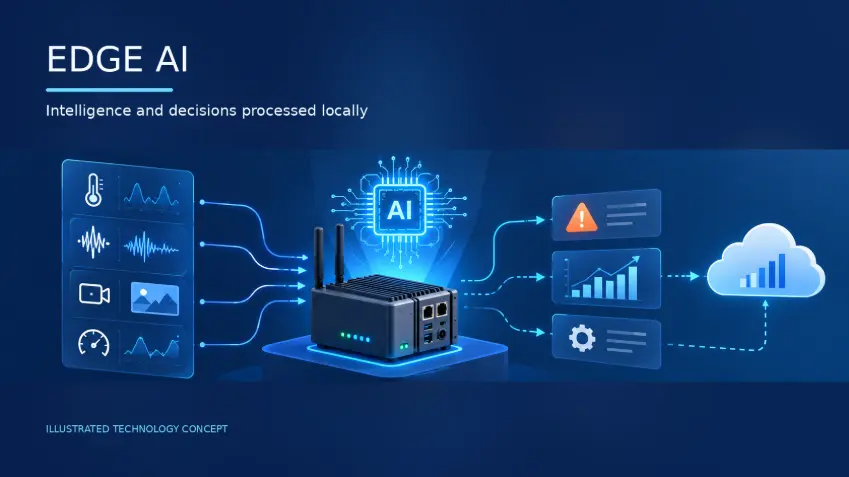
A typical Edge AI and IoT system follows five steps:
- Data collection: IoT sensors capture temperature, vibration, pressure, video, or other operational data.
- Local processing: An edge device or gateway prepares and processes the incoming information.
- AI inference: A trained AI model detects anomalies, recognizes objects, or predicts events.
- Decision and response: The system generates an alert, recommends an action, or triggers an authorized automated response.
- Cloud synchronization: Selected data, insights, and operational records are sent to cloud platforms for reporting, model improvements, or centralized management.
For example, a smart manufacturing system can analyze equipment vibration locally and alert technicians when unusual patterns appear.
Instead of continuously transmitting raw sensor data, it can send relevant alerts and selected measurements.
This architecture may reduce bandwidth consumption and allow certain decisions to continue when cloud connectivity is interrupted.
Edge AI vs. Cloud AI: What Is the Difference?
Both Edge AI and Cloud AI use artificial intelligence, but they differ in where data is processed.
| Feature | Edge AI | Cloud AI |
|---|---|---|
| Processing location | Device, gateway, or local server | Remote cloud infrastructure |
| Response time | Can support low-latency decisions | Depends partly on network conditions |
| Connectivity | Some functions work offline | Typically requires connectivity |
| Data transmission | Can reduce raw data transfers | Often sends more data to the cloud |
| Computing capacity | Limited by local hardware | Access to scalable compute resources |
| Best applications | Real-time monitoring and local control support | Large-scale analytics and model training |
Which is better? Neither architecture is universally better.
Edge AI is valuable when applications need fast local processing, limited bandwidth, or resilience during network outages.
Cloud AI is useful when workloads require extensive computing resources, centralized analysis, or large-scale model training.
For many organizations, a hybrid Edge AI and cloud architecture offers a practical balance.
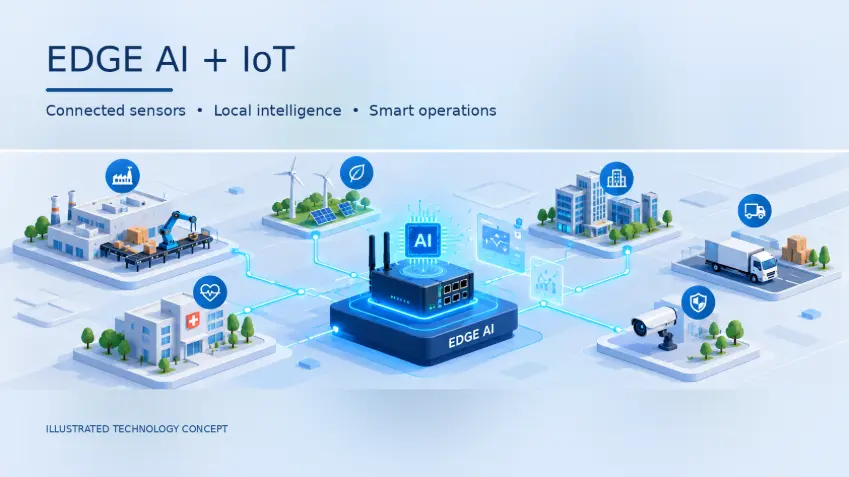
5 Real-World Edge AI and IoT Use Cases
1. Predictive Maintenance in Smart Manufacturing
Unexpected machine failures can interrupt production and increase maintenance costs. With industrial IoT sensors, organizations can continuously monitor temperature, vibration, and machine performance.
Edge AI models analyze this information and identify potential equipment anomalies. Business value:
- Earlier detection of potential faults
- Better maintenance scheduling
- Reduced need for continuous raw-data transmission
- Improved operational visibility
Predictive maintenance can help manufacturers move from reactive repairs toward condition-based maintenance. Its actual value depends on model accuracy, equipment characteristics, and maintenance processes.
2. Intelligent Logistics and Fleet Monitoring
Logistics providers increasingly depend on connected sensors and real-time operational data. Edge AI can support vehicle condition monitoring, driver-safety alerts, and local analysis of shipment conditions.
For example, temperature sensors in refrigerated transport can detect abnormal conditions and trigger alerts before sensitive goods are damaged.
Business value:
- Improved shipment visibility
- Faster incident detection
- More informed operational decisions
3. Smart Energy and Building Management
Commercial buildings use connected systems to monitor energy consumption, occupancy, temperature, and equipment performance. Edge AI can analyze these signals and support adjustments to heating, ventilation, air conditioning, and lighting.
For instance, occupancy-aware controls can help reduce unnecessary energy use in unoccupied spaces.
Business value:
- More efficient building operations
- Improved monitoring
- Potentially lower energy consumption
4. Healthcare and Remote Patient Monitoring
Connected medical devices can collect measurements such as heart rate, blood oxygen levels, and movement patterns. Edge AI can support local analysis and identify signals that require attention.
However, healthcare applications must meet relevant clinical validation, privacy, reliability, and regulatory requirements.
Business value:
- More timely monitoring insights
- Potentially reduced transmission of sensitive raw data
AI-generated alerts should complement, not automatically replace, professional medical judgment.
5. AI-Powered Quality Inspection
Manufacturers can combine industrial cameras with edge-based computer vision systems to identify visible defects. A model may detect scratches, missing components, incorrect assembly, or packaging inconsistencies.
Local inference can allow inspection results to feed into production workflows without requiring every image to be processed in the cloud.
Business value:
- Faster inspection feedback
- More consistent defect screening
- Improved quality-control visibility
What Are the Main Benefits of Edge AI and IoT?
Faster Decision-Making
Processing data closer to connected devices reduces dependence on round trips to cloud infrastructure.
This can be especially useful for time-sensitive monitoring and industrial applications.
Lower Data Transmission Requirements
Rather than transmitting every sensor reading or video frame, edge devices can send selected events, summaries, or exceptions.
The potential savings depend on network design, data volume, and application requirements.
Better Data Control
Some sensitive information can remain within a device or local environment.
However, local processing does not automatically guarantee privacy. Encryption, access controls, retention policies, and secure administration remain essential.
Greater Operational Resilience
Certain edge applications can continue functioning during temporary internet disruptions.
This benefit depends on whether the application has been designed for offline operation and local decision-making.
More Scalable Connected Operations
Distributed processing can reduce dependence on centralized infrastructure for every operational task.
However, deploying and maintaining large numbers of edge devices also introduces management complexity.
What Are the Biggest Challenges?
Despite its advantages, Edge AI is not a simple plug-and-play solution. Businesses should address several challenges before scaling:
1. Device security: Connected systems need secure identities, authentication, updates, and lifecycle management.
2. Hardware limitations: Edge devices have constraints involving memory, computing power, and energy consumption.
3. Model accuracy: AI models must be validated against real-world operating conditions and monitored for performance changes.
4. System integration: Edge infrastructure must communicate reliably with existing IoT platforms, manufacturing systems, and business applications.
5. Deployment costs: Hardware, integration, monitoring, and maintenance can affect the overall return on investment.
For industrial environments, safety requirements and human oversight are particularly important. High-impact automated actions should use appropriate safeguards.
Emerging Edge AI and IoT Trends in 2026
1. AIoT Platforms Are Becoming More Intelligent
Industrial platforms are evolving beyond basic device connectivity and dashboard reporting.
Organizations are integrating analytics, AI, and operational workflows to support more intelligent industrial systems.
2. Agentic AI Is Entering Industrial IoT
Agentic AI refers to AI systems that can plan or execute sequences of actions toward defined goals, subject to their capabilities and controls. Within industrial IoT, potential applications include investigating equipment anomalies, coordinating maintenance workflows, and recommending operational responses.
This remains an emerging field. Organizations should carefully assess reliability, authorization, and human oversight before using agents to control physical equipment.
3. Hybrid Edge-Cloud Architectures Are Gaining Importance
Instead of choosing between local processing and cloud computing, enterprises are increasingly evaluating systems that combine both. This allows time-sensitive applications to run locally while maintaining cloud-based analytics, model management, and centralized reporting.
4. Security and Lifecycle Management Are Becoming Critical
As connected environments expand, organizations need dependable processes for software updates, device monitoring, access management, and incident response. Managing AI models and devices across multiple locations is becoming an important architectural consideration.
Frequently Asked Questions About Edge AI and IoT
1. What is the difference between IoT and AIoT?
IoT connects physical devices to collect and exchange data. AIoT adds artificial intelligence to analyze that data, recognize patterns, and support intelligent decisions.
2. Does Edge AI require an internet connection?
Not always. Edge AI can perform certain local processing and inference tasks offline, provided the hardware, models, and application have been designed for that purpose. Connectivity may still be necessary for software updates, centralized monitoring, and cloud synchronization.
3. Is Edge AI better than cloud computing?
Edge AI is often better suited to low-latency local processing, while cloud computing provides scalable resources for centralized analytics and model training. Many enterprise solutions combine the two.
4. What industries benefit most from Edge AI and IoT?
Manufacturing, logistics, energy, smart buildings, and healthcare are prominent application areas. The business case depends on the operational problem and deployment environment.
5. How much does an Edge AI and IoT solution cost?
Costs vary according to the number of connected devices, hardware capabilities, AI model requirements, data integration, cybersecurity needs, and ongoing maintenance. A pilot project is often the most practical way to estimate implementation costs and potential ROI.
The Future of IoT Is More Intelligent and Distributed
The Internet of Things is evolving from connected data collection toward systems that can interpret information and support more timely decisions. Edge AI is an important part of that evolution.
By combining local intelligence with connected devices and cloud platforms, organizations can create more responsive manufacturing operations, smarter infrastructure, and better-informed workflows.
However, successful adoption depends on choosing the right use cases, building reliable architectures, and measuring real business outcomes.
For businesses exploring intelligent IoT solutions, the best starting point is a focused, measurable pilot designed around a real operational challenge.
Ready to Explore an AI-Powered IoT Solution?
Whether you're building a connected product, modernizing an industrial system, or adding AI capabilities to an existing IoT platform, the right architecture matters.
Connect with BHSoft to discuss your IoT development requirements, Edge AI integration opportunities, and scalable software architecture.