
Ngoc Nguyen
SEO Engineer
Home > Insight > Technology
What is Microservices
5 minutes read
Audio description available
Mar 30, 2026
To stay competitive in 2026, businesses need the ability to release new features in hours—not weeks. Microservices are the key to transforming bulky, monolithic systems into lightweight, manageable services that can scale flexibly in the cloud. This guide dives into enterprise microservices solutions that help your business operate smarter and more efficiently.
What is Microservices?
Microservices is an approach to building applications by breaking down a system into multiple independent services. Instead of a single massive codebase (monolith), each service is responsible for a specific function, making it easier to scale and update quickly and flexibly.
From a technical standpoint, microservices is a software architecture style composed of loosely coupled services. Each service runs as its own process, has its own database, and communicates with other services through lightweight mechanisms such as REST APIs or message queues.
This architecture forms the foundation of modern cloud-native microservices architecture and is widely used in enterprise microservices solutions.
Key Characteristics
- Independence: Each service can be developed, deployed, and scaled independently without impacting the rest of the system.
- Organized by Business Capability: Services are structured around business functions (e.g., Payments, Inventory, Users) rather than technical layers.
- API-Based Communication: Services communicate through APIs, creating a connected yet flexible ecosystem—core to API-driven microservices architecture.
Read more: Transition from monolithic to microservices architecture
Monolithic vs. Microservices Architecture
As systems grow, architectural decisions directly impact scalability and operational speed.
Monolithic Architecture
In a monolithic architecture, the entire application (UI, business logic, and database) is built and deployed as a single codebase.
Advantages:
- Simple to start with
- Easier to develop and test locally
Limitations:
- Time-consuming deployments (even small changes require redeploying the whole system)
- Difficult to scale individual components
- Higher risk of cascading failures
Microservices Architecture
In a microservices architecture, the application is divided into independent modules. Each service handles a specific function and owns its own data.
Advantages:
- Enables parallel development across teams
- Supports independent deployment
- Optimizes resource usage efficiently
Challenges:
- More complex to manage and operate
- Requires handling communication between services
Quick Comparison
|
Aspect |
Monolithic |
Microservices |
|
Deployment |
Deploy entire system at once |
Deploy each service independently |
|
Scaling |
Scale the whole application |
Scale only overloaded services |
|
Failure Handling |
One issue can crash the system |
Failures are isolated per service |
|
Innovation Speed |
Slower due to tight dependencies |
Faster with flexible CI/CD pipelines |
Transitioning to cloud-native microservices architecture is no longer just a technical trend—it’s a survival strategy.
In a fast-changing market, businesses need systems that can adapt quickly, scale efficiently, and evolve continuously. Microservices make that possible.
How Microservices Work
Microservices operate based on a combination of full independence and flexible connectivity—making them ideal for microservices architecture for scalable applications.
Core Structure
Each service in a microservices system is essentially a self-contained mini application.
Independent Logic: Each service handles a single business function (e.g., tax calculation or email delivery).
Database per Service: This is a key principle. Services do not share databases.
It prevents cascading failures and allows each service to choose the most suitable database (e.g., SQL for payments, NoSQL for user behavior tracking).
Communication
Since services run on different servers or containers, they communicate in two main ways:
Synchronous Communication: Using REST APIs or gRPC—ideal when an immediate response is required (e.g., checking account balance).
Asynchronous Communication: Using message brokers like Kafka or RabbitMQ.
One service publishes an event, and others consume it when ready—helping the system stay stable under heavy load.
Deployment Model
In 2026, microservices are tightly coupled with modern cloud technologies:
Containers (Docker): Package code and runtime into a consistent unit that runs the same everywhere.
Orchestration (Kubernetes): Acts as the “conductor,” managing hundreds of containers—automatically restarting failures and scaling resources based on traffic.
This combination enables cloud-native microservices architecture that is scalable, resilient, and built for continuous delivery.
Learn more: Microservices-based cloud application development
Benefits of Microservices
Adopting microservices isn’t just a technical shift—it’s a strategic move that helps businesses operate faster, scale smarter, and stay flexible.
Scalability
Instead of scaling the entire application, you only scale the service under heavy load.
Example: In eCommerce, you can scale the payment service during peak sales without touching other services.
Agility & Faster Development
Microservices allow teams to work independently.
Faster releases with separate CI/CD pipelines
Update one service without waiting for others
Shorter time-to-market
Resilience
Microservices improve system reliability through fault isolation.
A failure in one service doesn’t bring down the entire system
Core functions (e.g., search, checkout) can continue running
Technology Flexibility
Each service can use the best technology for its job.
Python/Go for data processing
Node.js for fast APIs
This enables a flexible cloud-native microservices architecture.
Cost Optimization
Microservices help optimize infrastructure costs:
Scale only what you need
Use lightweight containers with auto-scaling
Avoid running oversized systems
Read more: Legacy system modernization with microservices
Microservices Architecture Components
A modern microservices architecture for scalable applications relies on several core components working together to ensure performance, reliability, and scalability.
Key Components
- API Gateway: Acts as the single entry point for clients. It routes requests to the right services, handles authentication, and enforces security.
- Service Registry & Discovery: Keeps track of all running services and their locations. Enables dynamic service-to-service communication in distributed systems.
- Load Balancer: Distributes incoming traffic across multiple service instances to ensure high availability and performance.
- Messaging System: Enables asynchronous communication using tools like Kafka or RabbitMQ—critical for event-driven microservices-based application development.
- Monitoring & Logging: Tracks system health, performance, and errors. Essential for maintaining production-ready microservices systems.
Microservices and DevOps
Microservices and DevOps go hand in hand.
CI/CD pipelines automate build, test, and deployment
Automation reduces manual errors and speeds up delivery
Enables continuous delivery and rapid iteration
This combination is key to building scalable microservices systems that can evolve quickly.
Microservices and Cloud-Native Architecture
Microservices work best when combined with cloud infrastructure.
👉 Microservices + Cloud = maximum efficiency
Key Benefits
- On-demand scaling
- Pay-as-you-go pricing
- High flexibility and resilience
- Foundation for Modern Systems
Microservices are the backbone of:
- SaaS platforms
- AI systems
- Modern digital platforms
This is why cloud-native microservices architecture is the standard in 2026.
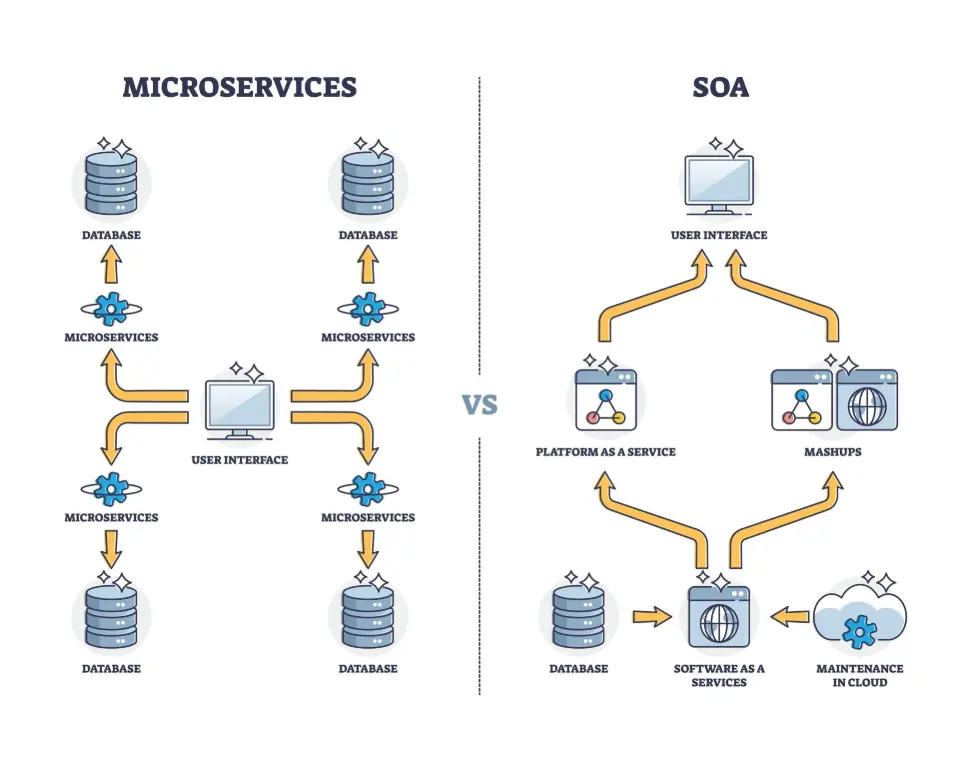
Microservices vs SOA (Service-Oriented Architecture)
While both architectures use services, they differ significantly in design and scalability.
|
Aspect |
Microservices |
SOA |
|
Service Size |
Small, focused |
Larger, more complex |
|
Architecture |
Decentralized |
Centralized governance |
|
Deployment |
Independent |
Often coordinated |
|
Flexibility |
High |
Moderate |
|
Scalability |
Highly scalable |
Less flexible |
Microservices Best Practices
Building a successful microservices system requires more than just splitting services. Below are four core principles to optimize performance and operations in modern microservices architecture for scalable applications.
Design Around Business Domains (Domain-Driven Design – DDD)
Instead of organizing by technical layers, structure services based on real business domains.
Each service owns a specific domain (e.g., Payments, Inventory, Customers)
Clear boundaries reduce dependencies between teams
Aligns architecture with business goals
Adopt an API-First Strategy
Design and define APIs before writing code.
Establish clear contracts between services
Enable teams to develop in parallel without blocking each other
Ensure consistency and seamless integration across systems
This is critical for API-first microservices architecture in cloud-native environments.
Implement Observability
In distributed systems, visibility is essential.
Logs & Metrics: Monitor errors and performance in real time
Distributed Tracing: Track requests across multiple services to quickly identify bottlenecks
Fully Automate with CI/CD & DevOps
Manual deployment doesn’t scale with microservices.
Use automated pipelines for build, test, and release
Reduce human error and improve deployment speed
Support continuous delivery without system disruption
The Future of Microservices
MACH Architecture
MACH is becoming the gold standard for modern enterprise systems:
Microservices + API-first + Cloud-native + Headless
Value: Eliminates dependency on legacy, monolithic platforms and allows businesses to adopt a best-of-breed approach—choosing and replacing components as needed.
AI-Driven Microservices
The rise of AI is making microservices smarter and more autonomous:
LLM Integration: Each microservice can now handle AI-powered tasks such as content summarization or real-time customer behavior analysis.
AIOps: AI is used to detect issues, predict traffic, and automatically adjust system resources (self-healing systems).
Serverless Microservices (FaaS)
The line between traditional microservices and serverless is fading:
Function-as-a-Service (FaaS)
Services are deployed as independent functions (e.g., AWS Lambda, Google Cloud Functions).
Benefits:
Zero cost when idle
Instant scalability without server management
Platform Engineering (The IDP Era)
As systems grow more complex, platform engineering is becoming essential:
Internal Developer Platforms (IDP)
Internal platforms that allow developers to provision services, deploy, and monitor without deep infrastructure knowledge.
Goal: Improve developer experience (DevEx) and accelerate time-to-market.
Conclusion:
Microservices have become the foundation of modern. As businesses evolve, adopting the right architecture is critical to staying competitive. With proven experience in digital transformation and custom software, Bachasoftware delivers tailored enterprise microservices solutions that help companies build, scale, and innovate with confidence.