
Ngoc Nguyen
SEO Engineer
Home > Insight > Technology
The Future of Coding: AI Code Generation Explained
5 minutes read
Audio description available
May 26, 2026
The global software development landscape is undergoing a massive paradigm shift. The phrase "the future of coding" is no longer a distant projection for the next decade—it is unfolding right now before our eyes. Driven by rapid advancements in artificial intelligence, software engineering workflows are gradually shifting from manual coding toward more intent-driven development approaches.
According to recent research and industry reports from leading AI research labs like Anthropic and OpenAI, autonomous systems are evolving past simple autocomplete mechanisms. Instead, they are taking on full-cycle development tasks. But what exactly is AI code generation explained in simple terms? Will artificial intelligence entirely replace software engineers, or will it act as a force multiplier that expands human capability? Let's analyze the technology, trends, and real-world implications shaping tomorrow's software landscape.
Fundamentals of AI Code Generation
To understand the future of software engineering, it is essential to examine the core technologies behind AI code generation. Unlike traditional rule-based automation, modern AI coding systems rely on advanced machine learning models capable of understanding both natural language instructions and programming logic.
The foundational architecture of AI code generation is built upon five interconnected pillars:
1. Large Language Models (LLMs) and Transformer Architectures
At the core of AI code generation are large language models powered by transformer architectures. These neural networks use Attention Mechanisms to recognize complex, long-range relationships between natural language prompts and code structures.
Instead of processing code line-by-line, Transformers evaluate the entire context simultaneously. However, they operate within a strict memory limit known as the Context Window. Modern AI coding systems optimize this window by using attention scores to pinpoint exactly which functions, variables, and global dependencies are relevant to the specific line of code being generated, maintaining logical consistency across large-scale projects.
2. Code-Specific Tokenization
Before a model can reason about software, raw text must be converted into numerical format through a process called tokenization. Traditional LLMs are tokenized for human conversations, but AI code generators employ specialized Code-Tokenizers.
Programming languages rely heavily on structural whitespace (such as Python’s indentation), special characters ({, }, =>, ++), and strict naming conventions (camelCase or snake_case). Code-specific tokenizers ensure these syntax-critical symbols are preserved and represented as distinct logical blocks. This prevents the model from breaking a single variable name into meaningless fragments, significantly reducing syntax errors during generation.
3. Massive Code Datasets and Technical Knowledge
Modern AI coding assistants are trained on massive, diverse datasets that include billions of lines of code from publicly available repositories, open-source projects, programming tutorials, and technical documentation.
By analyzing this vast multi-language corpus (including Python, Java, C++, TypeScript, and Go), AI models do not just memorize snippets; they learn universal computing patterns. They absorb syntax rules, architectural styles, standard debugging workflows, and common development conventions. This extensive pre-training allows the model to act as a multilingual engine capable of cross-language translation and polyglot reasoning.
Read more: Top programming languages for custom software development
4. Context Enrichment via Retrieval-Augmented Generation (RAG)
An AI model’s pre-trained knowledge is static, but software development is dynamic and highly customized. To bridge this gap, modern AI coding assistants utilize Retrieval-Augmented Generation (RAG) to understand a developer's local codebase in real-time.
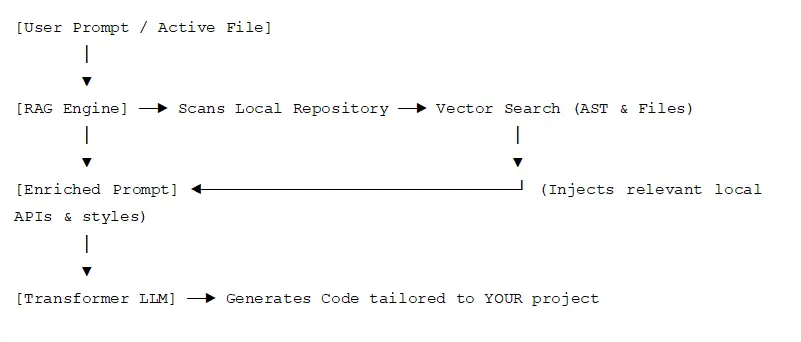
When a developer types a prompt or requests a code completion, the RAG engine automatically scans the local repository, indexing project-specific APIs, internal libraries, and unique coding standards. By injecting this relevant local context directly into the prompt before it reaches the LLM, the AI can generate tailored code that seamlessly integrates into the user's specific architecture without requiring fine-tuning.
5. Structural Understanding and Code Representation
Advanced AI coding systems go beyond surface-level text prediction. Many modern models incorporate structural code analysis techniques that help them better understand program logic, syntax relationships, and execution flow.
Many AI development frameworks leverage representations such as Abstract Syntax Trees (ASTs). By parsing code into a tree of structural nodes rather than a flat string of text, the system achieves a deeper mathematical understanding of scope, variable inheritance, and data flow. This structural awareness improves the validation, quality, and contextual reasoning of software generation.
6. Inference, Execution, and the Self-Correction Loop
The final fundamental element of AI code generation is the transition from passive text generation to active, closed-loop reasoning during the Inference (Decoding) phase.
Advanced AI coding systems do not just output the first code structure they calculate. They utilize decoding strategies (like top-p sampling or beam search) to evaluate multiple logical paths.
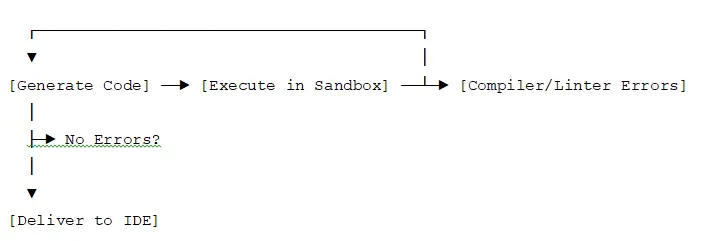
Furthermore, next-generation AI agents employ an Execution and Self-Correction Loop. When tasked with a complex problem, the AI generates code and executes it within an isolated virtual environment (sandbox). If the code fails, the system feeds the compiler errors, runtime logs, or linter warnings back into its own context window, automatically rewriting and refining the code until it passes validation before ever presenting it to the human developer.
Read more: The Best Web Development Tools to Use
AI Code Generation vs. Traditional Code Completion: What is the Difference?
While they may look similar inside an Integrated Development Environment (IDE), it is critical to separate next-generation AI from traditional software assistants.
|
Criteria |
Code Completion (Traditional IntelliSense) |
AI Code Generation (Generative AI) |
|
Core Technology |
Rule-based algorithms, static analysis, and regex patterns. |
Deep learning, Large Language Models (LLMs), and NLP. |
|
Scope of Output |
Single words, specific variable names, or basic method signatures. |
Full functions, complete classes, unit tests, or entire multi-file architectures. |
|
Contextual Awareness |
Limited to the immediate file or active library imports. |
Broad multi-repository awareness, structural codebase patterns, and natural language prompts. |
|
Problem Solving |
Cannot solve logical problems; only speeds up manual typing. |
Can synthesize new logic, convert pseudocode to functional algorithms, and refactor codebases. |
In short, while code completion acts as a smart typewriter, AI code generation functions as an intelligent co-developer.
Key Benefits of AI Code Generation in Software Development
Integrating generative AI into the software development lifecycle (SDLC) yields measurable strategic advantages for engineering teams, transforming not just how code is written, but how software is maintained and scaled:
1. Accelerated Developer Velocity & Productivity
AI automates repetitive, boilerplate code generation (such as setting up APIs, CRUD operations, and configuration files). This speeds up development cycles by 30% to 50%, allowing engineers to bypass mundane tasks and focus their energy on high-value business logic and system architecture.
2. Rapid Prototyping & MVP Deployment
Turning an abstract concept into working software used to take weeks. With AI, developers can describe a system in plain English and generate functional prototypes within hours. This radically accelerates time-to-market and allows teams to validate ideas with minimal upfront cost.
3. Continuous Testing & Automated Documentation
Writing tests and documentation often takes up more time than writing the actual feature code. AI tools can instantly generate comprehensive Unit Tests, Integration Tests, and edge-case scenarios that human developers might overlook. Simultaneously, AI can automatically generate precise API documentation and code comments, ensuring the codebase remains understandable.
4. Mitigation of Technical Debt & Code Standardization
Every developer has a unique coding style, which can lead to fragmented codebases and rising technical debt. When integrated with a team's specific coding guidelines, AI acts as a guardrail. It enforces clean code standards and design patterns across the entire team, ensuring that all generated code is uniform, maintainable, and highly readable.
5. Instantaneous Debugging and Optimization
AI tools can scan thousands of lines of code in seconds to identify hidden logic flaws, memory leaks, or suboptimal algorithms. Instead of spending hours digging through logs, developers receive instant refactoring suggestions, security vulnerability alerts, and precise hotfixes.
6. Frictionless Onboarding & Knowledge Democratization
Navigating a massive, legacy codebase is a major bottleneck for new hires. AI acts as an on-demand technical mentor and a "living map" of the project. New developers can ask the AI questions like "How does this payment gateway module work?" or "Where is the user authentication flow defined?", reducing onboarding times from months to days.
7. Elevating Developer Experience (DX) & Reducing Burnout
The requirement to manually write thousands of lines of repetitive code is a leading cause of developer burnout. By absorbing the cognitive load of routine coding tasks, AI significantly improves the daily Developer Experience. Engineers are freed to solve complex, creative, and challenging problems, leading to higher job satisfaction and lower team turnover.
Key Trends Outlining the Future of Coding
Empirical evidence underscores the rapid integration of AI tools within professional ecosystems. Industry data indicates that approximately 41% of all code assets are currently produced with AI assistance, and over 76% of software engineers have integrated generative AI platforms into their daily workflows.
Trend 1: From "Co-pilots" to Autonomous "AI Agents"
The industry is transitioning from simple autocompletion extensions to complex Agentic Coding ecosystems. Unlike standard tools that require line-by-line human oversight, autonomous AI Agents can independently reason, formulate test cases, resolve regression bugs, and manage multi-step deployment configurations across multi-day operations with minimal human intervention.
Trend 2: The Emergence of "Vibe Coding"
"Vibe Coding" describes an emerging paradigm shift where engineers focus exclusively on specifying system properties, overarching business logic, and UX objectives using natural language—the overall "vibe." Lower-level syntax execution and compilation are left entirely to integrated AI frameworks, enabling both developers and non-technical stakeholders to build robust systems at unprecedented speeds.
Trend 3: Software Engineers as Architectural Auditors
As AI handles tactical code execution, the human developer's role is shifting toward strategic oversight. Because different AI agents can solve identical problems using entirely disconnected software patterns, human engineers must step in as Architectural Gatekeepers. The primary objective is no longer writing code, but structural design, security auditing, and comprehensive validation.
Trend 4: The Rise of "Disposable Code" & AI-Native Architecture (Bổ sung mới)
Traditionally, companies spent millions maintaining legacy codebases to avoid breaking dependencies. The future belongs to Disposable Code and AI-Native systems. Instead of refactoring or maintaining old, complex software, AI will simply rewrite the entire application or microservice from scratch whenever requirements change. Code will become a temporary, just-in-time asset rather than a permanent liability.
Learn more: Low-code development services
How to Integrate AI Coding Tools into DevOps Workflows
To unlock the true power of AI code generation at an enterprise scale, it must be embedded directly into your Continuous Integration and Continuous Deployment (CI/CD) pipelines. Here is how leading teams integrate AI tools into a closed-loop DevOps workflow:
Step 1: Automated AI Code Review at Commit Stage
Integrate AI agents into repository webhooks (e.g., GitHub Actions, GitLab CI). Whenever a developer submits a Pull Request (PR), the AI automatically executes an initial review pass, scanning for style deviations, logical flaws, and anti-patterns before a human reviewer even opens the file.
Step 2: Automated Test Suite Generation
Embed AI tools within the testing pipeline to eliminate manual, tedious test writing. The AI analyzes new code additions in real-time and automatically generates comprehensive unit tests, integration tests, and edge-case validations, seamlessly boosting test coverage.
Step 3: Predictive Shift-Left Security Testing
By combining AI with Static Application Security Testing (SAST), the CI pipeline predictively rewrites vulnerable code segments during build time. If the AI detects a vulnerability (like an SQL injection), it doesn't just flag it—it injects a secure, parameterized code fix instantly.
Step 4: AI-Driven Documentation & Release Notes
As code moves toward deployment, AI tools parse the git diffs to automatically update internal technical documentation (e.g., Swagger/OpenAPI docs) and generate clean, human-readable release notes for the deployment logs.
Step 5: AI for Infrastructure as Code (IaC) Validation (Bổ sung mới)
DevOps requires secure infrastructure. AI engines scan environment configuration files (Terraform, Kubernetes YAML, Dockerfiles) within the CD pipeline to detect cloud misconfigurations, security drift, and cost inefficiencies before resources are provisioned.
Step 6: Automated Incident Response & Auto-Rollback (Bổ sung mới)
Once code is live, the loop closes with AIOps. If production monitors detect a crash or anomaly, the AI analyzes real-time logs and metrics to perform immediate Root Cause Analysis, identifying the exact code change that caused the failure. It can then automatically trigger a rollback to the last stable build while generating a hotfix PR for the engineering team.
Market-Leading AI Code Generation Ecosystems
To stay competitive in the shifting tech landscape, engineers and technology leaders must align themselves with market-dominant platforms:
|
Platform Name |
Developer Entity |
Core Competencies & Advantages |
|
GitHub Copilot |
GitHub / Microsoft |
Flawless Integration into native IDEs (VS Code), providing highly responsive inline autocompletion and structural boilerplate generation. |
|
Claude Code |
Anthropic |
Exceptional handling of large context windows, advanced architectural advice, and superb reasoning capabilities for complex logical bugs. |
|
Gemini Code Assist |
Google Cloud |
Expansive multi-repository awareness, tight Google Cloud integration, and robust enterprise-grade security protocols. |
|
Cursor / Windsurf |
AI-Native Projects |
Ground-up engineered developer environments designed explicitly around conversational AI interaction, optimizing multi-file edit workflows. |
Critical Obstacles and Strategic Challenges
Despite yielding software lifecycle efficiency gains between 30% and 50%, relying too heavily on generative AI introduces distinct engineering, legal, and operational risks:
1. Implicit Security Vulnerabilities & Hallucinations
AI models can introduce outdated code patterns, insecure library dependencies, or synthetic bugs (hallucinations) if their training data does not reflect recent security patches. Without rigorous scanning, these vulnerabilities can slip silently into production.
2. Intellectual Property & Licensing Compliance
Code segments generated by automated tools can occasionally mirror copyrighted open-source logic or copyleft-licensed code (e.g., GPL). This creates legal exposure, posing regulatory compliance and intellectual property (IP) challenges for commercial enterprise applications.
3. Code Blindness & Technical Debt
Blindly accepting AI recommendations without a deep architectural understanding of the software leads to "Code Blindness." This results in silent logical failures, fragmented software patterns, and structural technical debt that makes systems incredibly fragile and difficult to maintain over the long term.
4. Code Inflation & Hidden Maintenance Costs
Because AI makes code generation friction-free, developers tend to generate massive, overly complex codebases (over-engineering). This "Code Inflation" artificially inflates the asset size, leading to higher cloud computing costs, longer compile times, and an increased burden for code review teams.
5. Developer Skill Atrophy & Knowledge Loss
Over-reliance on AI poses a long-term talent risk. Junior engineers who rely on AI to solve every algorithmic challenge may experience skill atrophy, losing the ability to debug complex systems or reason from first principles. This creates an institutional knowledge gap and a shortage of future software architects.
6. Ecosystem Stagnation & Model Collapse
As the internet becomes saturated with AI-generated software, newer AI models risk being trained on data produced by older AIs. This creates a feedback loop that can lead to model collapse, where AI tools merely replicate existing software paradigms, potentially stagnating the evolution of new programming concepts and frameworks.
Leading the AI Transformation with Strategic Partners
AI is not replacing software engineers—it is transforming how software is built. Developers and organizations that effectively leverage AI-driven development will gain a significant competitive advantage in the evolving digital landscape.
To stay ahead, businesses must strengthen their AI development strategies, improve system design capabilities, and adopt reliable automated testing and verification processes.
As a AI development company in Vietnam, Bachasoftware helps global enterprises integrate AI-powered software development practices, build scalable architectures, and accelerate time-to-market through agile and intelligent engineering solutions. The future of software engineering is already here, and businesses that adapt early will be best positioned to lead the transformation.