
Ngoc Nguyen
SEO Engineer
Home > Insight > Technology
How to Set Up and Run an Offshore Development Center
5 minutes read
Audio description available
Jan 29, 2026
Building an Offshore Development Center (ODC) is no longer just a cost-saving move—it’s a strategic way to scale faster, access global tech talent, and maintain long-term control over product development. In this guide, How to Set Up and Run an Offshore Development Center, we share practical insights drawn from real delivery experience, including how BHSOFT’s Offshore Development Center helps global companies build stable, high-performing engineering teams. From planning and setup to daily operations and governance, this article is written to give decision-makers a clear, trustworthy, and actionable starting point.
What Is an Offshore Development Center (ODC)?
An Offshore Development Center (ODC) is a dedicated software development team located in another country that operates as a true extension of your in-house team. Unlike short-term vendor engagements, an ODC works exclusively for your business, follows your processes, and aligns with your long-term product roadmap, technical standards, and company culture.
ODC vs. Traditional Outsourcing: Key Differences
The biggest difference between an ODC and traditional outsourcing is control and integration. With an ODC, you directly manage the team’s priorities, workflows, and performance, just as you would with an internal team. The engineers are deeply integrated into your culture, communication style, and engineering practices.
Traditional outsourcing often focuses on project-based delivery with limited transparency and shared resources. An ODC gives you stronger intellectual property protection, consistent process control, and better knowledge retention, making it a preferred model for companies building core products or scaling engineering capacity long term.
Key Benefits of Setting Up an Offshore Development Center (ODC)
1. Cost Optimization
An Offshore Development Center helps significantly reduce hiring and operational costs compared to building the same team domestically. Companies save on salaries, office space, and infrastructure while maintaining full control over the team. By leveraging competitive labor markets in popular ODC destinations such as Vietnam, the Philippines, and India, businesses can achieve high-quality development at a lower total cost.
2. Access to Global Talent
An ODC opens the door to a broader, highly skilled talent pool. Companies can tap into specialists with deep expertise in modern technologies, emerging frameworks, and niche domains that may be hard or expensive to find locally.
3. Scalability and Flexibility
With an ODC model, team size can scale up or down quickly based on project needs. This flexibility allows businesses to respond faster to market changes without the long-term commitments of local hiring.
4. Faster Time to Market
Distributed teams working across time zones enable near-continuous development cycles. While one team signs off, another picks up the work, helping products move from idea to release more quickly.
5. Stronger Focus on Core Business
By delegating day-to-day development work to a trusted ODC team, companies can focus more on strategy, innovation, and core business value, without being slowed down by resource constraints or operational overhead.
Risks of Offshore Development Centers and How to Mitigate Them
1. Language and Cultural Barriers
Cultural differences and communication styles can lead to misunderstandings and reduce team efficiency if not managed properly.
How to mitigate: Invest in cultural training, set clear expectations from day one, and run a structured onboarding process to align values, workflows, and communication norms.
2. Time Zone and Communication Challenges
Working across time zones can make real-time collaboration harder, especially when there is little overlap in working hours.
How to mitigate: Define shared overlap hours for key meetings and rely on async-friendly tools like Slack, Notion, and Loom to keep work moving without delays.
3. Legal and Compliance Risks
Labor laws, data protection rules, and employment regulations vary by country and can create compliance risks if overlooked.
How to mitigate: Partner with a trusted local provider or engage legal experts early to ensure contracts, data security, and employment practices meet local and international standards.
4. Knowledge Transfer and Team Engagement
Without clear processes, offshore teams may struggle to fully understand products, domain knowledge, or long-term goals.
How to mitigate: Build strong onboarding and documentation practices, and assign mentors or technical leads to support continuous knowledge transfer and team alignment.
Common Offshore Development Center (ODC) Models
1. Managed ODC
In a Managed ODC model, the service provider handles end-to-end operations, including hiring, HR, infrastructure, and daily team management. The client focuses mainly on defining tasks, goals, and deliverables. This model is ideal for companies that want faster setup and lower operational overhead while still maintaining visibility into development progress.
2. BOT (Build – Operate – Transfer)
The BOT model allows a partner to build the team and infrastructure, operate the ODC for a defined period, and then transfer full ownership to the client. It’s a strategic option for businesses that want to establish their own offshore center long term but prefer to reduce initial risk and setup complexity.
3. Contractor vs. Customer ODC
Contractor ODC: The partner manages most operational aspects, including staffing, compliance, and performance management. This model offers convenience and speed, with less internal involvement required from the client.
Customer ODC: The client company fully owns and controls the ODC, from people and processes to culture and technology decisions. While this requires stronger internal management, it offers maximum control, transparency, and long-term stability.
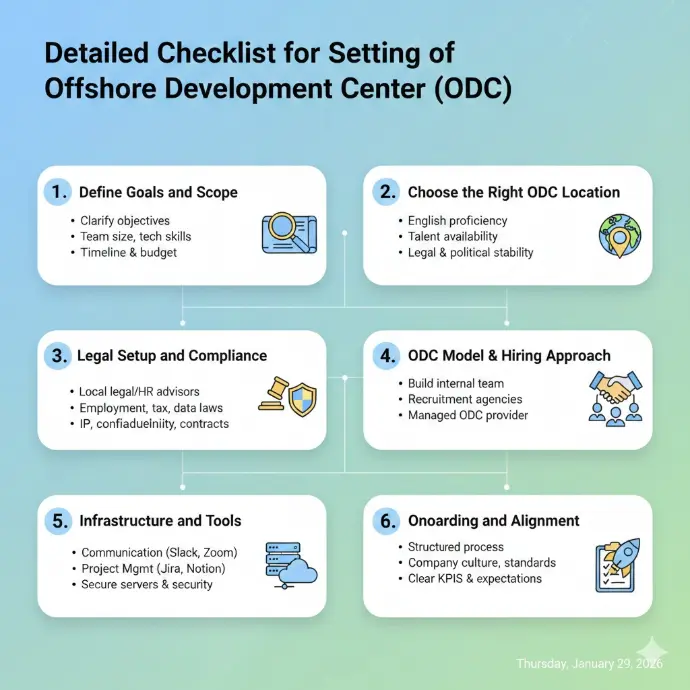
Detailed Checklist for Setting Up an Offshore Development Center (ODC)
1. Define Goals and Scope
Start by clarifying what you want to achieve with your ODC. Define the team size, required technical skills, expected timeline, and overall budget. Clear goals help avoid misalignment and guide every decision that follows.
2. Choose the Right ODC Location
Select a location based on key factors such as English proficiency, talent availability, cost efficiency, and legal and political stability. Popular ODC destinations succeed because they balance technical capability with predictable operating conditions.
3. Legal Setup and Compliance
Engage local legal and HR advisors early to navigate employment laws, tax requirements, and data protection rules. Ensure contracts clearly define IP ownership, confidentiality, and compliance to reduce long-term risk.
4. Select the ODC Model and Hiring Approach
Decide whether to build the team yourself, work with recruitment agencies, or partner with a managed ODC provider. Some partners can support both hiring and daily operations, helping you launch faster with lower setup effort.
5. Infrastructure and Tools
Set up reliable infrastructure, including communication tools like Slack and Zoom, project management platforms such as Jira and Notion, secure servers, and strong security controls to protect data and source code.
6. Onboarding and Alignment
A structured onboarding process is critical. Introduce company culture, working standards, and clear KPIs so the offshore team understands expectations and can contribute effectively from the start.
Operating and Managing an Offshore Development Center Effectively
1. Communication and Scheduling
Strong communication is the foundation of a successful ODC. Set daily overlap hours for real-time collaboration and define clear response-time expectations across channels. This helps avoid delays and keeps everyone aligned despite time zone differences.
2. KPIs and Performance Tracking
Track performance using well-defined metrics such as project milestones, sprint delivery, bug rates, and team velocity. These KPIs provide transparency, support data-driven decisions, and help identify issues early.
3. Team Engagement and Culture
Treat the offshore team as part of the same organization. Run regular all-hands meetings, virtual team-building activities, and consistent feedback cycles to build trust, motivation, and long-term commitment.
4. Training and Skill Development
Invest in continuous learning by offering clear development paths, technical training, and mentorship. Ongoing skill development not only improves delivery quality but also increases retention and team stability over time.
Conclusion
Building and operating an Offshore Development Center (ODC) is a strategic move for companies that want to scale sustainably, access specialized talent, and keep full control over their technology and IP. When done right, an ODC becomes a long-term extension of your in-house team—driving faster delivery, better quality, and stronger alignment with business goals.
At BHSOFT, we help global businesses design, launch, and run ODCs that deliver real impact. Our expertise spans GIS solutions, IoT & Smart City solutions, and DevOps services, enabling clients to build secure, scalable, and future-ready platforms with offshore teams they can truly rely on.
If you’re planning to set up an ODC or optimize an existing one, talk to BHSOFT today to see how our tailored ODC services and technology solutions can support your growth and innovation journey.