
Phuong Thao Do
Content Marketing
Home > Insight > IT Business
ERP Customization for Manufacturing in 2026: Scaling Toward Industry 5.0
5 minutes read
Audio description available
Update on Apr 26, 2026
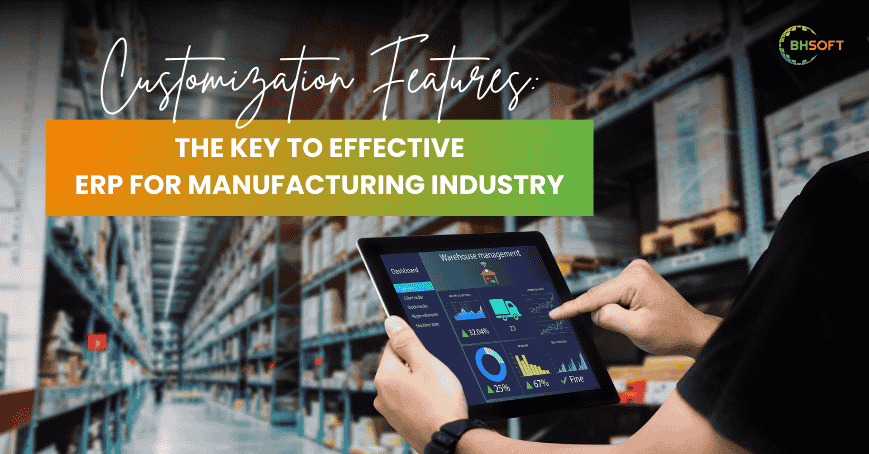
In 2026, the "out-of-the-box" ERP is a relic. As manufacturing shifts from mass production to hyper-personalization and resilient supply chains, the ability to customize your Enterprise Resource Planning (ERP) system has become a core competitive advantage.
At Bachasoftware, we’ve observed that the most successful manufacturers aren't just using ERPs to record data—they are customizing them to orchestrate intelligence. This guide explores how to strategically tailor your ERP to meet the manufacturing demands of 2026.
Why Standard ERPs Fail the Modern Factory Floor
According to Fortune Business Insights, the global ERP software market is expected to grow from $63.57 billion in 2023 to $145.58 billion by 2030, with manufacturing being one of the largest contributors. This growth highlights the increasing need for ERP systems to handle complex workflows in modern manufacturing.
Most legacy ERP systems were built for linear processes. However, modern manufacturing is non-linear. Standard modules often lack the granularity required for:
- Real-time IoT Integration: Syncing shop-floor sensor data directly into financial forecasting.
- Dynamic BOM (Bill of Materials): Managing complex versions for eco-friendly or customized product variants.
- Predictive Latency: Standard systems tell you what happened; customized systems tell you what will happen.
Read more: ERP For Retail Industry: Why Odoo is Essential
Why Customization is Non-Negotiable in 2026
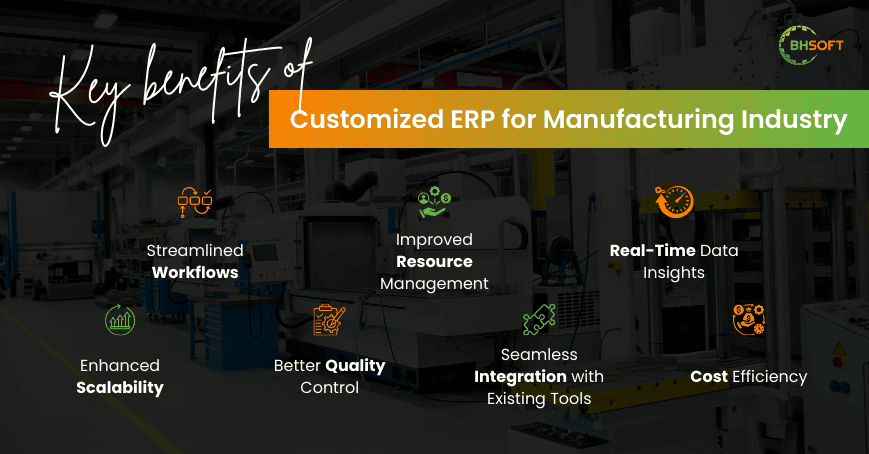
Moving beyond generic functionality, a tailored ERP acts as a "Digital Nervous System" for your factory. The core advantages include:
Hyper-Streamlined Workflows: Eliminates manual friction by automating niche shop-floor processes that standard "one-size-fits-all" software ignores.
Precision Resource Orchestration: Provides granular, real-time visibility into inventory and labor, drastically cutting waste and improving OEE (Overall Equipment Effectiveness).
Data-Driven Agility: Transforms raw data into actionable intelligence, allowing leadership to pivot production strategies based on live market shifts.
Future-Proof Scalability: Unlike rigid legacy systems, a custom architecture evolves with your business, supporting new product lines or global expansion without a total system overhaul.
Total Quality Synchronization: Integrates quality checkpoints directly into the production heartbeat, ensuring compliance and reducing defect rates to near zero.
Unified Ecosystem (Zero Silos): Seamlessly bridges the gap between the C-suite and the shop floor by integrating with existing CRMs, IoT sensors, and legacy accounting tools.
Long-Term Cost Optimization: By removing "feature bloat" and minimizing operational errors, customization delivers a significantly higher Lifetime Value (LTV) compared to off-the-shelf subscriptions.
Learn more: Custom ERP Software Development: Tailored Solutions for Your Business
Strategic Customization Trends for 2026
A. Composable ERP Architecture
The trend for 2026 is composability. Instead of a monolithic update, we customize by creating "Packaged Business Capabilities" (PBCs). This allows your ERP to be modular, where specific functions (like a custom Quality Control module for specialized electronics) can be updated without breaking the entire system.
B. AI & Generative Orchestration
We are no longer just customizing fields; we are customizing logic flows.
Agentic Workflows: We integrate AI agents into the ERP to automate procurement decisions based on geopolitical risk signals or fluctuating raw material costs.
Natural Language Querying: Customizing the UI so floor managers can ask the ERP, "Show me the impact on the July schedule if Machine 4 goes down for 6 hours," and receive an instant visual simulation.
C. Digital Twin Synchronization
Customization now involves bridging the physical and digital. By tailoring your ERP to feed data into a Digital Twin, manufacturers can simulate production runs before a single machine starts, saving thousands in potential waste.
Choosing the right ERP for Manufacturing Industry: Essential Criteria
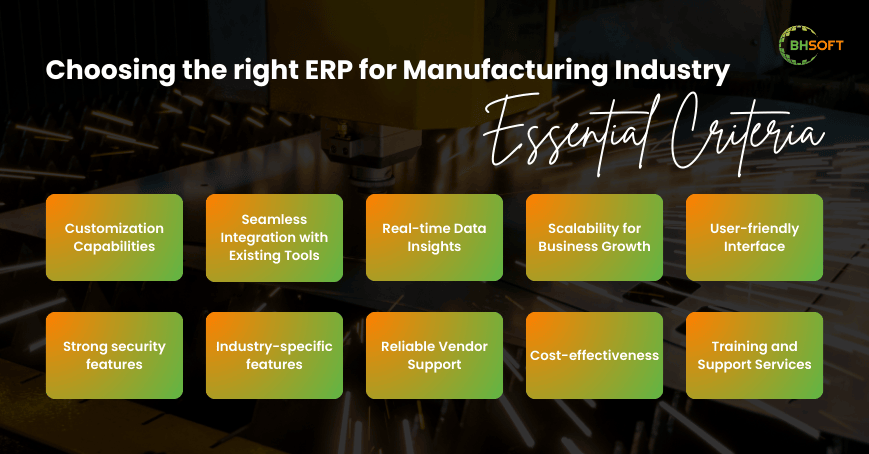
Selecting an ERP is no longer just about buying software; it is about building a digital foundation.
- Deep Customization & API-First Design: Avoid "vendor lock-in." Ensure the platform allows for deep architectural tailoring and seamless connection to your specific IoT and shop-floor ecosystem.
- Intelligence & Real-Time Orchestration: Prioritize systems that offer predictive analytics over static reporting. Your ERP must process live data to anticipate supply chain shifts and production bottlenecks before they occur.
- Elastic Scalability: In a volatile market, your system must scale instantly—supporting new global facilities, complex product lines, and increased data loads without performance degradation.
- Human-Centric UX & Security: High-tech doesn't have to be high-friction. Look for intuitive, role-based interfaces secured by zero-trust architectures and multi-factor authentication to protect your proprietary IP.
- Domain-Specific Expertise: Partner with a vendor that understands the "factory language." Effective implementation requires a partner who can bridge the gap between high-level code and physical production realities.
- Total Value of Ownership (TVO): Look beyond the initial sticker price. Evaluate the long-term ROI generated by increased efficiency, reduced waste, and the ability to pivot faster than the competition.
Learn more: Web UI For Terminal-Based Programs
High-Value Customization Areas for Manufacturers
Once you have selected the right ERP platform, the next step is identifying where customization delivers the highest business value. Instead of over-customizing everything, focus on areas that directly impact efficiency, cost reduction, and competitive advantage.
|
Feature Area |
Standard Function |
Customized Capability |
|
Inventory |
Min/Max Alerts |
AI Demand Sensing: Adjusts levels based on social trends & weather. |
|
Production |
Static Scheduling |
Autonomous Rescheduling: Real-time adjustments for energy costs. |
|
Supply Chain |
Vendor Lists |
Multi-tier Visibility: Tracking carbon footprints & Tier-3 supplier risks. |
|
Maintenance |
Calendar-based |
Predictive Maintenance: Integrated via IoT vibration sensors. |
Top 5 ERP Software for Manufacturing Industry
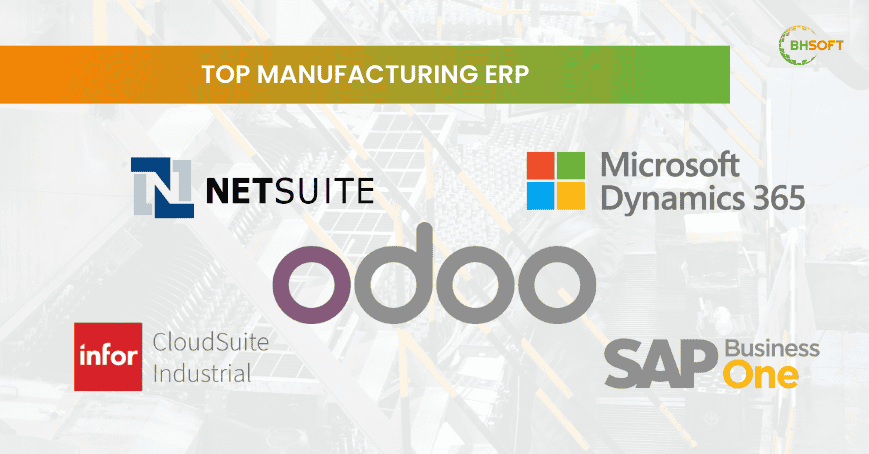
Choosing the right ERP for manufacturing industry is essential for improving efficiency, streamlining workflows, and supporting long-term growth. Here’s a comparison of the top ERP solutions tailored for manufacturing, highlighting their strengths and weaknesses.
1. NetSuite ERP
NetSuite is a leading cloud-based ERP platform widely used in the manufacturing sector. It provides robust modules for managing production schedules, inventory, procurement, and financial planning, making it suitable for manufacturers with diverse operational needs. The platform is designed to support businesses looking for real-time visibility across their operations, helping them make data-driven decisions.
Strengths:
- Fully customizable dashboards and workflows for production planning and inventory management.
- Strong integration capabilities with third-party tools.
- Real-time analytics for improved decision-making.
Weaknesses:
- High upfront costs and ongoing subscription fees.
- Limited flexibility for niche industries or highly specific workflows.
- Customization is dependent on external consultants, increasing costs and time.
2. SAP Business One
SAP Business One is a reliable and scalable ERP solution specifically tailored for manufacturing firms that require a balance between advanced features and affordability. Known for its efficiency, the platform simplifies core manufacturing processes such as production planning, inventory management, and compliance tracking.
Strengths:
- Scalable design to grow with your manufacturing operations.
- Advanced reporting tools for tracking production and sales.
- Seamless integration with IoT devices for enhanced shop-floor automation.
Weaknesses:
- Expensive implementation and maintenance, especially for smaller businesses.
- User interface can be challenging for non-technical teams.
- Limited customization compared to open-source solutions.
3. Microsoft Dynamics 365
Microsoft Dynamics 365 is a flexible, cloud-based ERP solution that integrates seamlessly with the Microsoft ecosystem, including tools like Excel, Teams, and Power BI. It is designed for manufacturers seeking a modular system where they can select and implement only the features they need. The platform offers specialized tools for managing production workflows, supply chain logistics, and customer interactions.
Strengths:
- Modular system that allows businesses to choose and integrate only the necessary features.
- Real-time visibility into production processes.
- AI-driven insights to optimize workflows and reduce waste.
Weaknesses:
- Complex implementation process requiring significant time and resources.
- High licensing costs for larger teams or additional modules.
- Customization options are limited within pre-defined parameters.
4. Infor CloudSuite Industrial (SyteLine)
Infor CloudSuite Industrial is a specialized ERP solution designed for manufacturers in both discrete and process industries. It offers a range of advanced tools for production scheduling, inventory control, and analytics, making it a go-to choice for businesses with complex operational requirements.
Strengths:
- Strong industry focus with tools for niche manufacturing processes.
- Powerful analytics for tracking and improving key production metrics.
- Easy customization of production schedules and workflows.
Weaknesses:
- Higher costs for cloud services compared to on-premise ERP options.
- Limited support for non-standard manufacturing operations.
- Requires ongoing vendor support for major customizations.
5. Custom-Built Odoo ERP
Odoo ERP stands out as an open-source, modular ERP solution offering complete customization for manufacturing businesses. Unlike other solutions, it gives manufacturers full control over every aspect of their ERP, from production planning to reporting tools. The system is designed for businesses looking for tailored solutions that fit their unique workflows, rather than settling for pre-configured modules.
Strengths:
- Odoo’s open-source framework allows businesses to create an unlimited customized ERP that aligns with their unique manufacturing processes.
- The modular pricing structure ensures you only pay for the features you need, making it cost-effective.
- Odoo integrates with existing tools, such as accounting software, CRMs, and IoT devices, for a unified workflow.
- Scalability allows the system to grow with your business, adapting to evolving needs like expanded production lines or new locations.
- With a comprehensive control, manufacturers can modify everything, from production workflows to reporting dashboards, without limitations
Weaknesses:
- Building a comprehensive and highly customized Odoo ERP requires significant time and collaboration with developers.
- The extensive customization options may require additional training for teams to use the system effectively.
Custom-built Odoo ERP ensures that manufacturers receive a solution tailored specifically to their needs, making it a smart investment for long-term success. It allows businesses to achieve the perfect balance between flexibility, cost-efficiency, and scalability.
Case Study: TOYOTA
Toyota implemented Odoo as its ERP for manufacturing. In just six months, the system streamlined their operations. Toyota used Odoo to integrate production workflows, manage inventory, and enhance reporting accuracy. This led to improved efficiency and better coordination across departments. Odoo’s flexibility allowed Toyota to customize features to their specific needs, showcasing how even large enterprises benefit from this adaptable ERP solution.
Conclusion
Customization and integration are the cornerstones of an effective ERP for manufacturing industry. By tailoring ERP systems to meet specific business needs and ensuring seamless integration with existing tools, manufacturers can unlock streamlined operations, better decision-making, and improved productivity.
Choosing the right ERP solution for manufacturing requires careful planning and a focus on flexibility and efficiency. Whether it’s enhancing production workflows, integrating real-time data, or simplifying inventory management, a customized ERP system empowers manufacturers to stay competitive and adapt to changing demands.
If you are looking to optimize your manufacturing firm's operations, exploring BHSoft’s Odoo Customization Solutions can be a step toward achieving operational excellence. A well-implemented ERP not only supports growth but also positions manufacturers for long-term success in an increasingly complex market.
Ready to take your manufacturing processes to the next level? Start by investing in a customized ERP solution that works for your business with BHSoft!