
Duc Ho
Content Marketing
Home > Insight > IT Business
AI Coder vs. AI Engineering: What's the Difference and Why It Matters
10 minutes read
Aug 17, 2026
Artificial intelligence is changing how software is built.
Developers can now describe a feature in natural language and have AI generate code, explain an unfamiliar codebase, identify bugs, write tests, or even work asynchronously on development tasks.
Tools such as GitHub Copilot and modern coding agents have moved beyond simple code completion. Today's AI coding agents can research tasks, plan changes, modify repositories, and create pull requests for developers to review.
This evolution has created a new question for businesses: Is using AI to write software the same as AI Engineering?
The short answer is no.
AI-assisted coding can make software development faster. AI Engineering is about designing, building, integrating, deploying, and continuously improving software systems that use AI as part of their core capabilities.
The difference may seem subtle, but it has significant implications for organizations looking to build reliable AI-powered products.
What Is an AI Coder?
The term AI Coder can describe a developer or increasingly, an AI coding agent that uses artificial intelligence to accelerate software development.
At its simplest level, AI coding helps with tasks such as:
- Generating code from natural-language instructions
- Completing functions and components
- Refactoring existing code
- Explaining unfamiliar code
- Finding potential bugs
- Writing unit tests
- Generating documentation
- Converting code between languages or frameworks
- Creating prototypes and proof-of-concepts
Modern coding agents can go further by working across a repository, executing development tasks, and preparing changes for human review. GitHub, for example, describes its coding agents as capable of independently carrying out research, planning, and coding tasks within a software development workflow. This can dramatically improve developer productivity. Instead of spending hours writing repetitive boilerplate or searching through documentation, engineers can delegate parts of the implementation process to AI and spend more time on higher-value engineering decisions.
AI Coding Is About Accelerating Implementation
The important point is that AI coding primarily focuses on how software gets implemented.
For example:
"Build a REST API endpoint that allows users to update their profile."
An AI coding tool may generate:
- The API route
- Controller logic
- Data validation
- Database queries
- Unit tests
- Documentation
That can save considerable development time.
But the AI coder does not automatically answer the bigger questions:
- Should this API exist in the first place?
- How should it fit into the existing architecture?
- What authentication model should it use?
- What data should it be allowed to access?
- How should failures be handled?
- How will it scale?
- How will it be monitored?
- What happens if the AI-generated implementation is incorrect?
- How does it affect the rest of the product?
Those questions belong to engineering.
What Is AI Engineering?
AI Engineering is the discipline of building software systems that use AI as an integrated part of the product or business process. It goes beyond generating code.
An AI Engineering project may involve:
- Understanding business requirements
- Designing system architecture
- Selecting appropriate AI models
- Integrating LLMs or other AI services
- Building AI agents
- Connecting AI with enterprise data
- Designing RAG pipelines
- Developing tool and API integrations
- Managing context and permissions
- Building evaluation frameworks
- Implementing security controls
- Monitoring AI behavior
- Managing cost and performance
- Deploying AI systems into production
- Continuously improving the system based on real-world usage
In other words:
AI Coding helps build the software. AI Engineering builds the system around the AI.
This distinction becomes especially important when AI moves from experimentation into production.
AI Coder vs. AI Engineering
The easiest way to understand the difference is to look at the scope.
| Area | AI Coder / AI-Assisted Coding | AI Engineering |
|---|---|---|
| Primary goal | Accelerate coding | Build AI-powered systems |
| Main focus | Code generation and modification | Architecture, AI capabilities, integration, and operations |
| Typical output | Code, tests, documentation | Production-ready AI solution |
| AI models | May use AI coding assistants | Select, integrate, evaluate, and manage AI models |
| Data | Usually existing application data | Enterprise data, knowledge bases, vector stores, APIs |
| Integrations | Primarily development tools | AI + APIs + databases + enterprise systems |
| Architecture | Works within an existing architecture | Designs the architecture around business requirements |
| Testing | Code-level testing | Code, model, workflow, and AI behavior evaluation |
| Security | Application security | Application + AI-specific security and access controls |
| Deployment | Software deployment | AI application deployment and operational infrastructure |
| Monitoring | Application performance | Application, model, quality, usage, and cost monitoring |
| Business context | Feature-level | End-to-end business workflow |
| Human role | Review generated implementation | Define, validate, govern, and continuously improve the system |
Neither approach is inherently better.
They operate at different levels of the software development lifecycle.
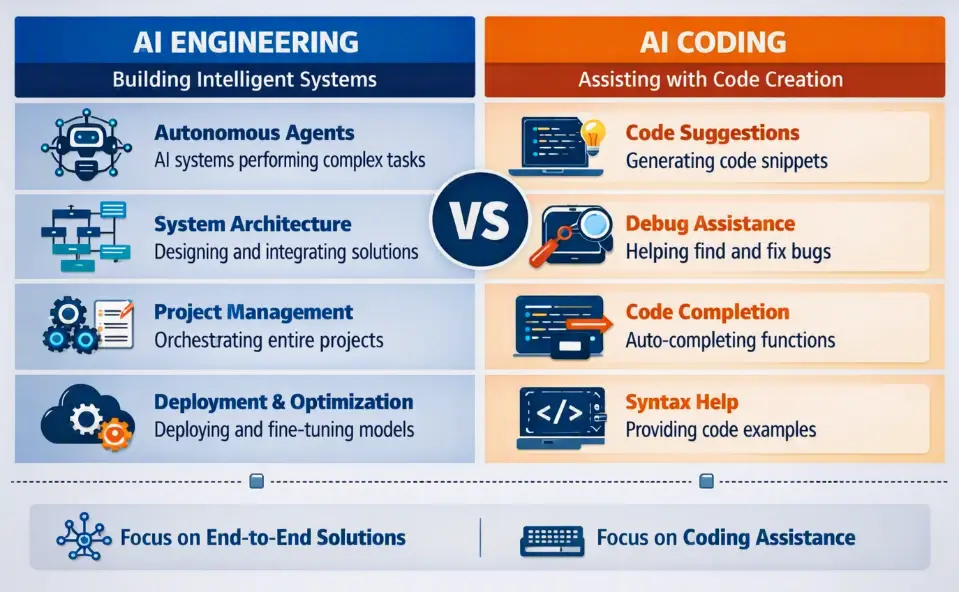
AI Coding Is a Tool. AI Engineering Is a Discipline.
One of the biggest misconceptions about AI development is that having an AI coding assistant automatically means an organization is doing AI Engineering. It doesn't.
A development team may use GitHub Copilot, Claude Code, Codex, or another coding agent to build a conventional web application. That application can be developed significantly faster with AI assistance, but it is not necessarily an AI-powered application.
The distinction is important.
Example 1: Building an E-Commerce Platform
A developer uses AI to generate:
- React components
- API endpoints
- Database queries
- Unit tests
This is AI-assisted software development. The product itself may not contain any AI functionality.
Example 2: Building an AI Customer Support Platform
The product:
- Retrieves customer information
- Searches internal knowledge
- Uses an LLM to interpret requests
- Determines which tools to call
- Executes actions through enterprise APIs
- Maintains conversation context
- Applies access controls
- Evaluates response quality
- Monitors AI behavior
- Escalates complex cases to humans
This is an AI Engineering project. AI is not merely helping developers write the system.
AI is part of the system itself.
Where AI Coding Fits into AI Engineering
This does not mean AI Engineering replaces software development. Quite the opposite. AI Engineering still depends heavily on strong software engineering foundations. AI coding tools can become powerful accelerators within an AI Engineering workflow.
For example:
Business Requirement → Solution Architecture → AI / Model Strategy → Data & Integration → Design AI Workflow / Agent Design → AI-Assisted Implementation → Testing & Evaluation → Security & Governance → Deployment Monitoring & Continuous Improvement
AI coding can contribute significantly during the implementation stage and increasingly across other stages as coding agents become more capable. But the surrounding engineering process remains essential.
Why Production AI Requires More Than Generated Code
Generating a working prototype is becoming easier. Building a reliable production system is still an engineering challenge.
An AI application may work perfectly during a demonstration and behave very differently when exposed to real users, real data, unexpected inputs, and real operational constraints. Several challenges become particularly important.
1. AI Model Selection
Different models have different capabilities, costs, latency, context windows, and reliability characteristics. The best model is not necessarily the largest or most expensive one.
AI Engineering involves selecting models based on the actual requirements of the application.
2. Data and Context
An AI system is only as useful as the information it can access. Enterprise AI applications may need to connect with:
- CRM systems
- ERP platforms
- Document repositories
- Databases
- Internal knowledge bases
- APIs
- Business applications
This requires more than sending a prompt to an LLM. The system needs to determine what information the model should receive, when it should receive it, and what it is allowed to access.
3. AI Agents and Tool Use
Modern AI systems can increasingly move from answering questions to taking actions. An agent may:
- Understand a user's request.
- Determine what information it needs.
- Call an internal API.
- Retrieve relevant data.
- Perform an action.
- Evaluate the result.
- Continue or escalate when necessary.
Anthropic's Agent SDK, for example, provides capabilities for building agents that can read files, execute commands, search information, and modify code programmatically. When these capabilities are connected to enterprise systems, architecture and permission boundaries become critical.
4. Evaluation and Reliability
Traditional software testing often expects deterministic behavior. AI systems are different. The same input may not always produce exactly the same response, and a response can be technically valid while still being incorrect, incomplete, or inappropriate for the business context.
AI Engineering therefore requires evaluation strategies that consider:
- Accuracy
- Relevance
- Consistency
- Safety
- Hallucination
- Tool execution
- Retrieval quality
- Response latency
- Cost
- Human escalation
This is one reason why the role of engineers does not disappear when AI becomes better at writing code. As AI handles more implementation work, verification and validation become increasingly important engineering responsibilities.
5. Security and Governance
AI systems can access information and perform actions that traditional software may not. This creates new security considerations. For enterprise AI applications, engineers may need to control:
- What data an AI system can access
- Which APIs an agent can call
- Which actions require human approval
- How sensitive information is handled
- How prompts and outputs are logged
- How model usage is monitored
- How unauthorized actions are prevented
As AI becomes more deeply integrated into software development and business workflows, security processes need to evolve alongside it. Anthropic, for example, has described how its own software development lifecycle has had to adapt its reviews, monitoring, and security processes as AI becomes responsible for a significant share of code creation.
6. Cost and Performance
AI introduces a new operational dimension to software systems. Every model request can have implications for:
- Token usage
- Infrastructure costs
- Response time
- Model selection
- Context size
- Concurrent users
- Tool calls
An AI Engineering approach considers these factors during architecture and continues monitoring them after deployment. A system that works technically but becomes prohibitively expensive at scale is not a successful production solution.
AI Engineering in the Agentic Era
The distinction between AI Coding and AI Engineering becomes even more important as software development moves toward agentic workflows.
Today's coding agents can increasingly perform multi-step tasks rather than simply suggesting individual lines of code.
- GitHub describes coding agents that can work asynchronously on issues and produce pull requests for developers to review.
- Anthropic's 2026 Agentic Coding Trends Report similarly describes a shift from simply writing code toward orchestrating agents that write code, while highlighting the continued importance of human judgment, quality, and security.
This changes the role of the software engineer. The engineer increasingly becomes responsible for:
Defining → Designing → Delegating → Evaluating → Governing → Improving
rather than simply: Writing → Testing → Deploying
AI coding therefore becomes one component of a broader AI-native engineering workflow.
From AI Coding to AI Engineering: A Practical Example
Consider a company that wants to automate customer support.
AI Coding Approach
A development team uses an AI coding assistant to build:
- Chat UI
- Backend API
- Database models
- Authentication
- Unit tests
The AI helps the developers build the application faster.
AI Engineering Approach
The team goes further and designs an end-to-end AI support system:
Customer → AI Assistant → Intent Detection → Knowledge Retrieval → LLM → Tool / API Selection → CRM / ERP / Ticketing System → Action → Response / Human Escalation
The engineering team must then determine:
- Which model should be used?
- What knowledge should the AI access?
- How should documents be indexed?
- How should retrieval work?
- What tools can the agent use?
- What permissions should it have?
- Which actions require human approval?
- How should hallucinations be detected?
- How should conversations be evaluated?
- How should the system scale?
- How should AI usage and costs be monitored?
That is the difference between using AI to build software and engineering software around AI.
AI Coder vs. AI Engineering: Which One Does Your Business Need?
The answer depends on the problem.
Choose AI-Assisted Coding When You Need To:
- Accelerate development
- Reduce repetitive coding
- Prototype ideas faster
- Refactor existing applications
- Generate tests and documentation
- Improve developer productivity
- Maintain existing software more efficiently
Consider AI Engineering When You Need To:
- Build an AI-powered product
- Integrate LLMs into an existing application
- Connect AI with enterprise data
- Build RAG-based applications
- Develop AI agents
- Automate complex business workflows
- Integrate AI with CRM, ERP, or internal systems
- Build production-grade AI applications
- Establish AI evaluation and monitoring
- Scale AI capabilities across an organization
In many cases, the answer is both. AI coding can accelerate the engineering process, while AI Engineering ensures that what gets built is aligned with business requirements and ready for real-world use.
Why AI Engineering Matters for Enterprises
For enterprises, AI adoption is rarely just about adding a chatbot to a website. Organizations often have complex technology environments involving:
- Legacy applications
- Enterprise databases
- CRM and ERP systems
- Internal APIs
- Identity and access management
- Data governance requirements
- Security policies
- Existing cloud infrastructure
AI must fit into this environment. That means enterprise AI requires a combination of software engineering, system architecture, data integration, AI expertise, security, and operational discipline.
This is where the difference between an AI coding provider and an AI Engineering partner becomes particularly important.
BHSoft: From Software Engineering to AI Engineering
At BHSoft, we believe AI should not be treated as a feature added to software as an afterthought. It should be engineered into the right products, workflows, and systems based on the business problem.
Our foundation is software engineering. That means our approach to AI Engineering starts with the same principles we apply to enterprise software:
- Understand the business problem.
- Design the right architecture.
- Integrate with existing systems.
- Build for security and scalability.
- Test before deployment.
- Monitor real-world performance.
- Continuously improve the solution.
AI then becomes an additional capability within that engineering framework.
Whether the solution involves an AI assistant, intelligent automation, RAG, AI-powered search, workflow agents, document intelligence, or AI integration with existing enterprise systems, the objective remains the same:
Build AI that works reliably within the real environment of the business.
AI Engineering Is Not About Replacing Software Engineering
One of the most important lessons of the AI era is that software engineering is not becoming irrelevant. It is evolving.
As AI takes on more implementation work, engineers can spend more time on:
- Architecture
- Product thinking
- System design
- Business logic
- Security
- Data strategy
- AI evaluation
- Reliability
- Governance
- Integration
- Long-term maintainability
AI coding tools can make developers faster. AI Engineering makes organizations better at building and operating AI-powered systems. The two should therefore not be viewed as competing approaches.
AI Coding is an accelerator.
AI Engineering is the discipline that turns AI capabilities into reliable products and business systems.
Conclusion
The conversation around AI in software development is increasingly moving beyond: "Can AI write the code?"
The more important questions are:
- "Can we build the right system?"
- "Can it work with our data and existing applications?"
- "Can we trust its decisions and actions?"
- "Can we secure, evaluate, monitor, and scale it?"
That is where AI Engineering comes in.
AI coding can dramatically accelerate implementation, but production AI requires much more than generated code. It requires architecture, data, integrations, security, evaluation, deployment, monitoring, and continuous engineering.
At BHSoft, we see this as the next evolution of software development:
From writing code → to engineering intelligent systems.
Looking for an AI Engineering Partner?
BHSoft combines software engineering expertise with AI capabilities to help organizations move from AI experiments and prototypes to practical, production-ready solutions.
Whether you are exploring AI integration, building an AI-powered product, developing intelligent automation, or connecting AI with your existing enterprise systems, our team can help you design and build the right solution.
👉 Build smarter. Engineer AI for real-world impact. Contact BHSOFT today to discuss your project!